
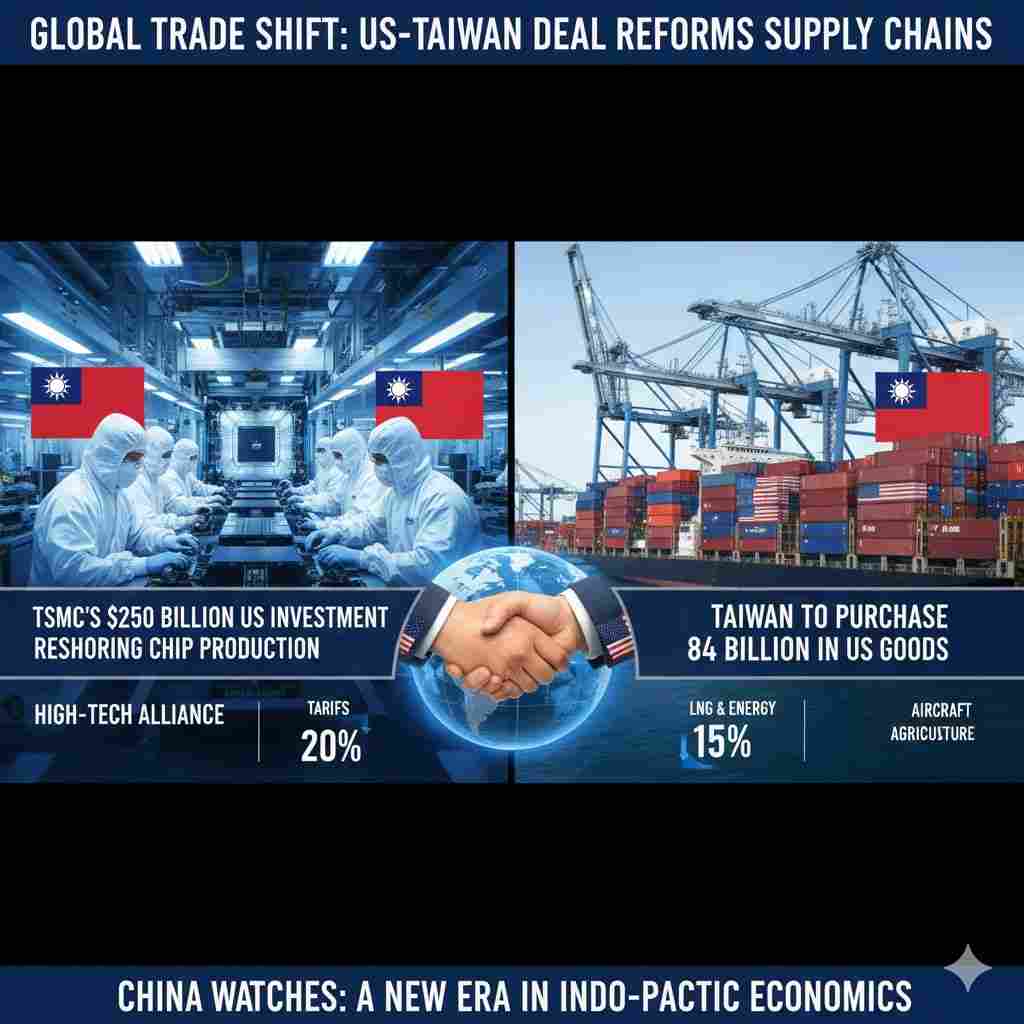
The United States and Taiwan sealed their historic economic alliance, officially signing a final reciprocal trade agreement on February 12, 2026, in a landmark shift for global trade and high-tech supply chains. The deal effectively reduces U.S. tariffs on Taiwanese exports to 15%, putting the island on equal footing with regional giants like Japan and South Korea.
The agreement comes at a critical juncture, as the U.S. continues to struggle with a massive trade imbalance—which ballooned to nearly $127 billion in 2025—largely driven by the insatiable global demand for advanced AI chips produced by Taiwan.
United States and Taiwan A Look at the Deal: Reciprocal Commitments
The framework is built on a “carrot and stick” strategy designed to narrow the trade deficit while securing the U.S. semiconductor supply chain.
1. Tariff Reductions and Market Access
Washington has reduced its baseline reciprocal tariff on Taiwanese goods from 20% to 15%. In a massive reciprocal gesture, Taiwan has committed to:
- Remove or reduce 99% of tariff barriers on U.S. goods.
- Provide “preferential market access” for U.S. industrial and agricultural exports, including automobiles, beef, dairy, and minerals.
- Resolve non-tariff barriers: Taiwan will now accept U.S. vehicles built to U.S. Federal Motor Vehicle Safety Standards without requiring additional modifications.
2. The $84 Billion Purchase Pledge
To directly address the trade gap, Taiwan has committed to an massive purchasing schedule between 2025 and 2029.
| Category | Value (USD) | Key Items |
| Energy | $44.4 Billion | Liquefied Natural Gas (LNG) and Crude Oil |
| Aviation | $15.2 Billion | Civil aircraft and engines |
| Infrastructure | $25.2 Billion | Power grid equipment, generators, and steelmaking machinery |
United States and Taiwan Reshoring the “Silicon Shield”
The crown jewel of the agreement is a massive investment pledge aimed at “reshoring” America’s semiconductor sector.
- Direct Investment: Taiwanese firms have pledged $250 billion to build and expand advanced semiconductor, energy, and AI production facilities within the United States.
- TSMC’s Role: Taiwan Semiconductor Manufacturing Co. (TSMC) is the primary driver, committing $165 billion to expand its Arizona campus and establish a world-class R&D center.
- Credit Guarantees: The Taiwanese government will provide an additional $250 billion in credit guarantees to facilitate smaller Taiwanese suppliers in moving their operations to the U.S.
However, the “reshoring” goal remains a point of friction. While U.S. officials aim to bring 40% of the entire semiconductor supply chain to American soil, Taiwan’s Vice Premier Cheng Li-chiun has pushed back, stating that the island’s complex ecosystem, built over decades, cannot be simply uprooted without endangering its global leadership.
Regional Competition: The Impact on India
The deal sends ripples through the Indo-Pacific, particularly for India. Just a week prior, on February 6, 2026, the U.S. and India struck an interim deal cutting tariffs on Indian exports to 18%.
With Taiwan now securing a 15% rate, Indian electronics and high-tech exporters face even sharper competition. While India retains a zero-duty advantage in sectors like textiles, pharmaceuticals, and gems, the U.S.-Taiwan alliance creates a “high-tech corridor” that could tighten supply chains for advanced electronics, making it harder for Indian firms to break into the top-tier chip market without faster strategic partnerships.
Geopolitical Fallout and China’s Reaction
As expected, Beijing has lashed out at the agreement. Chinese officials characterized the deal as “economic plunder,” accusing the U.S. of “hollowing out” Taiwan’s key industries.
Despite the lack of a mutual defense treaty, the U.S. remains Taiwan’s most important international supporter. The trade deal coincides with recent approvals for $11.15 billion in arms sales to the island, signaling that the economic and security relationship between Washington and Taipei is becoming increasingly inseparable.