
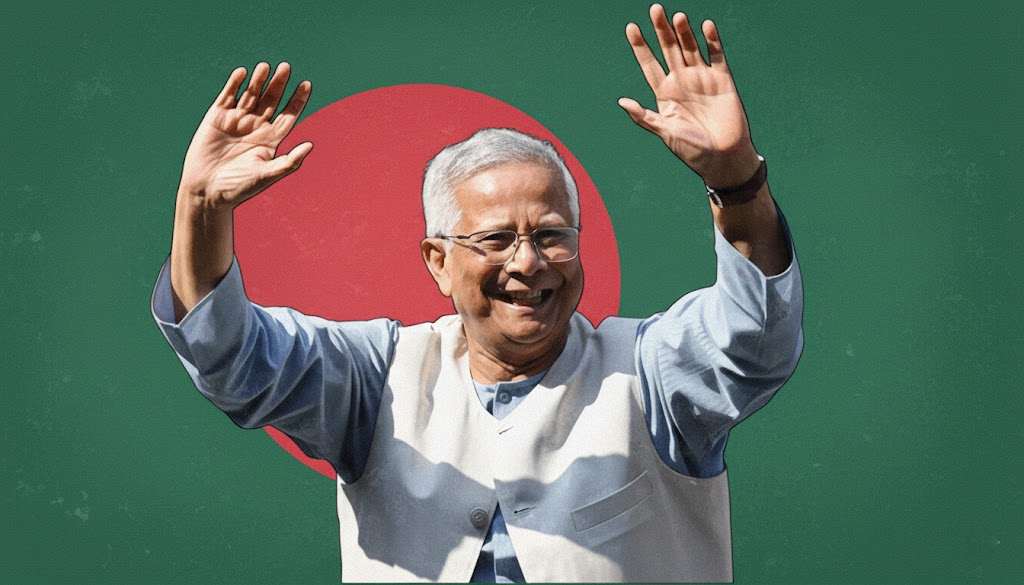
“Sovereignty or Provocation? In a final, high-stakes address that has sent ripples through the South Asian diplomatic community, Bangladesh’s outgoing Chief Adviser, Muhammad Yunus, used his farewell speech to project a vision of “sovereign defiance.” Delivered on Monday, February 16, 2026, just hours before handing over power to the newly elected Prime Minister Tarique Rahman, the Nobel laureate’s speech was marked by sharp nationalist rhetoric and a calculated geopolitical nudge toward India.
While Yunus presented his 18-month tenure as a period of national restoration, critics argue the address was a defensive maneuver intended to pivot attention away from severe domestic failures, specifically the government’s inability to protect religious minorities and stabilize a fractured democratic process.
The “Seven Sisters” “Sovereignty or Provocation?
The most striking element of Yunus’s address was his reference to the “Seven Sisters“—the collective term for India’s northeastern states. In a move widely interpreted as an attempt to undermine India’s territorial integrity, Yunus grouped these states alongside sovereign nations like Nepal and Bhutan when discussing regional trade.
“Our open seas are not just borders—they are gateways to the global economy,” Yunus asserted. “With Nepal, Bhutan, and the Seven Sisters, this region has immense economic potential. Economic zones and trade agreements can establish Bangladesh as a global manufacturing hub.”
By omitting any mention of India while discussing its integral territories, Yunus echoed a controversial stance he first took during a 2025 visit to China. On that occasion, he had described India’s northeast as “landlocked” and positioned Bangladesh as the “guardian of the ocean” for the region. This narrative effectively seeks to invert the traditional relationship between the two neighbors, suggesting that India’s own internal connectivity and economic success in the northeast are contingent upon Bangladesh’s strategic benevolence.
The China Pivot and Strategic Balance
Yunus’s speech underscored a significant shift in Dhaka’s foreign policy orientation. He spoke proudly of deepening ties with Beijing, specifically highlighting the Teesta River restoration project. This Chinese-backed initiative is a point of extreme sensitivity for New Delhi, as it is located near the “Chicken’s Neck” or Siliguri Corridor—the narrow strip of land connecting mainland India to its northeastern states.
“Significant progress has been made on the Teesta River project and a 1,000-bed international hospital in Nilphamari,” Yunus stated, signaling that his administration had prioritized “strategic balance” over Indian security concerns. This “not submissive” foreign policy, as Yunus termed it, is a direct critique of the previous Sheikh Hasina administration, which was often viewed as being in lockstep with Indian interests.
A Legacy of Domestic Silence
While Yunus used the international stage to grandstand on sovereignty, his speech was notably silent on the chaos that characterized his 18-month interim rule. Since the July 2024 uprising that ousted Sheikh Hasina, Bangladesh has been plagued by a surge in law-and-order challenges and targeted violence.
Human rights organizations and minority councils have presented a harrowing picture of the state of religious freedom under the interim government:
· Violence Against Hindus: According to the Bangladesh Hindu Buddhist Christian Unity Council (BHBCUC), over 2,000 communal incidents were reported in the weeks following the 2024 uprising alone.
· Temple Attacks: Reports from early 2026 indicate that at least 152 Hindu temples were desecrated or damaged during the interim period.
· Casualties: Independent data suggests that between August 2024 and January 2026, approximately 82 to 100 individuals from minority communities were killed in incidents of mob violence or targeted lynchings.
Yunus chose not to offer an apology or a plan for reconciliation for these victims. Instead, he presented a rosy picture of institutional reform, claiming his administration implemented over 130 new laws and hundreds of executive orders. Critics, however, point out that laws on paper have done little to stop the influence of Islamist radical groups that emerged emboldened after the previous regime’s collapse.
India’s Sharp Reaction
While the Indian government has maintained a cautious diplomatic silence, public and legal figures in India have been vocal. Senior Supreme Court advocate Mahesh Jethmalani slammed Yunus’s speech as “headline-chasing,” accusing him of manufacturing an “external villain” to mask his internal failures.
“When you can’t govern, you grandstand,” Jethmalani remarked, noting that Yunus’s refusal to acknowledge the Seven Sisters as part of India revealed a “dangerous mindset” shared by the interim administration’s hardline allies.
The Road Ahead: A Reset Under Tarique Rahman?
As Yunus exits, all eyes are on the incoming government. The Bangladesh Nationalist Party (BNP), led by Tarique Rahman, secured a landslide victory in the February 12 elections, winning 209 out of 300 seats.
The transition marks the end of an 18-month period where India-Bangladesh relations hit their lowest ebb in decades. Under Yunus, not only did diplomatic trust erode, but economic cooperation also stalled, with India even withdrawing certain trans-shipment facilities in 2025 citing security and congestion concerns.
Prime Minister Narendra Modi was among the first to congratulate Tarique Rahman on his victory, expressing a desire to work toward a “democratic, progressive, and inclusive Bangladesh.” Whether Rahman will continue the provocative nationalist path carved by Yunus or seek a pragmatic reset with New Delhi remains the most critical question for regional stability in 2026.
Yunus leaves behind a nation that is arguably more polarized than when he arrived—a legacy defined by a Nobel laureate who chose geopolitical provocation over domestic protection.
Disclaimer: This information is based on various inputs from news agency.