
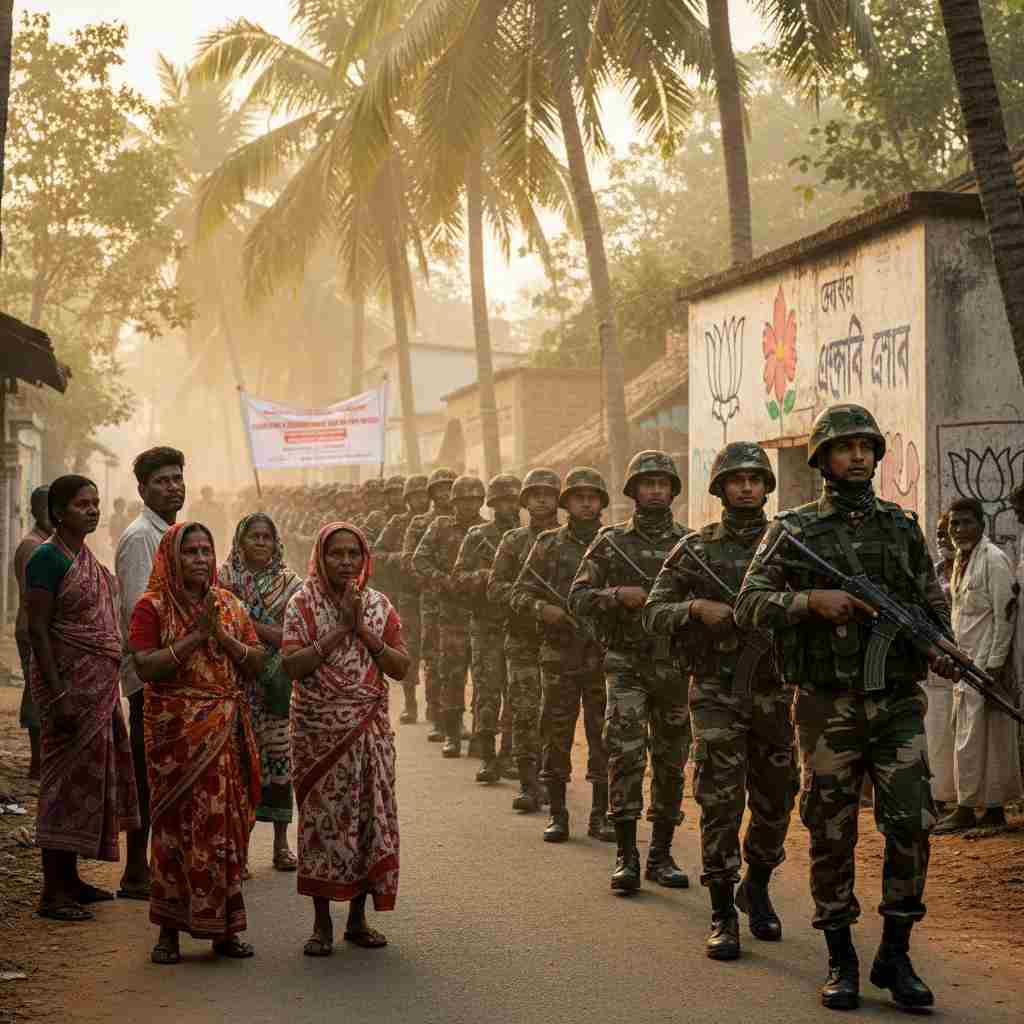
KOLKATA –West Bengal ahead of 2026 Polls: In a significant move to ensure a “free, fair, and violence-free” electoral process, the Election Commission of India (ECI) has announced the deployment of Central Armed Police Forces (CAPF) in West Bengal starting March 1, 2026. This early deployment comes even before the formal announcement of the Assembly election dates, signaling the Commission’s proactive stance on the state’s historically sensitive security climate.

West Bengal ahead of 2026 Polls: A Two-Phase Security Blanket
The Ministry of Home Affairs (MHA), following the ECI’s requisition, has outlined a strategic two-phase arrival for the paramilitary forces. A total of 480 companies (approximately 35,000 to 40,000 personnel) will be stationed across the state by the end of the first ten days of March.
Phase 1 (March 1): The first batch of 240 companies will arrive and immediately begin operations.
Phase 2 (March 10): The remaining 240 companies will join the ranks to complete the initial deployment.
The forces will comprise a mix of elite units, including the Central Reserve Police Force (CRPF), Border Security Force (BSF), Indo-Tibetan Border Police (ITBP), Central Industrial Security Force (CISF), and Sashastra Seema Bal (SSB). Notably, the CRPF will act as the nodal agency, with IG Sanjay Yadav appointed as the state coordinator for CAPF deployment.
Focus on “Confidence-Building Measures”
The primary objective of this early arrival is not just policing, but Confidence-Building Measures (CBMs). In many parts of West Bengal, particularly in rural and politically volatile pockets, voters often report feeling intimidated.
By conducting route marches and area domination exercises weeks before the first vote is cast, the ECI aims to:
Establish a visible security presence to deter potential troublemakers.
Assure the general public of their safety during the voting process.
Support the execution of the final electoral roll publication, scheduled for February 28, just one day before the forces land.
The Backdrop: A Climate of “Trust Deficit”
The decision for such an early deployment follows a period of heightened legal and administrative scrutiny. Recently, the Supreme Court of India took the “extraordinary” step of appointing serving and retired judicial officers to oversee the Special Intensive Revision (SIR) of electoral rolls in the state.
This move was prompted by what the court described as a “trust deficit” between the state administration and the ECI. There have been ongoing allegations regarding the exclusion of genuine voters and the inclusion of “ghost” entries, leading the judiciary to step in to ensure the sanctity of the voter list.
”The early deployment of central forces is a necessity to ensure that the polling environment is sanitized well in advance. We want every voter to feel they can walk to the booth without fear,” a senior ECI official noted.
Political Reactions
As expected, the move has drawn mixed reactions from the state’s political heavyweights:
The Opposition (BJP, Left, and Congress): These parties have largely welcomed the move. Leaders from the Bharatiya Janata Party (BJP) have been vocal about the need for central intervention, citing past instances of post-poll and pre-poll violence. They argue that local police are often “partisan,” making central forces essential for a level playing field.
The Ruling Trinamool Congress (TMC): While the TMC has historically criticized the “excessive” use of central forces as an affront to federalism, the party has officially maintained that they are ready for the challenge. However, some party spokespersons have questioned why West Bengal is being singled out for such early and massive deployment compared to other poll-bound states like Tamil Nadu or Kerala.
What Lies Ahead?
While the forces arrive on March 1, the official election schedule is expected to be released by the middle of March. It is anticipated that the 2026 Assembly elections will be conducted in multiple phases—similar to the eight-phase marathon seen in 2021—to allow the movement of these 480 companies (and potentially more) from one region to another.
From the Darjeeling hills in the north to the sensitive border districts and the crowded lanes of Kolkata, the “men in fatigue” will soon become a common sight. For the people of West Bengal, these boots on the ground represent a hope for a democratic process where the only thing that speaks is the ballot.