
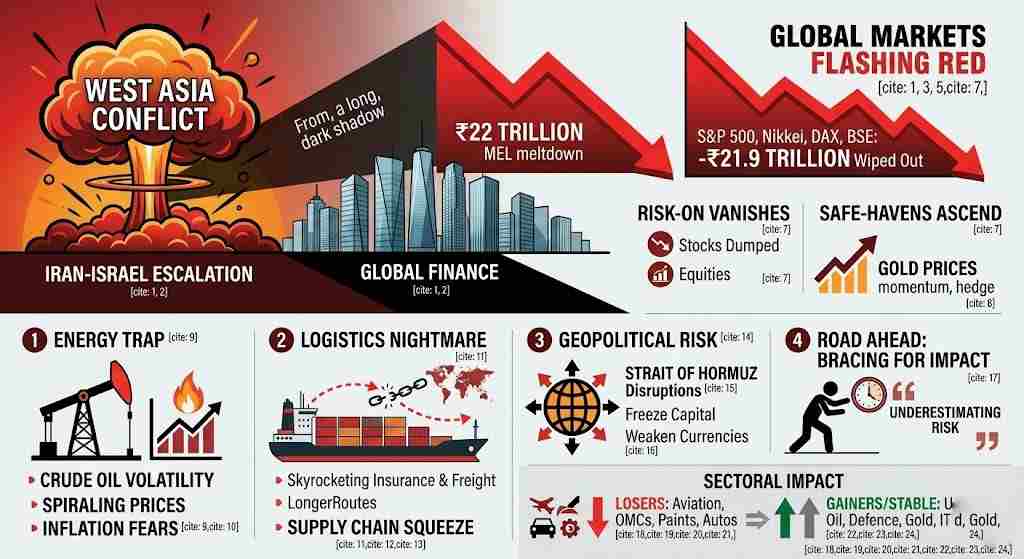
The Global Economic Bracer:The smoke rising over the horizons of West Asia is casting a long, dark shadow over the glass towers of global finance. While the immediate devastation of bombs and missiles is contained within the geographic borders of the escalating Iran-Israel confrontation, the economic aftershocks are radiating outward, shattering investor confidence from Mumbai to New York.
What began as a regional security crisis has rapidly metastasized into a systemic financial shockwave. We are no longer just witnessing a military conflict; we are watching a real-time erosion of global wealth.
The ₹22 Trillion Meltdown: Panic in the Indian Markets
The Global Economic Bracer: How West Asian Conflict Wiped Out ₹22 Trillion in Three Days: For the Indian investor, the numbers are nothing short of harrowing. In just three trading sessions, the market capitalization of the Bombay Stock Exchange (BSE) has been gutted. A staggering 21.9 trillion rupees—nearly ₹22 trillion—has been wiped out as the “sell” button became the default setting for institutional and retail traders alike.
This isn’t merely a “correction” or standard market volatility. This is a manifest display of market panic.
- Market Cap Erosion: The loss of ₹21.9 trillion represents one of the swiftest wealth destructions in recent memory.
- The Red Screen: From blue-chip stocks to mid-cap favorites, the sell-off has been indiscriminate.
- Deepening Uncertainty: Analysts warn that we may not have seen the bottom yet. As the conflict expands, the “fear gauge” continues to climb, suggesting that the initial reaction might still be underestimating the long-term geopolitical risks.
Global Contagion: From Tokyo to Wall Street-
The Global Economic Bracer: How West Asian Conflict Wiped Out ₹22 Trillion in Three Days:
India is not an island in this crisis. The financial tremors are being felt across every major trading floor on the planet. From the Nikkei in Japan to the DAX in Germany and the S&P 500 in the United States, the screens are flashing a universal, warning red.
As uncertainty deepens, the traditional “Risk-On” sentiment has vanished. Investors are dumping equities and scurrying toward safe-haven assets.
- Gold’s Ascent: As fear spreads, gold prices are gaining momentum, serving as the ultimate hedge against a world that feels increasingly unstable.
- Currency Weakness: Emerging market currencies are under pressure as capital freezes and investors pull back to the perceived safety of the US Dollar.
The Energy Trap: Oil, Freight, and Inflation
The most dangerous conduit for this crisis is the energy market. West Asia remains the world’s most critical energy artery, and any disruption there has an immediate, inflationary impact on the global doorstep.
1. The Volatility of Crude
Oil prices have become a reflection of the battlefield. Every headline regarding a potential strike on energy infrastructure sends crude prices spiraling upward. For a country like India, which imports the vast majority of its energy needs, sustained high oil prices are a direct threat to the fiscal deficit and the value of the Rupee.
2. The Logistics Nightmare
The conflict is not just hitting what we burn, but how we move it.
- Shipping Insurance: Costs for insuring vessels passing through volatile corridors are skyrocketing.
- Freight Rates: Supply chains are being forced into longer, more expensive routes to avoid the zone of conflict.
- Supply Chain Squeeze: When shipping becomes expensive, everything from electronics to grain becomes more expensive.
3. The Return of the Inflation Ghost
Just as global central banks were beginning to signal a victory over post-pandemic inflation, this conflict threatens to undo that progress. When energy and freight costs climb, inflation fears follow, potentially forcing central banks to keep interest rates higher for longer—a move that would further stifle economic growth.
Why This Time Feels Different: Geopolitical Risk Re-evaluated
Historically, markets have been somewhat resilient to regional skirmishes. However, the current confrontation involving Iran and Israel represents a “tier-one” geopolitical risk. This isn’t just a border dispute; it’s a clash that involves major regional powers with the capacity to disrupt the Strait of Hormuz—the world’s most important oil transit chokepoint.
Wars do more than destroy physical infrastructure. They:
- Disrupt Trade: Established routes and partnerships are severed overnight.
- Freeze Capital: Investment into the region stops, and capital flight from neighboring markets accelerates.
- Test Resilience: They push the limits of how much stress a global economy—already weary from years of high interest rates—can actually take.
The Road Ahead: Bracing for Impact
As of today, the global economy is in a state of “bracing.” The sell-off that continued into this session suggests that the market is beginning to price in a protracted conflict rather than a short-lived flare-up.
“The damage is not contained to missile strikes and military targets. It is moving through supply chains. It is shaking investor confidence. We are witnessing a market reaction that may still be underestimating the full scale of the risk.”
The bombs may be falling in West Asia, but the financial damage is being felt in every retirement account, every corporate boardroom, and every corner of the global marketplace. The “economic shockwave” has arrived, and for now, the path toward stability remains obscured by the smoke of war.
The ₹22 Trillion Ripple Effect: Tracking the Sectors Crushed by Rising Crude and Those Finding a Safe Haven
The Hardest Hit (Losers)
Aviation & Logistics: The “double whammy” of skyrocketing Aviation Turbine Fuel (ATF) prices and forced flight rerouting due to closed airspaces has hammered stocks like InterGlobe Aviation (IndiGo) and SpiceJet.
Oil Marketing Companies (OMCs): Companies like IOCL, BPCL, and HPCL are bleeding because they cannot easily pass on the high cost of imported crude to consumers, leading to massive margin compression.
Paints & Chemicals: These industries rely heavily on crude-based derivatives. Rising oil prices act as a direct hit to their raw material costs, dragging down giants like Asian Paints and Berger Paints.
Automobiles: Higher fuel prices and rising input costs (like tires and plastics) are dampening consumer sentiment, leading to a sell-off in Maruti Suzuki and Tata Motors.
The Defensive Stand (Gainer/Stable)
Upstream Oil & Gas: Unlike retailers, explorers like ONGC and Oil India actually benefit from higher global crude prices as their realization per barrel increases.
Defence: Geopolitical instability traditionally boosts sentiment for the defense sector. Stocks like HAL and Bharat Electronics have shown relative resilience due to expectations of increased security spending.
Gold & IT: With the Rupee hitting record lows against the Dollar, IT exporters (TCS, Infosys) are finding some “currency tailwind” support. Meanwhile, Gold financing firms are seeing traction as the yellow metal hits new highs.