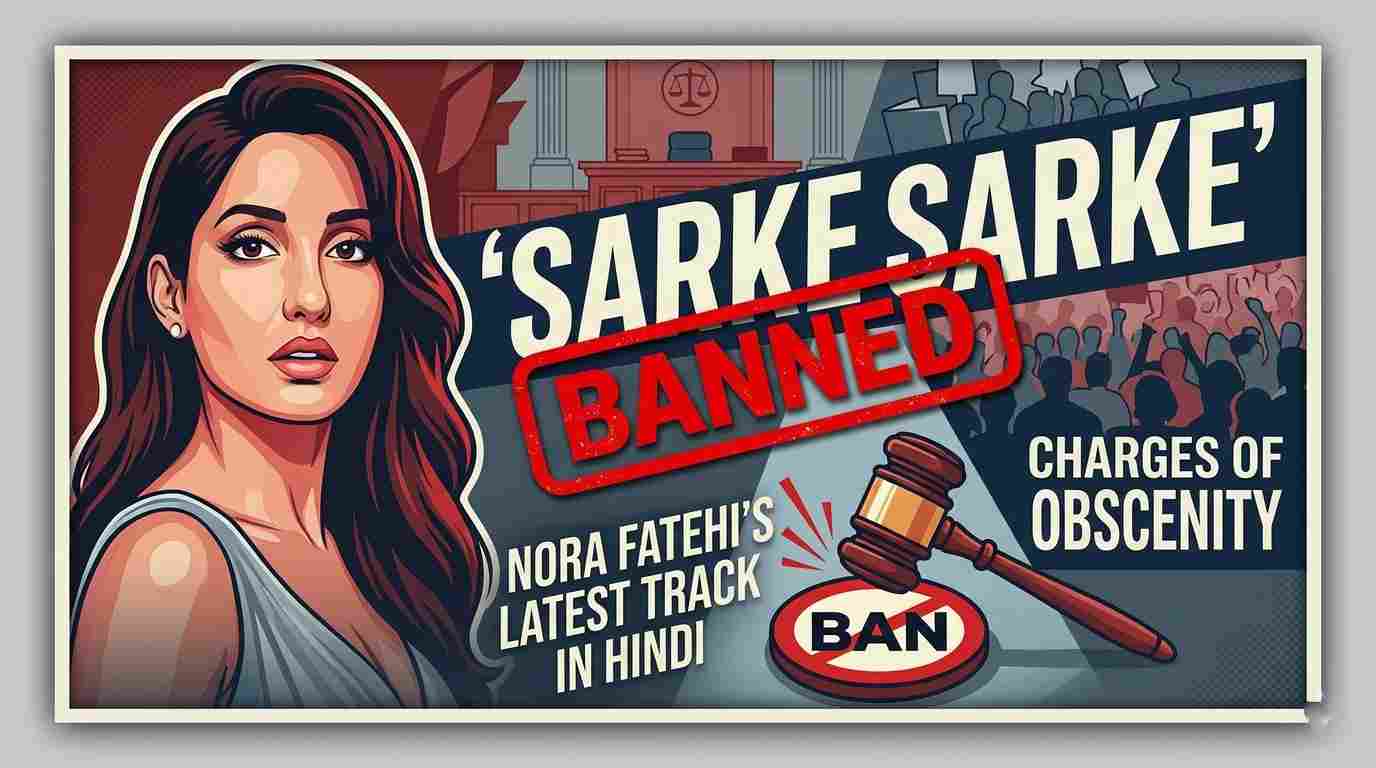
Nora Fatehi’s “Sarke Sarke”: What was intended to be the next viral sensation of 2026 has instead become a case study in controversy. On March 14, KVN Productions released the highly anticipated dance number “Sarke Chunar Teri Sarke” from the upcoming pan-India film KD: The Devil. Featuring the reigning queen of Bollywood dance, Nora Fatehi, alongside veteran superstar Sanjay Dutt, the song was designed to be a multi-language chartbuster.
However, the “storm” began almost immediately. Within hours of its digital debut, the Hindi version of the track was met with a wall of resistance that transcended typical social media trolling. By March 17, following a formal legal complaint and a wave of public indignation, the Hindi version was delisted from major streaming platforms and YouTube. Yet, in a move that has baffled many, the Kannada, Tamil, Telugu, and Malayalam versions remain live, thriving, and racking up millions of views.
The Anatomy of a Takedown: Why “Sarke Sarke” Was Delisted
The Storm Over “Sarke Sarke”: Nora Fatehi’s Latest Track Banned in Hindi Amid Charges of Obscenity
The swift removal of the Hindi version wasn’t a voluntary PR move by the producers; it was a response to escalating legal and public pressure.
The Legal Complaint
On March 17, Advocate Vineet Jindal filed a formal complaint with the Central Board of Film Certification (CBFC) and the Ministry of Information and Broadcasting. The complaint was a scathing indictment of the song’s creative choices, alleging that the lyrics and visuals were:
Highly Vulgar: Crossing the line from “sensual” to “obscene.”
Sexually Suggestive: Relying on double entendres that were deemed inappropriate for public consumption.
Harmful to Minors: Citing the ease of accessibility on platforms like YouTube and Instagram.
The legal filing didn’t pull its punches, citing provisions under the Bharatiya Nyaya Sanhita (BNS), the Protection of Children from Sexual Offences (POCSO) Act, and the Information Technology Act.
The Public Outcry
Beyond the legalities, the “court of public opinion” was equally harsh. Social media users questioned the efficacy of Indian censorship in the digital age. One viral post asked, “Is there even a censor board in India? How are such songs allowed to go mainstream?” Others focused on the cultural ripple effect, fearing that such “vulgar” lyrics would soon become the soundtrack to thousands of mindless social media reels, further desensitizing the youth.
The Linguistic Paradox: One Song, Five Languages, One Standard?
The most striking aspect of this controversy is the selective censorship. While the Hindi version has been scrubbed from the internet, the original Kannada version and other South Indian dubs are flourishing.
Consistency in Content
An analysis of the lyrics across all five languages reveals a startling consistency. Using AI translation tools to break down the metaphors and phrasing, it becomes clear that the core meaning—the very “obscenity” that led to the Hindi ban—remains intact in the other versions.
Kannada (Original): The source of the lyrical content.
Tamil/Telugu/Malayalam: Direct translations or adaptations that mirror the suggestive nature of the Hindi lyrics.
The “Regional” Shield
Why have the other versions escaped the axe? This discrepancy highlights a long-standing gap in how content is monitored in India. Regional language content often flies under the radar of national activists and Delhi-based legal watchdogs, whereas Hindi content—given its massive reach across the North and the diaspora—is subjected to much stricter scrutiny.
“This Is Not My Creation”: The Lyricist Speaks Out
In the midst of the firestorm, Hindi lyricist Raqueeb Alam found himself at the receiving end of the public’s ire. However, Alam has moved quickly to distance himself from the track, revealing a fractured and pressurized creative process.
In an explosive interview with Variety and a subsequent Instagram clarification, Alam claimed he was little more than a “translator” under duress.
“The song has been written in Kannada by the director, and he told me to do a translation. It is not my creation,” Alam stated.
Alam’s defense paints a picture of a creator uncomfortable with his own work:
Refusal to Write: Alam claims he initially refused to write the lyrics due to their suggestive nature.
Pressure from Production: He alleges the director insisted he simply “fit in Hindi words” to match the existing meter and melody.
Miscredited: Alam expressed shock that he was credited as the primary lyricist for the Hindi version and has announced plans to reach out to the production house to have his name cleared or the credits amended.
The Business of Controversy: 10 Million Views and Counting
While the Hindi version is in legal limbo, Anand Audio, the music label behind the film, isn’t slowing down. In fact, they are celebrating.
The label recently announced on Instagram that one of the regional versions has surpassed 10 million views. The film’s director—who also wrote the original Kannada lyrics—and the composer continue to promote the track aggressively. This “business as usual” approach suggests a calculated gamble: the controversy in the Hindi market might actually be driving curiosity and traffic to the regional versions.
The “Reel” Effect: Cultural Concerns in 2026
The backlash against “Sarke Sarke” isn’t occurring in a vacuum. In 2026, the lifespan of a song is determined by its “viral potential” on short-form video platforms. Critics argue that when a song is designed specifically to trigger “trends,” the lyrics are often sacrificed for shock value.
The concern raised by many is that these lyrics enter “everyday spaces”—played in malls, at weddings, and in the background of children’s social media feeds—long before parents or authorities can intervene. The “Sarke Sarke” incident has reignited the debate: Should digital music releases be subject to the same pre-certification as theatrical films?
Conclusion: A Selective Silence
The “Sarke Sarke” saga is a testament to the complex, often contradictory world of Indian entertainment. While the Hindi version’s removal satisfies a specific legal demand, the continued availability of the song in four other languages suggests that the “moral” objection is, at best, inconsistently applied.
For Nora Fatehi and the makers of KD: The Devil, the song has provided a massive amount of publicity, albeit of the “infamous” variety. As the film approaches its release, the industry will be watching closely to see if the Hindi version is re-released with “cleaner” lyrics or if the shadow of this controversy will follow the film to the box office.
Quick Facts: The “Sarke Sarke” Timeline
| Date | Event |
| March 14 | Multi-language release of “Sarke Sarke” featuring Nora Fatehi. |
| March 15-16 | Massive social media backlash over “obscene” Hindi lyrics. |
| March 17 | Formal complaint filed by Advocate Vineet Jindal to CBFC and I&B Ministry. |
| March 17 (Evening) | Hindi version delisted from YouTube and streaming platforms. |
| March 18 | Lyricist Raqueeb Alam denies responsibility, citing “forced translation.” |