
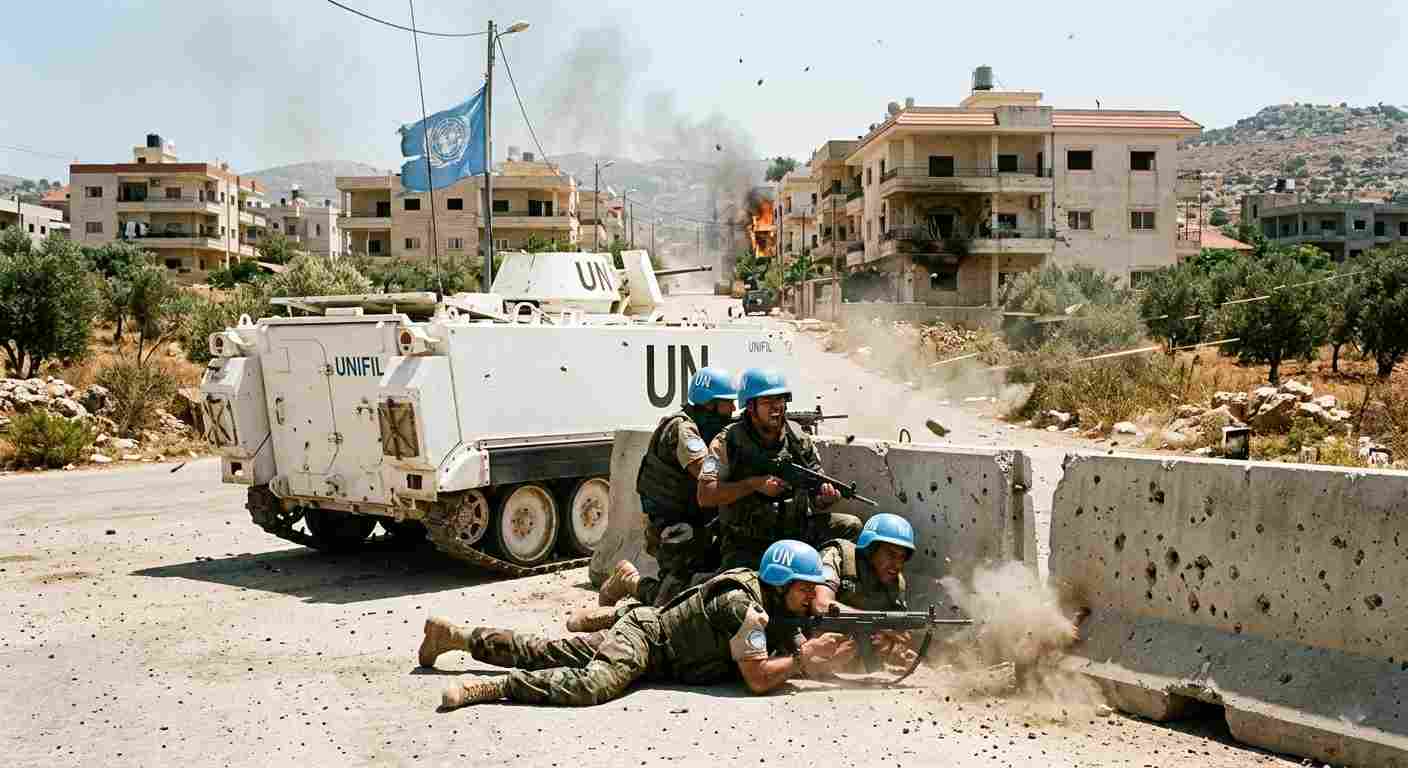
UN Peacekeepers Under Fire in Lebanon: The southern border of Lebanon, once a fragile landscape of monitored peace, has transformed into a high-stakes combat zone. In recent weeks, the world has watched with growing alarm as the United Nations Interim Force in Lebanon (UNIFIL)—a mission designed to maintain stability—has found itself directly in the line of fire.
With 642 Indian soldiers currently deployed as part of this mission, the stakes for New Delhi have never been higher. As projectiles strike UN headquarters and patrols face “intense gunfire,” the question on everyone’s mind is: How safe are our peacekeepers, and what does this mean for the future of international diplomacy in the Middle East?
UN Peacekeepers Under Fire in Lebanon The Incident: UNIFIL Headquarters and Patrols Targeted
In March 2026, the security situation in Southern Lebanon took a dark turn. According to official UNIFIL statements, the mission’s headquarters in Naqoura was struck by a projectile during a period of heavy fighting between the Israel Defense Forces (IDF) and Hezbollah.
Key Details of Recent Attacks:
• The Naqoura Strike: A projectile hit a building inside the UNIFIL HQ. Explosive Ordnance Disposal (EOD) specialists were rushed to the scene to secure the area. UNIFIL officials believe the strike originated from a “non-state actor”—a term often used to refer to militant groups like Hezbollah.
• Direct Fire on Patrols: On March 15 and 16, 2026, UN peacekeepers were fired upon while conducting routine patrols in areas like Yatar, Dayr Kifa, and Qallawiyah. In one instance, bullets landed within five meters of the Blue Helmets.
• Mistaken Identity? Earlier in the month, an Israeli tank strike hit a UN position at the al-Qawzah base, wounding Ghanaian peacekeepers. The IDF later apologized, stating they had misidentified the UN position while responding to Hezbollah anti-tank fire.
These incidents highlight a terrifying reality: peacekeepers are no longer just observers; they are becoming targets, whether through “mistaken identity” or deliberate intimidation.
India’s Stake: 642 Soldiers in the Eye of the Storm
India has a long and proud history with UNIFIL, being one of the largest troop contributors since the mission’s expansion. Currently, 642 Indian personnel are stationed in the volatile southern sector.
Are the Indian Soldiers Safe?
As of late March 2026, there have been no reports of casualties among the Indian contingent. However, their safety is under constant threat due to their proximity to the “Blue Line”—the 120-km line of withdrawal between Lebanon and Israel.
India’s Permanent Representative to the UN, Ambassador Parvathaneni Harish, recently joined 30 other nations to issue a stern warning. He emphasized that “peacekeepers must never be the target of attacks or intimidation,” and called on all parties to respect UN Security Council Resolution 1701.
“We are unequivocally against any attacks on UN Peacekeepers for which there can be no justification.” — Ambassador P. Harish
The Indian government is in constant contact with the UN Department of Peace Operations to monitor the ground situation and ensure that “all necessary measures” are taken to protect the soldiers.
The Conflict: Israel vs. Hezbollah (2026)
The current violence is not just a skirmish; it is being described as the 2026 Lebanon War. The conflict reignited on March 2, 2026, when Hezbollah launched projectiles into Northern Israel, citing Israeli “aggression.”
Why the Violence Has Escalated:
• Broken Ceasefires: The November 2024 ceasefire, which had brought a brief period of calm, has effectively collapsed.
• Ground Incursions: The IDF has conducted limited ground operations and airstrikes deep into Lebanese territory, including the capital, Beirut.
• Hezbollah’s Stance: Hezbollah claims its actions are a response to regional tensions (including the wider Iran-Israel conflict), though they have also stated their goal is to force Israel to evacuate seized border positions.
For UNIFIL, this means operating in a “buffer zone” that is no longer a buffer but a front line.
What is UNIFIL and Why is it Still There?
The United Nations Interim Force in Lebanon (UNIFIL) was established in 1978. While its original goal was to confirm the withdrawal of Israeli forces, its mandate was significantly expanded after the 34-day war in 2006.
The Mission’s Core Tasks:
• Monitoring the Cessation of Hostilities: Ensuring both sides respect the Blue Line.
• Supporting the Lebanese Armed Forces (LAF): Helping the Lebanese government regain authority in the south.
• Ensuring a Weapons-Free Zone: Preventing any armed personnel (other than the LAF and UNIFIL) from operating between the Litani River and the Blue Line.
The Sunset Clause:
Interestingly, the UN Security Council recently voted to extend UNIFIL’s mandate for a “final time” until December 31, 2026. This means that by 2027, the mission is expected to begin a complete drawdown. The current surge in violence is a direct challenge to this exit strategy, as a withdrawal now could leave a massive power vacuum.
Who is Behind the Attacks?
Assigning blame in a war zone is complex. UNIFIL reports have pointed fingers in both directions:
• Non-State Actors (Hezbollah): UNIFIL has noted that “non-state armed groups” have fired on patrols and likely launched the projectile that hit their HQ.
• The IDF: Israel has admitted to tank fire hitting UN positions “by mistake,” but UN findings in some cases suggested the strikes were “deliberate,” given that UN positions are clearly marked and their coordinates are shared with all parties.
Global Reaction and the Road Ahead
The international community, led by countries like India, France, and Italy (the top troop contributor), has condemned the violence. France has called the attacks “unacceptable” and urged a return to the 2024 ceasefire.
The Strategic Dilemma
If UNIFIL is forced to retreat or remains hunkered down in bunkers, its monitoring mission fails. If it continues patrols, it risks more casualties. For India, the priority remains the safety of its 642 soldiers, who are performing their duties under the most grueling conditions in decades.
Conclusion
The attack on UNIFIL is not just an attack on a few buildings or soldiers; it is an attack on the very concept of international peacekeeping. As the Israel-Hezbollah conflict intensifies, the “Blue Helmets”—including our brave Indian soldiers—stand as the only thin line preventing a total regional explosion.
The coming months will be critical. Will the world allow the UN mission to be bullied out of Lebanon, or will there be a renewed diplomatic push to enforce Resolution 1701? For now, the 642 Indian soldiers remain on high alert, serving as the world’s eyes and ears in a land where peace is currently a distant memory.
Disclaimer: This information is based on various inputs from news agency.