
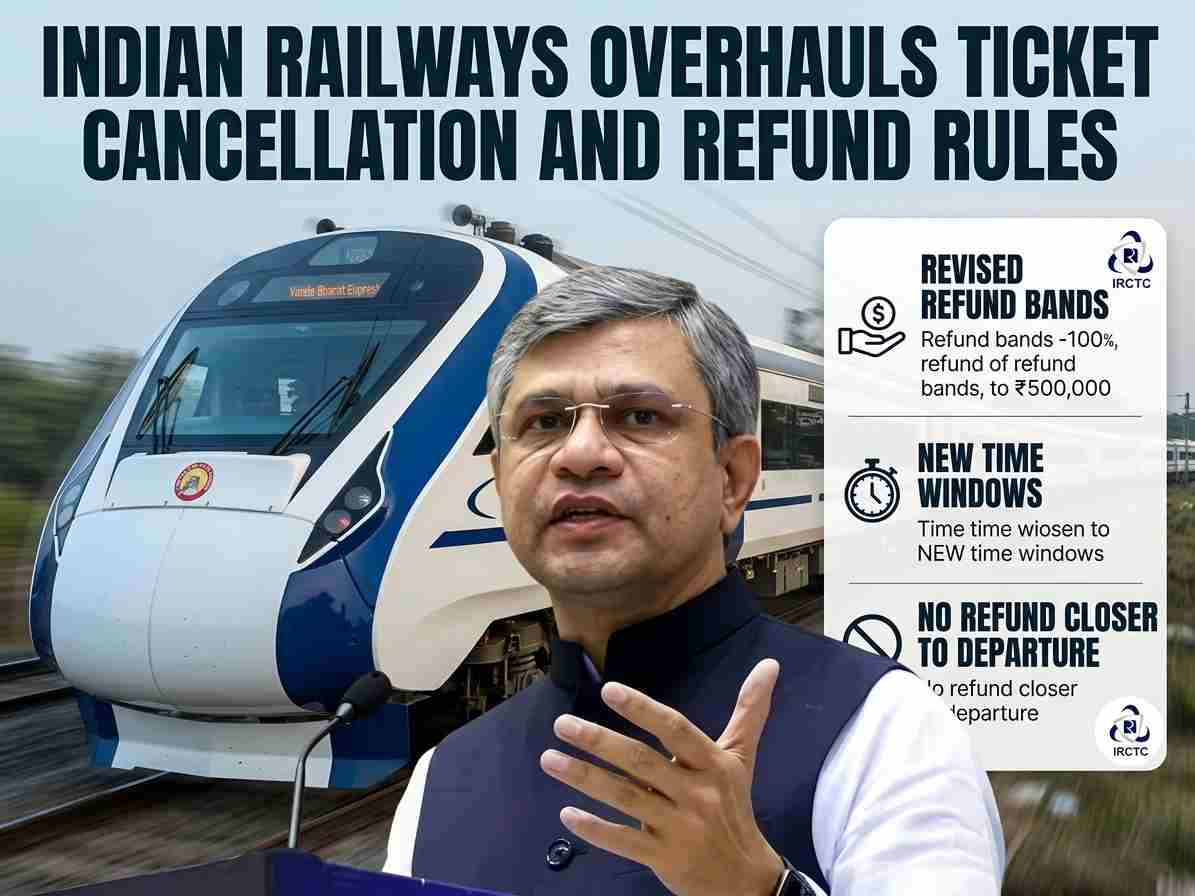
Indian Railways Overhauls Ticket Cancellation :In a move aimed at dismantling the “touts and agents” network and improving seat availability for genuine travelers, Union Minister for Railways Ashwini Vaishnaw has announced a comprehensive set of reforms under the “Reform Express” initiative. Effective from April 2026, these changes introduce stricter cancellation windows, higher penalties for last-minute changes, and advanced technology for Tatkal bookings.
The New Refund & Cancellation Toolbar: At a Glance
Reform Express 2026: Indian Railways Overhauls Ticket Cancellation and Refund Rules
To help passengers navigate these changes, we have summarized the revised refund structure effective from April 2026. Note the significant shift in the “No Refund” window.
| Cancellation Timeframe (Before Departure) | Refund Percentage | Penalty/Deduction |
| More than 72 Hours | Maximum Refund | Flat cancellation charge only |
| 72 Hours to 24 Hours | 75% Refund | 25% of fare deducted |
| 24 Hours to 8 Hours | 50% Refund | 50% of fare deducted |
| Less than 8 Hours | 0% Refund | No refund permitted |
Why the Rules are Tightening: Curbing the “Speculation Culture”
For years, the Indian Railway Catering and Tourism Corporation (IRCTC) system has been plagued by “speculative bookings.” Travel agents and individuals often book multiple tickets across different dates or trains, holding onto them until the last minute before deciding which one to use. Under the old rules, a passenger could cancel a ticket up to four hours before departure and still claim a partial refund.
Minister Vaishnaw explained that this created an artificial shortage of seats. “The goal of the Reform Express is to ensure that a seat is not kept empty due to a last-minute cancellation where no one else can then book it,” he stated. By moving the “No Refund” window from 4 hours to 8 hours, the Railways hopes to force passengers to make a decision earlier, allowing waitlisted passengers enough time to receive a confirmation and reach the station.
Technological Warfare: Aadhaar and the Death of “Fake Accounts”
One of the most significant pillars of the Reform Express is the integration of Aadhaar-based verification. To combat the menace of ticket touts and automated booking bots that “corner” Tatkal tickets within seconds of the window opening, the following measures have been introduced:
Aadhaar-OTP for Tatkal: All Tatkal bookings will now require Aadhaar-based OTP verification. This ensures that the person booking the ticket is a verified individual and not a script running on an agent’s computer.
Purging the System: Using advanced data analytics, the Railways has already identified and removed nearly three crore (30 million) fake accounts from the IRCTC system.
Bot Detection: New software protocols have been deployed to detect and block non-human behavior during the high-traffic booking windows.
The “Chart Preparation” Shift: 18-Hour Planning
In the past, the final reservation chart was prepared four hours before a train’s departure. This often led to a frantic last-minute rush and uncertainty for waitlisted travelers. Under the new reforms, the chart preparation window has been significantly extended.
Charts will now be prepared between 9 to 18 hours before departure. This shift provides several benefits:
Reduced Uncertainty: Waitlisted passengers will know much earlier if their seat is confirmed, allowing them to plan their journey to the station or seek alternative transport.
Transparency: Early charting reduces the scope for “on-board” corruption where vacant berths were sometimes sold by TTEs (Travel Ticket Examiners) under the table.
Remote Accessibility: Travelers from remote areas, who may need hours to reach a railway junction, can now travel with the confidence of a confirmed ticket.
Flexibility Reimagined: Digital Boarding and Class Upgrades
While the cancellation rules have become stricter, the Ministry has balanced this with unprecedented flexibility in other areas. These “passenger-friendly” measures acknowledge the chaotic nature of modern travel.
1. Last-Minute Boarding Station Change
In perhaps the most popular move of the reform, passengers can now change their boarding station digitally up to 30 minutes before the train leaves its originating station.
Previously, this had to be done before the chart was prepared (which was 4 hours prior). Now, if a passenger misses their train at the first station due to traffic, they can quickly update their boarding point to the next stop via the IRCTC app and keep their confirmed seat.
2. Class Upgrades on the Go
Ever regretted not booking a 2AC coach when the heat gets too much? Passengers can now request a class upgrade up to 30 minutes before departure, even after the chart has been prepared, provided there is vacancy.
3. Universal Counter Cancellations
Gone are the days when a physical ticket bought at a “counter” had to be cancelled at the same station or the originating station. Under the new rules, counter tickets can be cancelled at any railway station in India, significantly easing the process for travelers who have already moved away from their starting point.
The End of the TDR Hassle
The Minister also announced the end of the Ticket Deposit Receipt (TDR) requirement for e-tickets. Previously, if a passenger couldn’t travel due to a late train or other systemic issues, they had to file a TDR to initiate a refund—a process that was often slow and cumbersome.
Moving forward, refunds will be processed automatically upon cancellation. This automation is expected to save millions of man-hours for both the passengers and the railway administration.
Impact on the “Common Man”
While the 50% deduction (24-8 hours) and the 100% loss (less than 8 hours) might seem harsh, the Minister emphasized that these reforms are for the “genuine passenger.”
“When a tout books 10 tickets and cancels 9 at the last minute, the genuine traveler who actually needed to go home for a medical emergency or a wedding is left stranded,” Vaishnaw noted. “By making the penalty for speculative booking higher, we are making the system more equitable.”
Final Thoughts: Is the “Reform Express” on the Right Track?
The 2026 ticketing reforms represent a “tough love” approach by the Indian Railways. On one hand, the system is leveraging India’s digital public infrastructure (Aadhaar) to kill the black market. On the other, it is providing digital tools that give passengers more control over their journey until the very last minute.
The success of these reforms will depend on the stability of the IRCTC servers and the public’s ability to adapt to the 72-hour and 8-hour windows. For the seasoned traveler, the message is clear: Plan early, confirm your identity, and if you can’t make it, don’t wait until the last 8 hours.
Key Summary for Your Next Trip:
Plan for 3 days: Try to cancel more than 72 hours out to save your money.
The 8-Hour Deadline: Remember, if the clock ticks past the 8-hour mark before your train leaves, your money stays with the Railways.
Boarding Flexibility: Don’t panic if you’re late to the station; use the app to move your boarding point to the next stop!