
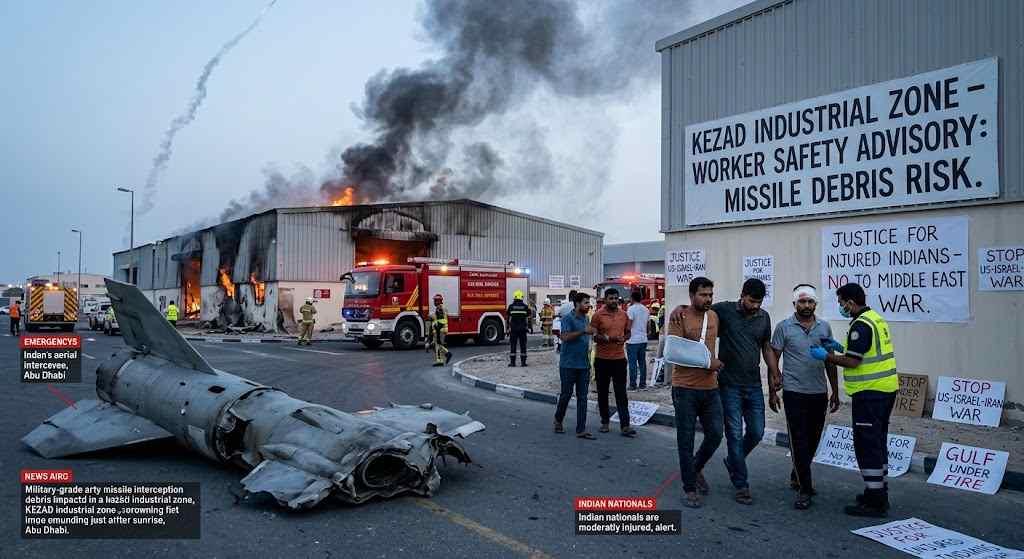
Middle East War Escalation: The widening arc of the US-Israel-Iran war struck the heart of the United Arab Emirates’ industrial sector early Saturday, leaving five Indian nationals injured. The incident, caused by falling debris from a successfully intercepted ballistic missile, has sent ripples of concern through the millions-strong expatriate community in the Gulf as the conflict spills far beyond the borders of the Levant.
The casualties occurred in the vicinity of the Khalifa Economic Zones Abu Dhabi (KEZAD), a massive logistics and manufacturing hub. While UAE air defenses successfully neutralized the incoming threat, the kinetic energy of the mid-air interception resulted in a shower of fragments that triggered at least two fires on the ground.
The Incident at KEZAD: What We Know
Middle East War Escalation: 5 Indians Injured by Missile Debris in Abu Dhabi Interception :According to the Abu Dhabi Media Office and the UAE Ministry of Defense, the ballistic missile was detected and engaged in the early hours of Saturday, March 28, 2026.
- The Victims: Authorities confirmed that all five individuals injured are of Indian nationality.
- Medical Status: The injuries range from minor to moderate. Emergency services reached the industrial zone within minutes, and the victims are currently receiving treatment at a nearby medical facility. Officials have clarified that none of the injuries are considered life-threatening.
- Infrastructure Impact: While the debris sparked fires in the KEZAD area, civil defense teams brought the blazes under control quickly. No large-scale structural collapses were reported, though the psychological impact on the workforce in the zone is significant.
This follows a tragic report from earlier in the week where another Indian national was among two people killed when missile fragments struck a street in a different part of the capital.
A Region Under Fire: The Widening Combat Zone
Middle East War Escalation: 5 Indians Injured by Missile Debris in Abu Dhabi Interception : The strike on Abu Dhabi is part of a coordinated retaliatory wave launched by Iran following heavy US and Israeli strikes on Tehran’s nuclear and military infrastructure. For the first time in this month-long war, the conflict has transformed into a pan-regional struggle.
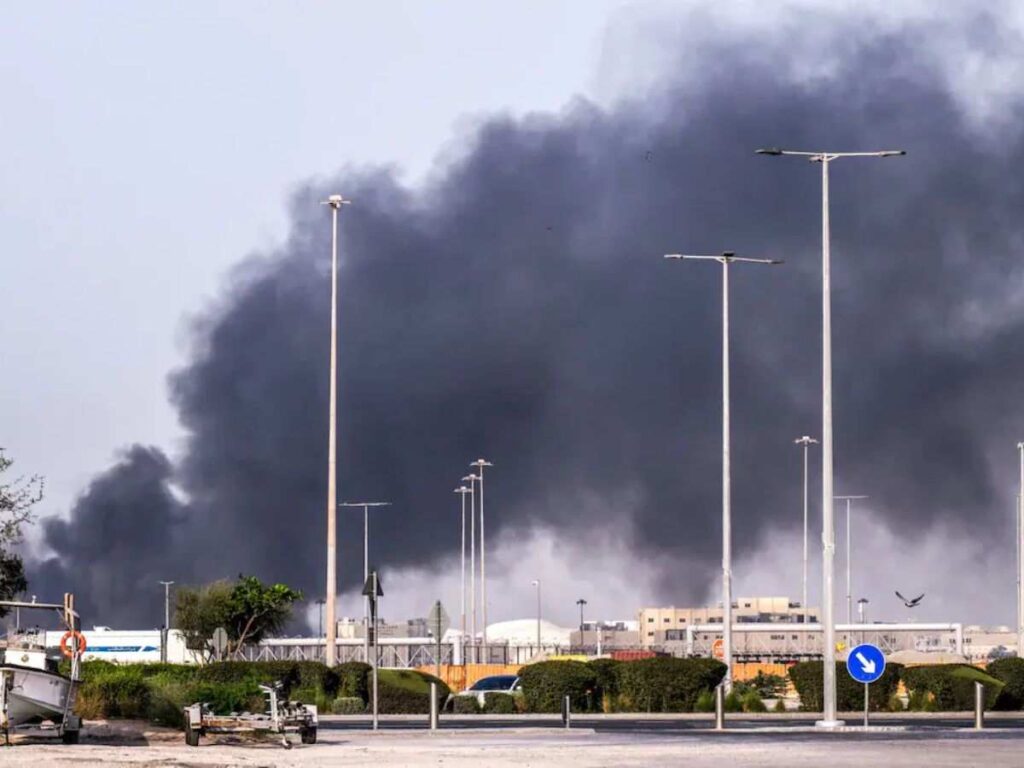
In the last 24 hours alone, the geography of the war has expanded at a terrifying pace:
- Oman: A drone strike on the Salalah Port injured one worker and caused “limited damage” to the facility.
- Saudi Arabia: At least 12 US service members were wounded, two seriously, when a combined missile and drone attack struck the Prince Sultan Air Base.
- Bahrain: Sirens have become a constant fixture in Manama, with residents urged to head to shelters as fires broke out at unidentified facilities following Iranian salvos.
- Israel: Early Saturday, the IDF confirmed it intercepted a missile fired from Yemen, marking the official entry of the Houthi rebels into the direct theater of war.
The Human Toll: A Grim Ledger
The casualty figures across the Middle East have reached staggering heights in just four weeks. As of March 28, the estimated death toll across various fronts is as follows:
| Region | Reported Deaths | Key Details |
| Iran | 3,389 | Includes 1,527 civilians and 228 children. |
| Lebanon | 1,142 | Result of Israeli strikes; includes over 400 Hezbollah fighters. |
| UAE | 10 | Includes two army soldiers and eight civilians/contractors. |
| Israel | 23 | 19 civilians killed by missiles; 4 soldiers killed in Lebanon. |
| United States | 13 | Service members killed in action or in refueling accidents. |
Economic Ripples: Energy and the “Rocket Ship”
Despite the falling debris in Abu Dhabi and the strikes on Saudi bases, global markets are reacting with a mix of dread and strange optimism.
Speaking at the FII Priority Summit in Miami, US President Donald Trump played down the recent stock market volatility. He suggested that once the “dark cloud” of the Iranian regime is removed, the global economy will take off like a “rocket ship.” However, the reality on the ground in the Gulf tells a more complex story. The Strait of Hormuz, which handles 20% of the world’s oil and 30% of its fertilizer trade, remains a flashpoint. In a rare diplomatic breakthrough this morning,Tehran agreed to a UN request to allow humanitarian aid and agricultural shipments through the waterway—a move intended to prevent a global food security crisis.
Geopolitical Shifts: “Cuba is Next”
In a characteristic and controversial pivot during his Miami remarks, President Trump suggested the US military focus might shift even further after the Iran conflict. “And Cuba’s next, by the way. But pretend I didn’t say that,” he told a stunned audience, adding a new layer of unpredictability to an already strained global security environment.
Meanwhile, in the Middle East, the Houthis in Yemen have signaled they are no longer bound by the 2022 truce. Their missile launch toward Beer Sheba and Israel’s nuclear research center suggests a coordinated “axis of resistance” strategy to overwhelm regional air defenses.
Public Advisory in the UAE
The UAE Ministry of Defense has issued a high-alert notice to all residents. In the event of a missile threat, the public is urged to:
- Move to the nearest secure building immediately.
- Stay away from windows, doors, and glass facades.
- Follow official government channels (such as the Abu Dhabi Media Office) and avoid spreading unverified rumors on social media.
The Outlook: Justice or Escalation?
As five Indian families wait for news on their loved ones in Abu Dhabi hospitals, the world watches the skies over the Gulf. The shift from “proxy war” to “direct state-on-state conflict” is now complete. With Israel targeting Iran’s nuclear facilities and Iran striking back at US allies in the GCC, the threshold for a “Total War” has never been closer.
The “No Kings” protest movement is expected to draw millions to the streets in US cities like Chicago and San Francisco today, opposing the escalation. But for the expatriates in KEZAD and Salalah, the war is no longer a political debate—it is a rain of fire from which there is no easy escape.