
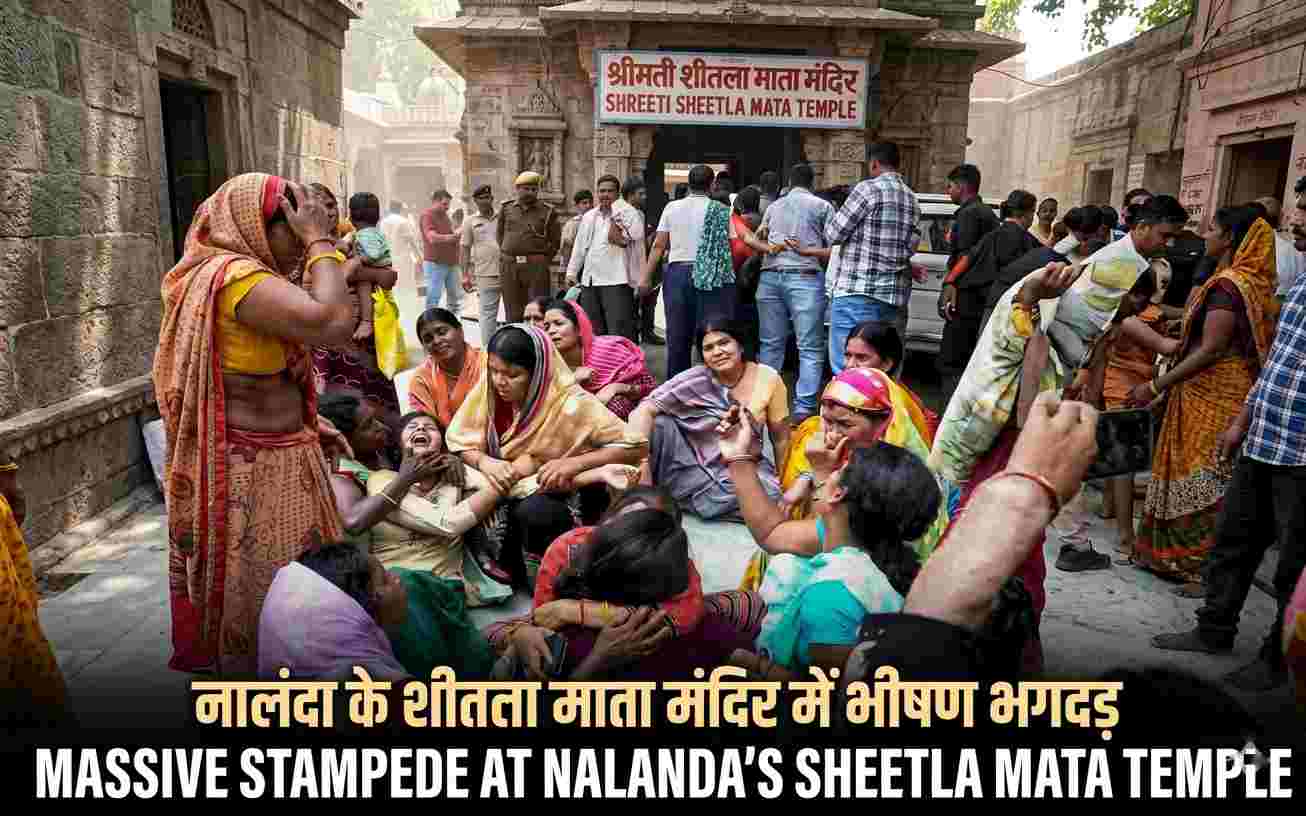
Tragedy in Bihar: The state of Bihar is mourning today following a horrific crowd disaster at the Sheetla Mata Temple in Maghada village, Nalanda district. On Tuesday, March 31, 2026, what was meant to be a day of spiritual devotion turned into a scene of chaos and despair as a massive stampede claimed the lives of at least nine devotees and left several others fighting for their lives.
The incident has sparked widespread outrage over administrative negligence, with locals and survivors pointing toward a complete lack of security arrangements despite the predictable surge of pilgrims on a Tuesday.
Tragedy in Bihar Sequence of Events: A Devotional Tuesday Turns Fatal
The Sheetla Mata Temple in Maghada is a site of immense faith for people across Nalanda and neighboring districts. Every Tuesday, thousands of devotees flock to the shrine to offer prayers. However, this particular Tuesday coincided with Mahavir Jayanti, significantly multiplying the usual crowd size.
According to eyewitnesses, the rush began early in the morning. As the gates opened, the surge of pilgrims became uncontrollable. The narrow pathways leading to the sanctum sanctorum were choked with people.
The Moment of Chaos
Around mid-morning, as the crowd density reached a breaking point, a rumor or a sudden push near the barricades triggered a panic. Reports suggest that several devotees, mostly women and elderly citizens, lost their footing. In the ensuing scramble to escape, people were trampled under the feet of the surging crowd.
“The barricades broke, and suddenly a stampede occurred. People were being trampled on. There was no police presence to manage the thousands who had gathered,” said Lalit Kumar, a local resident who witnessed the tragedy.
Casualties and Identification
As of the latest reports, nine deaths have been confirmed, though local sources fear the toll may rise as several injured individuals remain in critical condition.
Identified Victims
The district administration has begun the process of identifying the deceased. Two of the victims have been identified as:
Rita Devi (50), wife of Dinesh Rajak.
Rekha Devi (45), wife of Kamlesh Prasad, a resident of Mathurapur Noorsarai.
Most of the victims are women who were caught in the middle of the crush. The injured were initially rushed to a local health center and subsequently shifted to larger medical facilities for specialized treatment.
Government Response: Ex-Gratia and Condolences
The tragedy has resonated at the highest levels of government, with both state and central authorities announcing immediate financial relief for the victims.
State Government Support
Bihar Chief Minister Nitish Kumar and Deputy CM Samrat Choudhary expressed their deep sorrow over the loss of life. The Bihar Government has announced an ex-gratia payment of ₹6 lakh to the families of each deceased victim.
Central Government Intervention
Prime Minister Narendra Modi took to social media to express his grief. He announced a relief package from the PM Relief Fund:
₹2 lakh for the kin of the deceased.
₹50,000 for those injured in the stampede.
President Droupadi Murmu also shared a heartbreaking message on X (formerly Twitter), stating: “The news of the death of numerous devotees in a stampede at a temple in Nalanda, Bihar, is extremely heartbreaking. I express my deepest condolences to all the bereaved families.”
Allegations of Administrative Failure
While the government has been quick to announce compensation, the local community is livid. The primary grievance remains the inadequacy of security personnel.
Lack of Crowd Control
Despite the temple’s history of drawing massive crowds every Tuesday, survivors allege that the police presence was negligible.
Mamata Devi, a devotee from Patna, noted: “It is always crowded here on Tuesday. We came for darshan, but there was no system. When the stampede broke out, it was every person for themselves.”
Inadequate Infrastructure: Locals pointed out that the barricading was flimsy and unable to withstand the pressure of thousands of people pushing forward simultaneously.
Shutting Down the Premises
In the immediate aftermath, the district administration moved to close the temple and the associated fair to prevent further incidents. Senior officials, including the Sub-Divisional Police Officer (SDPO), arrived at the site to oversee the clearing of the premises and to ensure that the situation did not escalate further.
High-Level Probe Initiated
To address the growing public anger and to determine the exact cause of the disaster, the Bihar government has ordered a high-level inquiry.
Chief Secretary Pratyaya Amrit has officially initiated a probe. He has directed the Patna Divisional Commissioner and the Range Inspector General (IG) to visit the site, examine the security protocols (or lack thereof), and submit a detailed report.
The investigation will likely focus on:
Why additional forces were not deployed despite the coincidence of Tuesday prayers and Mahavir Jayanti.
The structural integrity of the barricades.
The emergency response time of the medical teams and local police.
A Recurring Nightmare: The History of Temple Stampedes in India
The Nalanda tragedy adds a dark chapter to India’s long history of crowd management failures at religious gatherings. From the 2005 Wai temple stampede to the 2013 Ratangarh tragedy, the pattern remains disturbingly similar: overcrowding, poor infrastructure, and a lack of real-time monitoring.
Why do these incidents keep happening?
Experts suggest that religious sites often operate on “traditional” management styles that are not equipped to handle the modern scale of pilgrimage.
Lack of Headcounts: Most temples do not have a system to count entries and exits.
Narrow Access Points: Ancient temple structures often have “bottleneck” entries that become death traps during a panic.
Communication Gaps: In the absence of a public address system, rumors spread faster than official instructions.
Current Situation: Hospitalized and Grieving
The atmosphere in Maghada and Noorsarai is one of mourning. Outside the hospitals, families wait for news of their loved ones. Home Minister Samrat Choudhary has assured the public that the government is bearing all costs for the treatment of the injured.
“All possible support and relief is being provided. Proper treatment of the injured has been arranged, and we are monitoring the situation closely,” Choudhary stated.
What Lies Ahead?
The Sheetla Mata Temple will remain closed until the administration can guarantee a safer environment for devotees. The probe report is expected to be submitted within a week, which will hopefully hold the responsible officials accountable for the security lapse.
Conclusion: A Call for Reform
The loss of nine lives in Nalanda is a grim reminder that faith should not have to come at the cost of safety. While ex-gratia payments provide some financial relief, they cannot replace the lives lost due to systemic negligence.
It is high time that the Bihar government—and temple boards across the country—invest in technology-driven crowd management, such as AI-based density monitoring and professionalized security forces, to ensure that such a “Black Tuesday” never repeats itself.
Our thoughts and prayers remain with the bereaved families of Nalanda.