
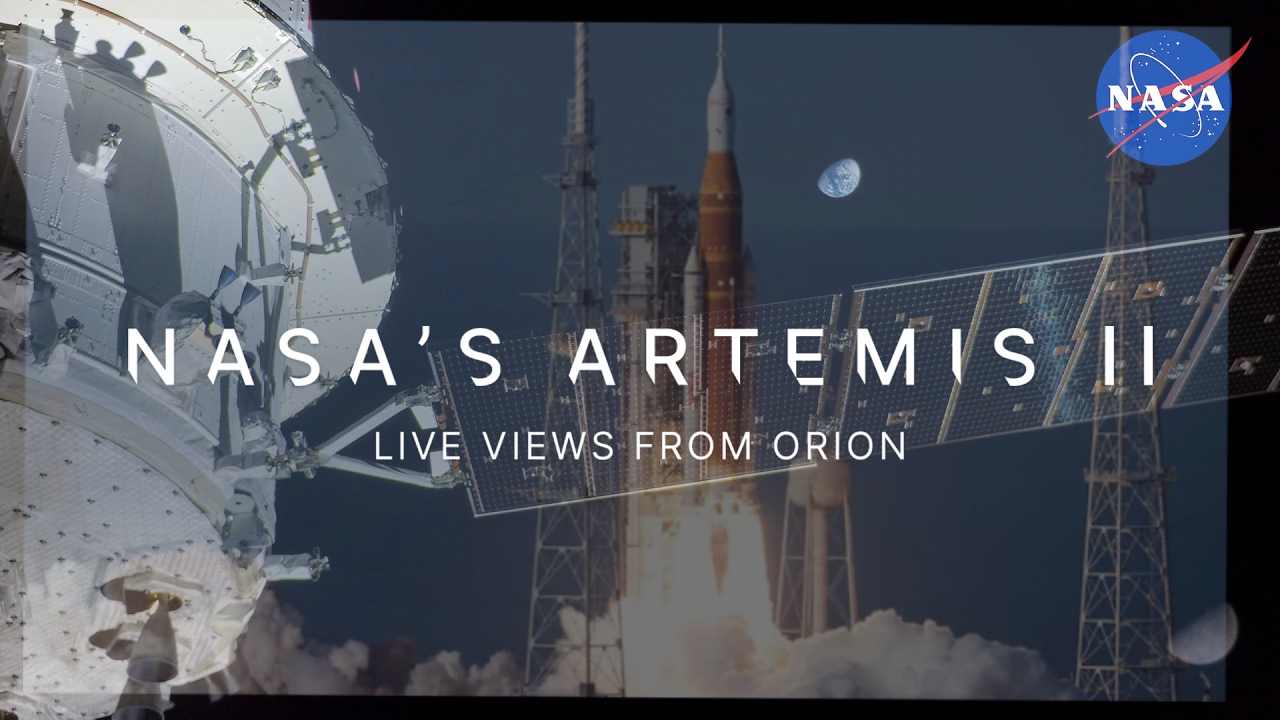
Artemis 2 Moon Mission Launch:The silence of the Florida coastline was shattered this Wednesday by the roar of 8.8 million pounds of thrust as NASA’s Space Launch System (SLS) rocket ascended into the heavens. Carrying the hopes of a new generation, the Artemis II mission has officially commenced, marking the first time humans have ventured toward the Moon in over half a century.
While tens of thousands of spectators gathered at the Kennedy Space Center, some of the most “unreal” views of the liftoff came from an unexpected vantage point: the window seats of a commercial airliner.
The “Accidental Upgrade”: A View from 35,000 Feet
Artemis 2 Moon Mission Launch Embarks on a Historic Lunar Odyssey, As the 32-story SLS rocket pierced the atmosphere, passengers on a routine flight over Florida were treated to a spectacle that social media users are calling the “best accidental upgrade in aviation history.”
Footage captured by a passenger shows the rocket as a brilliant streak of light, trailing a massive plume of white exhaust as it punched through the cloud layer. From the perspective of the airplane, the sheer scale of the launch was amplified. “Oh my God!” a woman can be heard exclaiming in the background of the viral video, capturing the raw emotion of witnessing history from a “front-row seat” in the sky.
Meet the Crew: The New Pioneers
The Artemis II mission is not just a feat of engineering; it is a milestone for humanity. The four-member crew represents a diverse cross-section of modern exploration:
Reid Wiseman (Commander): A veteran NASA astronaut leading the mission.
Victor Glover (Pilot): The first person of color to embark on a lunar mission.
Christina Koch (Mission Specialist): The first woman to travel into cislunar space.
Jeremy Hansen (Mission Specialist): Representing the Canadian Space Agency (CSA), the first non-American to head toward the Moon.
Shortly after liftoff, Commander Wiseman reported back to Mission Control with awe: “We have a beautiful moonrise, we’re headed right at it.”
Technical Tensions: Overcoming the Hydrogen Hurdle
The road to this successful launch was paved with high-stakes troubleshooting. NASA engineers faced intense pressure following previous countdown tests that revealed dangerous hydrogen leaks.
To the relief of the entire agency, the loading of 700,000 gallons of cryogenic fuel went smoothly on Wednesday. However, the “clean” launch was not without its last-minute drama. Engineers had to scramble to resolve two primary technical glitches:
Flight-Termination System: A communication error briefly interrupted the system responsible for self-destructing the rocket if it veered off course.
Orion Battery Temps: Temperature readings for a battery in the Orion capsule’s launch-abort system dipped outside the “green” range, requiring rapid troubleshooting before the crew was cleared for boarding.
The Flight Plan: 10 Days in the Deep Dark
Artemis II is a rigorous “stress test” for the Orion spacecraft. Unlike the upcoming Artemis III, this mission will not land on the lunar surface. Instead, it follows a Free-Return Trajectory.
Phase 1: High Earth Orbit (Days 1–2)
The crew will spend the first 24 to 48 hours orbiting Earth. This “checkout” phase is critical. Since this is the first time humans have flown in the Orion capsule, they must manually test the life-support systems, navigation, and even docking simulations.
Phase 2: Translunar Injection (TLI)
Once the systems are verified, the rocket’s upper stage will perform a massive engine burn. This maneuver, known as Translunar Injection, will provide enough velocity to break free from Earth’s gravity and sling the crew toward the Moon.
Phase 3: The Lunar Flyby
The spacecraft will swing behind the Moon, using lunar gravity to “whip” itself back toward Earth. During this time, the crew will travel further from Earth than any human in history, capturing high-resolution data and imagery of the lunar far side.
Phase 4: The Fiery Return
The mission concludes with a high-speed re-entry. The Orion capsule will hit Earth’s atmosphere at 40,233 km/h (25,000 mph). The heat shield must withstand temperatures nearly half as hot as the sun before the parachutes deploy for a splashdown in the Pacific Ocean.
Why This Matters: “This Is Their Apollo”
It has been 54 years since Apollo 17. For more than half of the current global population, lunar exploration is something found only in history books.
NASA Science Mission Chief Nicky Fox emphasized that Artemis is for the “now” generation. While Apollo was born of the Cold War, Artemis is built on international cooperation and the long-term goal of reaching Mars. By testing the SLS and Orion with a human crew, NASA is ensuring that the “highway” to the Moon is safe for the next mission—Artemis III—which intends to put boots back on the lunar dust.
“On this historic mission, you take with you the heart of this Artemis team, the daring spirit of the American people, and the hopes and dreams of a new generation,” said Launch Director Charlie Blackwell-Thompson.
Conclusion: A Giant Leap for the 21st Century
The Artemis II launch is a reminder of what humanity can achieve when curiosity meets cutting-edge technology. Whether you were watching from the beaches of Cape Canaveral, a smartphone screen halfway across the world, or through the double-paned glass of a commercial airliner, the message is clear: We are going back.
As the Orion capsule continues its 10-day journey, the world remains transfixed. This isn’t just a flight; it’s the dawn of the “Artemis Generation.”