
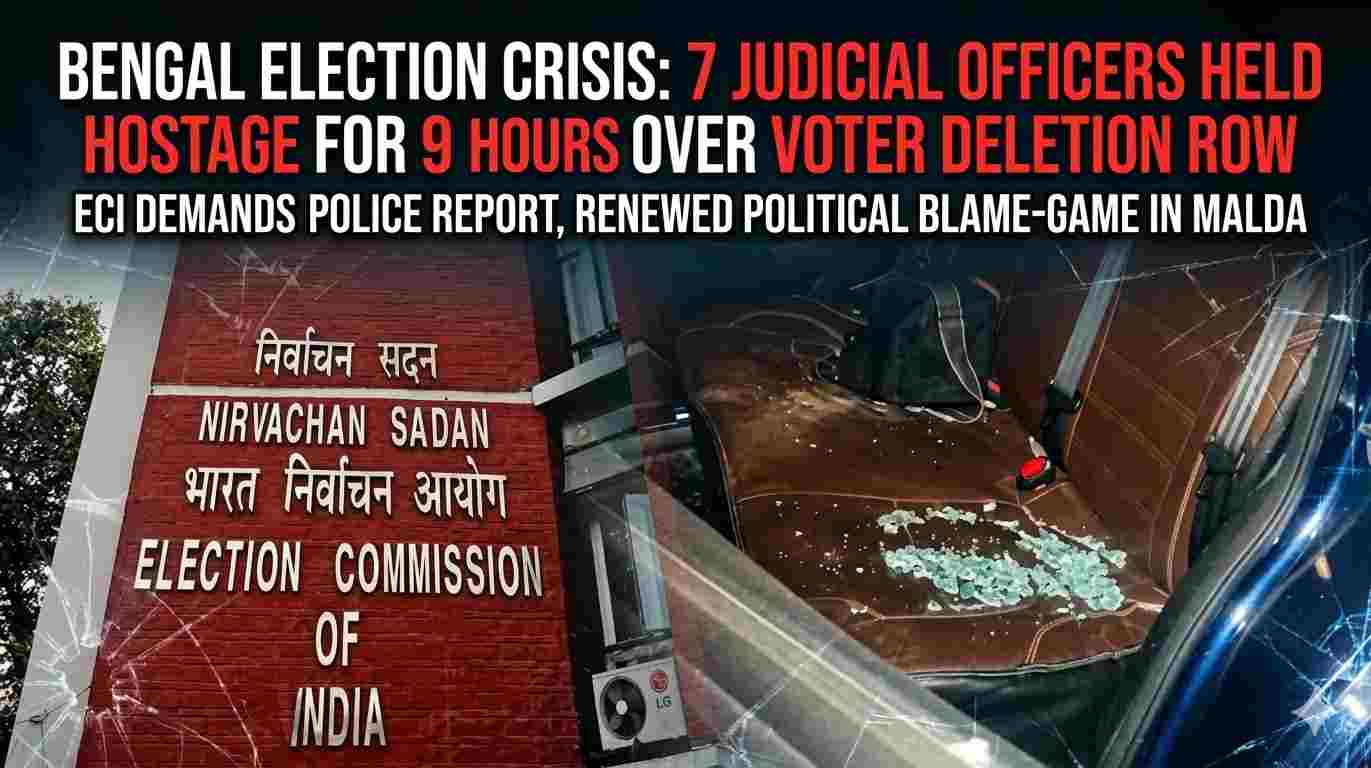
7 Judicial Officers Held Hostage for 9 Hours in Bengal :The fabric of administrative and judicial sanctity in West Bengal faced a severe test this week as seven judicial officers, including three women, were held hostage for nearly nine hours in the Kaliachak area of Malda district. The incident, which has sent shockwaves through the legal and political corridors of the country, stems from the ongoing Special Intensive Revision (SIR)—a pan-India exercise aimed at purifying electoral rolls.
As the Election Commission of India (ECI) demands an immediate report from the Director General of Police (DGP), the incident has ignited a fierce political firestorm between the ruling Trinamool Congress (TMC) and the Bharatiya Janata Party (BJP), highlighting the volatile intersection of judicial duty and grassroots political agitation.
The Siege at Kaliachak: A Timeline of Tension
Democracy Under Duress: 7 Judicial Officers Held Hostage for 9 Hours in Bengal Over Voter Deletion Row, The ordeal began on Wednesday morning when the judicial officers were conducting hearings related to “logical discrepancies” in the voters’ list. Under the SIR mandate, judicial officers are tasked with adjudicating cases where voter data appears redundant, fraudulent, or technically mismatched.
By afternoon, a mob consisting of disgruntled individuals whose names had been purged from the rolls converged on the venue. What started as a protest quickly escalated into a blockade.
The Gherao: The seven officers were surrounded and prevented from leaving the premises. Reports suggest the protesters were agitated by the “mass deletion” of names in the minority-dominated blocks of Kaliachak.
The Nine-Hour Standoff: Despite initial attempts by local police to pacify the crowd, the siege continued well into the night. The officers remained trapped inside without adequate security or a clear exit path.
The Midnight Rescue: It wasn’t until 1:00 AM on Thursday that a massive police contingent, led by senior district officials, managed to break the perimeter. Even as the officers were being escorted to safety, the convoy reportedly faced stone-pelting and attempts at physical obstruction.
Simultaneously, another group of protesters paralyzed traffic on the National Highway adjacent to Kaliachak Block-I (Sujapur constituency), demanding the immediate reinstatement of their voting rights.
Political Volatility: The Blame Game Begins
The incident has provided fresh ammunition for the ongoing battle between the saffron camp and the TMC. The rhetoric has shifted from administrative failure to accusations of “provocative politics.”
BJP: “Provocation from the Top”
Union Minister and former Bengal BJP President Sukanta Majumdar directly blamed the TMC leadership for the chaos. He argued that constant rhetoric against the Election Commission has emboldened mobs to target constitutional officials.
“SIR is a pan-India exercise. Such chaos is not seen in any other state, including those ruled by the opposition. West Bengal is the only exception because the ruling party has been attempting to sabotage the process since day one,” Majumdar stated.
The BJP contends that by labeling the ECI’s routine cleaning of the rolls as a “conspiracy,” the state government has created a climate where judicial officers are seen as enemies of the people rather than facilitators of democracy.
TMC: “ECI’s Failure to Protect”
The Trinamool Congress has distanced itself from the violence while placing the burden of security squarely on the Election Commission. Since the Model Code of Conduct (MCC) is in force, the TMC argues that the state administration is technically under the ECI’s thumb.
Kunal Ghosh, TMC General Secretary and candidate for Beleghata, dismissed the BJP’s allegations:
“The responsibility for the safety of these officers lies with the ECI. While we protest the mass deletion of legitimate voters, we do not support taking the law into one’s hands. This chaos is the work of fringe elements supported by the BJP to defame the state.”
Ghosh subtly pointed toward parties like the Aam Aadmi Unnayan Party (AAUP) and AIMIM, suggesting they are acting as “B-teams” for the BJP to stir communal and administrative unrest in minority-heavy districts like Malda.
Understanding the SIR Row: Why Malda is the Flashpoint
The Special Intensive Revision (SIR) is a critical tool used by the ECI to ensure “One Person, One Vote.” In West Bengal, however, this has become a demographic and political minefield.
Logical Discrepancies: This refers to entries that the ECI’s software flags as suspicious—such as multiple people sharing the same Voter ID number, impossible age gaps in a family tree, or “ghost” voters residing at non-existent addresses.
The Minority Factor: Malda and Murshidabad have high concentrations of minority voters. Political parties often view voter list revisions through the lens of “disenfranchisement,” leading to heightened sensitivities during the adjudication process.
The Judicial Role: Judicial officers are brought in to provide a fair hearing to those whose names are marked for deletion. By attacking these officers, the protesters are essentially stalling the legal recourse meant to help them.
Demographic and Statistical Context
To understand the scale of the tension, one must look at the numbers. West Bengal has historically seen high voter turnout, often exceeding 80%. However, allegations of “scientific rigging” and “duplicate voters” have been a staple of every election cycle for three decades.
| Category | Impact of SIR in Bengal (Approx.) |
| Total Flagged Entries | Over 1.2 Million across the state |
| Resolved Cases | ~65% through field verification |
| Judicial Adjudication | Required for the remaining 35% “contentious” cases |
| Malda District Impact | One of the top 3 districts for “logical discrepancies” |
The ECI has noted that while SIR is routine, the level of resistance in Bengal is “unprecedented.” In states like Uttar Pradesh or Tamil Nadu, the deletion rate is often higher, yet it rarely results in the hostage-taking of judicial staff.
The ECI’s Response and Future Implications
The Election Commission has not taken the Malda incident lightly. By seeking a report from the DGP, the ECI is signaling that it may take “coercive action” against the local administration if negligence is proven.
Security Upgrades: Expect a surge in Central Armed Police Forces (CAPF) deployment specifically for the protection of judicial and electoral officers in sensitive blocks.
Legal Consequences: FIRs have been lodged against the protesters in Kaliachak. However, in the high-stakes environment of an election, making arrests without sparking further riots remains a tightrope walk for the local police.
The Trust Deficit: The most significant casualty of the Kaliachak incident is the trust between the electorate and the administrative machinery. When voters feel their primary right is being “deleted,” and the administration feels their lives are at risk for doing their jobs, the democratic process suffers.
Conclusion: A Dangerous Precedent
The nine-hour ordeal of the seven judicial officers in Malda is more than just a local law-and-order failure; it is a symptom of a deeply polarized political landscape where constitutional processes are viewed with suspicion.
If judicial officers—the very people designated to ensure fairness—cannot perform their duties without fear of being held hostage, the integrity of the upcoming elections comes under a cloud. As the ECI prepares its next move, the eyes of the nation remain on West Bengal, a state where the battle for the ballot often spills over into the streets.
Disclaimer: This information is based on various inputs from news agency