
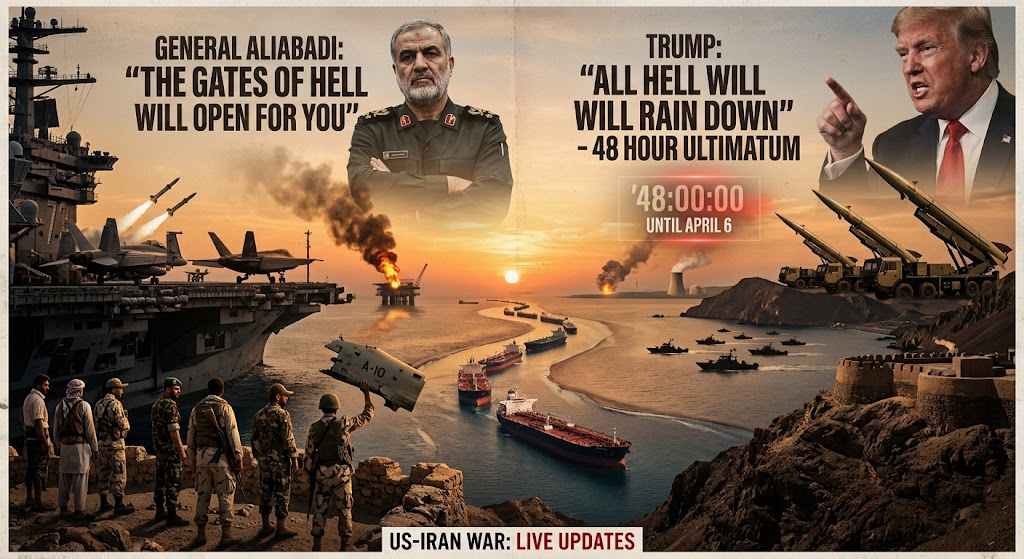
TEHRAN/WASHINGTON —Iran Defies Trump’s “Stupid” 48-Hour The Middle East stands on the precipice of a total regional conflagration this weekend as the Islamic Republic of Iran officially rejected a 48-hour ultimatum from U.S. President Donald Trump. In a high-stakes exchange of “fire and fury” rhetoric, Tehran dismissed the American president’s threats as the “nervous” ramblings of a failing administration and warned that a “big surprise” is being prepared for U.S. and Israeli forces.
The latest escalation comes as the conflict, which began on February 28, 2026, enters its sixth bloody week. With the global economy reeling from the partial closure of the Strait of Hormuz and the death toll climbing into the thousands, the world is watching the clock tick toward 8:00 P.M. Eastern Time on Monday, April 6—the moment Trump has vowed that “all hell will rain down” on Iran’s vital infrastructure.
“Stupid and Unbalanced”: Tehran’s Defiant Rebuttal
The Gates of Hell: Iran Defies Trump’s “Stupid” 48-Hour Ultimatum with “Big Surprise” Warning: The Iranian military establishment did not mince words in its response to the White House. General Ali Abdollahi Aliabadi, representing the powerful Khatam al-Anbiya Central Headquarters, issued a blistering statement on Saturday via the Fars news agency.
“After having admitted successive defeats, the aggressive and warmongering president of the United States has, in a desperate, nervous, unbalanced, and foolish move, threatened Iran’s infrastructure and national assets,” Abdollahi stated.
Echoing the apocalyptic language used by President Trump on Truth Social, Abdollahi turned the threat back on Washington, warning that if the U.S. follows through on its ultimatum, “the gates of hell will open for you.” He emphasized that the Iranian armed forces would not hesitate “for a moment” to protect national assets and would meet any strike with “devastating and continuous” attacks on all U.S. military assets in the Middle East and Israeli infrastructure.
The 48-Hour Countdown
The Gates of Hell: Iran Defies Trump’s “Stupid” 48-Hour Ultimatum with “Big Surprise” Warning: The current crisis was ignited by a series of social media posts from President Trump. After initially granting a 10-day pause on March 26 to allow for negotiations, Trump took to Truth Social to signal that his patience had evaporated. He demanded that Iran either “strike a deal” or fully reopen the Strait of Hormuz—the world’s most critical oil artery—within 48 hours.
“Time is running out,” Trump wrote. “All hell [will] rain down on them” if the demands are not met. While Trump claimed in the same post that talks were “going very well,” the reality on the ground suggests a massive disconnect between diplomatic efforts and military posture.
A “Big Surprise” and Asymmetric Warfare
Perhaps most concerning for Pentagon planners is the mention of a “big surprise” in store for the U.S. and Israel. An unnamed Iranian security official told Fars news agency that Tehran is moving forward with a “specific target bank” and that the U.S. intelligence on Iranian positions is “inaccurate.”
The official mocked Trump’s specific threats to strike Iranian bridges, calling them “laughable” and a desperate reaction to the “failure of American military operations.” This likely refers to the recent downing of two U.S. warplanes—an F-15 and an A-10 Thunderbolt II—which has dealt a symbolic blow to U.S. air superiority in the theater.
“We have learned well in asymmetric warfare how to wear down the enemy,” the official added. “America has failed in its strategy of clean, quick, and easy attack.”
| Conflict Statistics (As of April 5, 2026) | |
| Iran Death Toll | 3,500+ |
| Israel Death Toll | 1,300+ |
| United States Death Toll | 13 |
| Regional Impact (Iraq, UAE, Qatar, Kuwait) | 134+ |
| Strait of Hormuz Status | 90% reduction in traffic |
| Global Oil Prices | Near-historic highs |
Nuclear Proximity: The Bushehr Incident
The human and environmental cost of the war nearly took a catastrophic turn on Saturday when strikes landed near the Bushehr nuclear power plant. The incident forced the immediate evacuation of 198 Russian and Iranian workers.
Iranian Foreign Minister Abbas Araghchi issued a chilling warning to the Gulf Cooperation Council (GCC) states, noting that the Bushehr plant is geographically closer to capitals like Kuwait City, Manama, and Doha than it is to Tehran.
“Continued attacks on the plant… could eventually lead to radioactive fallout that would end life in GCC capitals,” Araghchi warned. The International Atomic Energy Agency (IAEA) has expressed “deep concern,” confirming this was the fourth time the area around the plant has been targeted since the war began.
The Strait of Hormuz: A Global Chokehold
Central to the conflict is the Strait of Hormuz, through which 20% of the world’s oil flows. While Iran claims it has authorized the passage of ships carrying “essential and humanitarian goods,” shipping data tells a grimmer story.
Traffic through the waterway has plummeted by over 90% as insurance rates skyrocket and the risk of missile strikes remains high. Major energy producers in the region, including Qatar and Kuwait, have declared force majeure on several contracts, sparking fears of a global energy depression. Trump’s ultimatum is specifically aimed at breaking this “selective blockade,” which Tehran uses as its primary lever of economic pressure.
The Search for the Missing Airman
Amidst the grand strategy and nuclear threats, a more localized drama is unfolding in the rugged terrain of the Kohgiluyeh and Boyer-Ahmad province. Following the downing of the U.S. aircraft, one crew member was reportedly rescued by U.S. Special Forces, but another remains missing.
Fattah Mohammadi, a local Iranian official, confirmed that “popular forces and tribesmen” have joined military units in a sweeping search for the American airman. In a separate but related move, the U.S. announced the arrest of two relatives of the late General Qassem Soleimani (killed in 2020), a move Tehran has denounced as “kidnapping” and “a lie,” claiming the individuals have no relation to the family.
Conclusion: The Monday Deadline
As the 48-hour clock winds down to the Monday evening deadline, the Middle East is a powder keg with a very short fuse. President Trump’s gamble rests on the belief that overwhelming military pressure will force a desperate Iranian regime to the negotiating table. Conversely, Tehran appears to be betting that its “asymmetric” capabilities and its hold over the world’s energy supply will allow it to outlast American resolve.
If the “big surprise” Iran has promised manifests as a direct hit on U.S. carriers or a strike on regional energy infrastructure, the “gates of hell” mentioned by General Abdollahi may indeed swing wide, dragging the entire world into a conflict from which there is no easy exit.