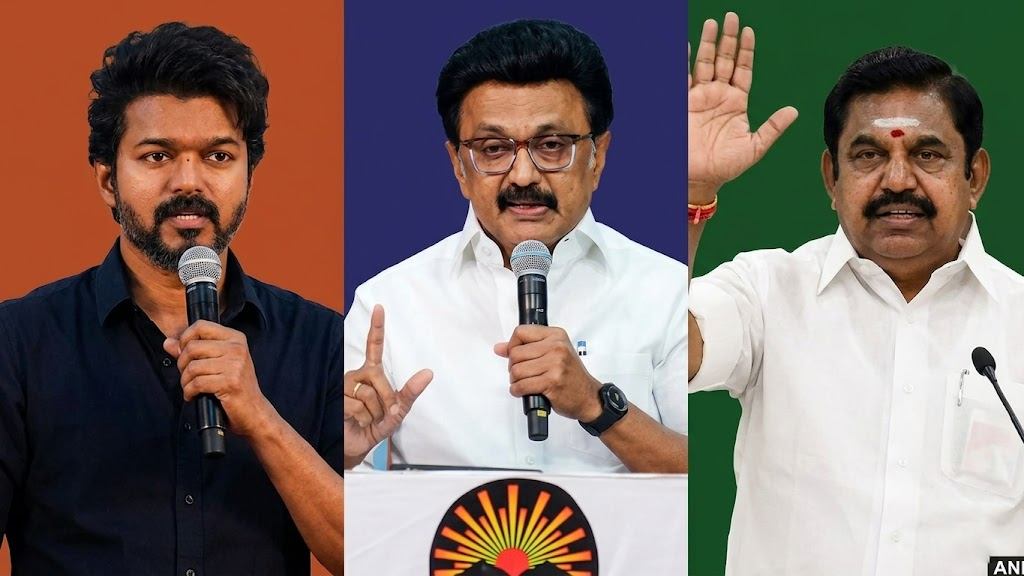
Chennai: DMK, NDA, or TVK: As the sun sets on the campaign trails of the Coromandel Coast, all eyes are fixed on April 23, 2026—the day Tamil Nadu heads to the polls to decide the fate of its 234-member Assembly. For decades, the state’s political narrative was a rhythmic pendulum swinging between the DMK and the AIADMK. But as we approach this landmark election, the rhythm has changed. The entry of a cinematic icon, the realignment of old alliances, and a formidable push from the ruling dispensation have turned this into a high-stakes, multi-cornered thriller.
With less than three weeks to go, two major pre-poll surveys—Lok Poll and Poll Tracker—have released their findings. The data suggests a clear frontrunner, a struggling veteran, and a “X-factor” that could redefine the state’s youth vote forever.
1. The Numbers: A Dominant Lead for the Rising Sun
DMK, NDA, or TVK: Who Has the Edge in the 2026 Tamil Nadu Battle? What the Latest Surveys Reveal: According to both major surveys, the ruling Dravida Munnetra Kazhagam (DMK) alliance, led by Chief Minister MK Stalin, is not just leading—it is poised for a landslide.
The Lok Poll Projections
The survey conducted by Lok Poll, which sampled a massive 1,17,000 respondents between March 1 and April 1, suggests a “Stalin Wave” is still very much in effect.
- DMK Alliance: Projected to win 181–189 seats (Majority: 118).
- Vote Share: 40.1%.
- Opposition AIADMK-led NDA: Projected at 38–42 seats.
- Vote Share: 29%.
- TVK (Vijay): Projected at 8–10 seats with a surprising 23.9% vote share.
The Poll Tracker Projections
DMK, NDA, or TVK: Who Has the Edge in the 2026 Tamil Nadu Battle? What the Latest Surveys Reveal: Poll Tracker offers a similar, albeit slightly more conservative, seat count but highlights a stronger vote consolidation for the ruling front.
- DMK Alliance: 172–178 seats with a 42.7% vote share.
- AIADMK-led NDA: 46–52 seats.
- TVK: 6–12 seats with a 19.2% vote share.
2. Why the DMK Holds the Advantage: The “Welfare” Fortress
The surveys indicate that Chief Minister MK Stalin’s “Dravidian Model” of governance has struck a deep chord with the electorate, particularly among women and rural voters.
The Lok Poll survey specifically pointed to three pillars of the DMK’s popularity:
- Kalaignar Magalir Urimai Thogai: The monthly financial assistance for women.
- Free Bus Travel: A scheme that has drastically increased the mobility and economic independence of women.
- The Breakfast Scheme: The pioneering initiative providing nutritious meals to school children.
“The DMK alliance is clearly ahead, mainly because of its strong welfare schemes… These have especially connected well with women in rural and semi-urban areas, giving DMK a solid advantage,” the Lok Poll analysis stated.
Furthermore, MK Stalin remains the most preferred Chief Ministerial candidate across the state. His image as a “familiar and established leader” compared to his rivals has helped him navigate the traditional anti-incumbency that usually plagues five-year terms.
3. The “Thalapathy” Factor: Vijay’s Political Debut
The biggest disruptor in this election is undoubtedly actor Vijay and his newly formed party, Tamilaga Vettri Kazhagam (TVK). While the surveys do not project him winning a large number of seats, his vote share projections (between 19% and 24%) are staggering for a debutant.
Vijay is successfully tapping into:
- First-time voters: Capturing the imagination of Gen Z.
- The “Anti-Establishment” sentiment: Attracting those unhappy with both the DMK and the AIADMK.
- Youth Appeal: His massive fan base is translating into a disciplined political cadre.
However, there is a catch. The survey notes that because TVK is contesting alone, this high vote share is spread thin across the state. While it may not result in a high seat count, it is significantly splitting the opposition vote, which directly benefits the DMK.
4. The AIADMK’s Uphill Battle
For the AIADMK, led by Edappadi K. Palaniswami (EPS), the road to April 23 looks treacherous. Once the dominant force under Jayalalithaa, the party is now struggling with internal friction and identity crises.
The surveys highlight several critical issues for the AIADMK:
- Internal Splits: The lingering impact of leadership tussles and the loss of key regional heavyweights have demoralized the cadre.
- Regional Weakness: Traditionally strong in the “Delta” and southern districts, the party is reportedly losing ground in these former bastions.
- The Minority Vote: Poll Tracker indicates that the AIADMK’s perceived proximity to the BJP has led to a consolidation of minority votes (Muslim, Christian, and Dalit communities) toward the DMK alliance.
5. Community Leanings and Demographic Trends
The Poll Tracker analysis suggests a broad-based coalition for the DMK. Specifically, communities like the Mudaliar, Naidu, and Muslim communities are showing a distinct inclination toward the “Rising Sun.”
Meanwhile, the Naam Tamilar Katchi (NTK), led by Seeman, continues to hold a niche but loyal base, projected at around 4.9% to 5.1% of the vote share, though they are unlikely to secure more than 0–2 seats.
| Party / Alliance | Projected Seats (Avg) | Projected Vote Share | Key Strength |
| DMK+ | 175–185 | 40% – 43% | Welfare Schemes & Minority Support |
| AIADMK / NDA | 40–50 | 29% | Traditional Rural Base |
| TVK (Vijay) | 8–12 | 19% – 24% | Youth & First-time Voters |
| NTK / Others | 0–2 | 5% – 7% | Tamil Nationalist Identity |
The Verdict: A Split Opposition is a DMK Blessing
The most significant takeaway from the 1.17 lakh respondents is that the opposition is fractured. In a “First Past The Post” system, a split between the AIADMK-led NDA and Vijay’s TVK essentially clears a path for the DMK to sail through, even in closely contested seats.
While Vijay has emerged as a “living presence and emotion” in many households, as he recently claimed in his Vellore address, the lack of a robust alliance structure may keep him in the role of a “king-maker” or a significant “spoiler” rather than a king in 2026.
As April 23 approaches, the AIADMK will need a miracle to consolidate its base, while Vijay will need to prove that his massive rallies can translate into actual button-presses at the EVM. For now, however, MK Stalin sits comfortably in the driver’s seat, bolstered by a portfolio of social welfare that seems to have insulated him from the winds of change.
The counting of votes will take place on May 4, 2026. Until then, Tamil Nadu remains a fascinating laboratory of Indian democracy, where cinema, welfare, and caste identity continue to brew a potent political cocktail.