
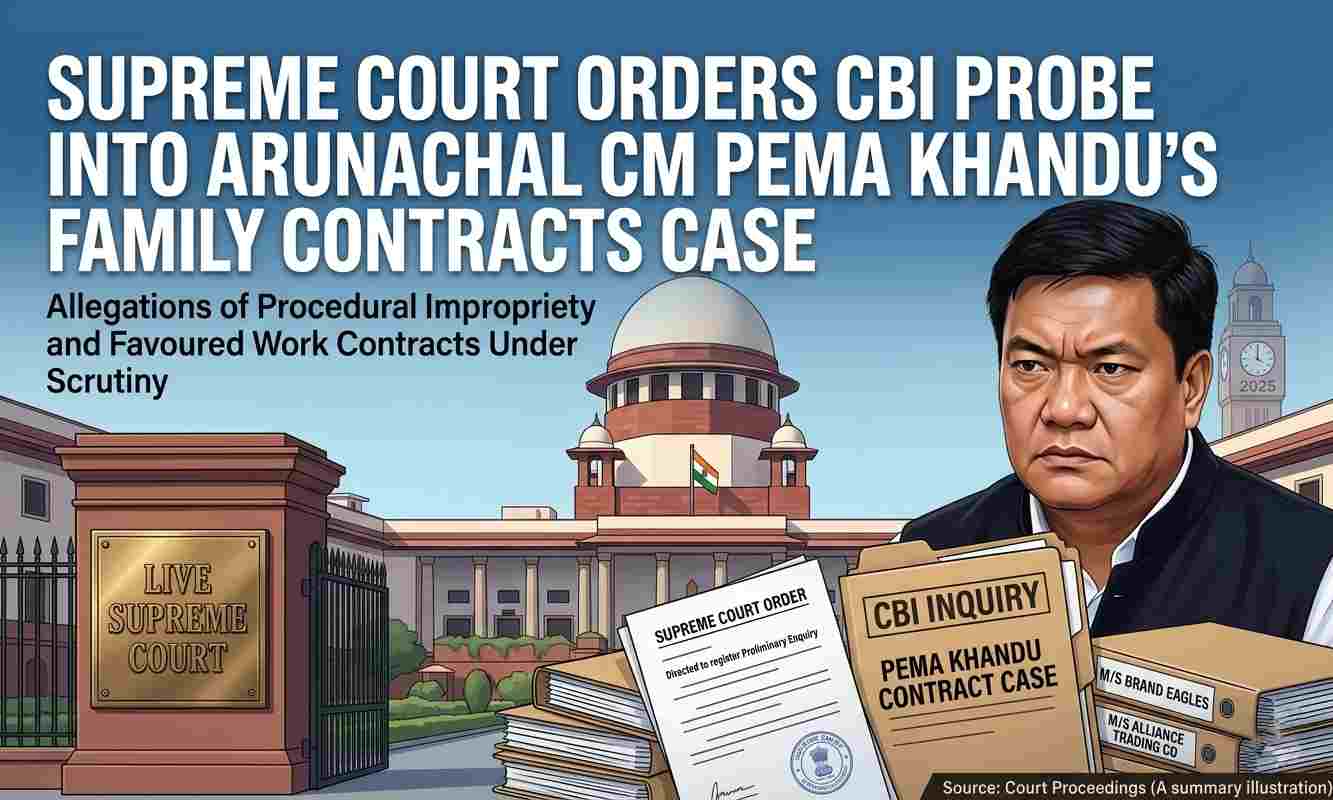
Supreme Court Orders CBI Probe Into Arunachal CM Pema Khandu’s : In a landmark development that has sent shockwaves through the political corridors of Itanagar and New Delhi, the Supreme Court of India has directed the Central Bureau of Investigation (CBI) to register a preliminary enquiry into the award of public work contracts in Arunachal Pradesh. The investigation specifically targets allegations that lucrative government tenders were systematically funneled to firms owned by the family members of the sitting Chief Minister, Pema Khandu.
The decision marks a significant setback for the Khandu administration, which has long faced scrutiny from local activist groups regarding its procurement processes. By handing the reins to a central agency, the apex court has signaled that the gravity of the allegations warrants an investigation free from the potential influence of state-level machinery.
The Core of the Contention: Tenders and Relatives
Supreme Court Orders CBI Probe Into Arunachal CM Pema Khandu’s : The legal battle, spearheaded by petitioners Save Mon Region Federation and Voluntary Arunachal Sena, alleges a deep-rooted pattern of favoritism. At the heart of the complaint is the claim that the state’s tendering process was bypassed or manipulated to benefit a select inner circle.
Key Entities Under Scrutiny:
M/s Brand Eagles: A construction company allegedly linked to the Chief Minister’s wife.
M/s Alliance Trading Co: Owned by Tsering Tashi, Pema Khandu’s nephew and the MLA from Tawang District.
Wider Family Network: The petitioners claim that firms associated with the Chief Minister’s mother and other close relatives were also primary beneficiaries of state largesse.
According to the petitioners, the financial scale of these “family-run” contracts is staggering. They allege that works worth approximately ₹1,245 crore were allotted through formal tenders, while an additional ₹25 crore was distributed via direct work orders. While the state counsel argued that these contracts represented only about three percent of the total government work awarded during the period, the court found the allegations of procedural bypasses significant enough to warrant a formal look by the CBI.
The Court’s Directive: A Tight Timeline for Accountability
A three-judge bench comprising Justices Vikram Nath, Sandeep Mehta, and NV Anjaria presided over the hearing, concluding that a preliminary enquiry was necessary to establish the facts. The court’s order is comprehensive and leaves little room for bureaucratic foot-dragging.
Key Mandates from the Supreme Court:
Immediate Action: The CBI must register the preliminary enquiry within two weeks.
Scope of Investigation: The probe will cover all public works, contracts, and work orders executed between January 2015 and December 2025.
Preservation of Evidence: In a stern warning, the court stated that the state must ensure no records are destroyed.
Nodal Oversight: The Chief Secretary of Arunachal Pradesh has been tasked with appointing a nodal officer to facilitate seamless coordination with the CBI.
Status Report: The CBI is required to submit its first status report to the court within 16 weeks.
The “Sponsored Litigation” Defense
Throughout the proceedings, the counsel representing the Arunachal Pradesh government sought to dismiss the plea as “sponsored litigation.” This defense suggested that the petitioners were acting at the behest of political rivals rather than out of a genuine concern for public interest.
However, the Supreme Court’s previous demand on December 2 for a comprehensive affidavit—detailing all contracts awarded to the CM’s family over a ten-year span—suggested that the bench was not satisfied with mere denials. The failure of the state to sufficiently clear the air led to Monday’s transition from a judicial inquiry to a criminal agency investigation.
Political Implications for Pema Khandu
Pema Khandu, who has been a dominant figure in Northeast politics, now faces one of the most challenging chapters of his career. While a “preliminary enquiry” is not an indictment or a formal First Information Report (FIR), it is the essential first step toward a criminal case.
For the opposition, this is a potent weapon. The allegation that the “Frontier State” was being treated as a family enterprise strikes at the heart of the “Double Engine” governance model often touted by the ruling dispensation. If the CBI finds evidence of quid pro quo or the deliberate flouting of the General Financial Rules (GFR), the political fallout could be catastrophic.
Why a Central Probe?
The petitioners argued successfully that a state-level probe would be inherently compromised. Given that the Chief Minister sits at the apex of the state’s executive branch, the local police or vigilance departments would face an impossible conflict of interest.
The Supreme Court’s decision to involve the CBI reinforces a growing judicial trend: ensuring that the “high and mighty” are held to the same standards of transparency as any other citizen. By focusing on the decade between 2015 and 2025, the court is looking at a timeline that spans the entirety of Khandu’s rise and consolidation of power.
What Happens Next?
The legal teams for all parties have been granted two weeks to submit their final written arguments before the bench delivers its final verdict on the matter. However, the CBI’s work begins now.
Over the next four months, the agency will likely pore over:
Tender Logs: Comparing bid amounts and qualification criteria.
Banking Trails: Tracking the flow of funds from the state treasury to the private accounts of the mentioned firms.
Departmental Notes: Checking if technical experts were overruled to favor specific contractors.
As the CBI enters the hills of Arunachal, the eyes of the nation will be on the 16-week deadline. For the people of Arunachal Pradesh, the hope is that this investigation will lead to a more transparent system where public funds are used for the development of the many, rather than the enrichment of the few.
Disclaimer: The investigation is currently at the “Preliminary Enquiry” stage. Under Indian law, all individuals are presumed innocent until proven guilty in a court of law.