
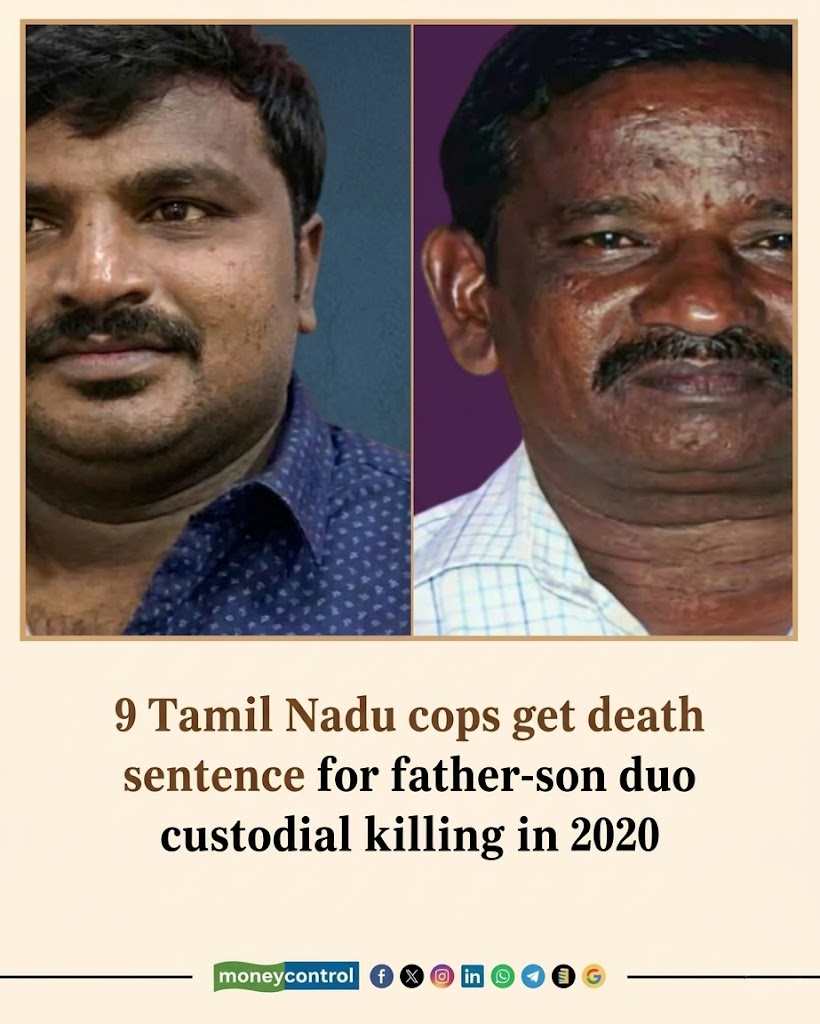
All Nine Policeman Sentenced to Death: The small trading town of Sathankulam in Tamil Nadu’s Thoothukudi district is, by all accounts, a quiet place. But on the night of June 19, 2020, it became the epicenter of a crime so grotesque that it would eventually shake the conscience of the nation and redefine the discourse on police accountability in India.
Six years after the brutal deaths of P. Jayaraj (59) and his son J. Benicks (31), a special court in Madurai has delivered a landmark verdict. In a move that sends a shivering message through the corridors of power, nine police officials were handed the death sentence. Terming the case “rarest of rare,” Judge G. Muthukumaran underscored that the ruling was intended not just as punishment, but to instill a necessary fear among those who would dare to abuse the khaki uniform.
The Night the Shutters Stayed Closed
Shadows in Sathankulam: All Nine Policeman Sentenced to Death for the Brutal 2020 Custodial Killings : The tragedy began with something as mundane as a lockdown restriction. During the height of the COVID-19 pandemic, shops were mandated to close by a specific hour. J. Benicks, who ran a modest mobile phone shop near the Kamarajar statue, was wrapping up his day around 8:00 PM.
Reports suggest that his father, P. Jayaraj, had already been picked up by the police from his nearby woodworks shop following an alleged minor altercation the previous day. When Benicks learned of his father’s detention, he rushed to the Sathankulam police station—a decision that would prove fatal.
Eyewitnesses recall Benicks being made to wait outside initially. When he was finally summoned inside, he did what any concerned son would do: he questioned why his elderly father was being assaulted. According to witnesses, that single question ignited a fuse of unchecked rage.
A Fabricated Narrative vs. A Bloody Reality
Shadows in Sathankulam: Nine Cops Sentenced to Death for the Brutal 2020 Custodial Killings : The initial First Information Report (FIR) filed by the Sathankulam police was a masterclass in obfuscation. The police claimed that Jayaraj and Benicks had violated lockdown rules and, when confronted, verbally abused the officers. The FIR went so far as to suggest that the father and son “sat on the ground and rolled around,” implying that the horrific injuries they sustained were self-inflicted during a frantic resistance.
However, the truth began to leak through the station walls almost immediately. Friends who stood outside the station through the long night reported hearing harrowing screams.
The investigation, eventually spearheaded by the Central Bureau of Investigation (CBI), dismantled the police narrative piece by piece. The CBI’s findings painted a picture of premeditated, sustained, and merciless torture that lasted for hours.
The Anatomy of Brutality
According to the chargesheet, the “modus operandi” of the torture was systematic. The victims were stripped to their underwear and forced to bow down on a wooden table. While several officers held their limbs to prevent any self-defense, others took turns raining blows with lathis (heavy wooden batons) on their buttocks and backs.
The brutality was so extreme that:
- The victims’ lungis had to be changed multiple times because they were completely soaked in blood.
- The men were allegedly forced to clean their own blood off the station floor.
- Jayaraj, despite pleading with the officers and citing his history of diabetes and high blood pressure, was shown no mercy.
- Allegations of sexual violence emerged, adding a layer of depravity to the physical assault that fueled national outrage.
The Failure of the Safeguards
In the Indian legal system, several checks are supposed to prevent custodial torture. This case, however, highlighted a systemic collapse of those safeguards.
- The Medical Check: Before being produced in court, detainees must undergo a medical fitness test. In this case, the “fitness” certificates were allegedly issued despite the men being in critical condition and bleeding profusely.
- The Judicial Magistrate: On June 20, when the duo was produced before a magistrate, the official was accused of passing remand orders without physically examining the men or questioning their visible injuries, as mandated by law.
- The Transfer: Instead of being sent to the nearby Perurani district jail, the father and son were transported 100 kilometers away to the Kovilpatti sub-jail—a move many believe was intended to hide the severity of their condition from their local community.
The Final Hours
By the night of June 22, the human body could no longer endure the trauma. Benicks complained of intense chest pain and was rushed to the Kovilpatti Government Hospital. He died shortly after arrival.
In a tragic mirror image, his father Jayaraj passed away in the early hours of June 23 at the same facility. The official police line cited “medical complications,” but the public knew better. The news of the double death acted as a lightning rod for a state already weary of lockdown tensions.
From Sathankulam to the World: The “George Floyd” Moment
The deaths sparked an unprecedented wave of protests. Shopkeepers across Tamil Nadu shut their doors in solidarity, and the hashtag #JusticeForJayarajAndBennix trended globally.
Public commentators drew immediate parallels to the death of George Floyd in the United States, which had occurred just weeks earlier. The Sathankulam incident forced India to confront its own “George Floyd moment,” highlighting a culture of “encounter killings” and custodial violence that often goes unpunished in the world’s largest democracy.
The Road to Justice: Judicial Intervention
Realizing the potential for a cover-up, the Madurai Bench of the Madras High Court took suo motu (on its own motion) cognisance of the case. The court’s intervention was surgical and decisive:
- It ordered a postmortem by a team of three doctors, mandated that it be videographed, and ensured the preservation of CCTV footage.
- When local police attempted to intimidate a judicial team during an inspection—with one officer even telling a magistrate, “You can’t touch us”—the court swiftly moved the probe to the CBI.
The Convicted
The trial lasted six years, seeing the death of one accused (Special Sub-Inspector Pauldurai) due to COVID-19. The remaining nine were found guilty of murder, conspiracy, and destruction of evidence:
- Inspector Sridhar (The presiding officer who sanctioned the violence)
- Sub-Inspectors Raghu Ganesh and Balakrishnan
- Personnel: Murugan, Samadurai, Muthuraja, Chelladurai, Thomas Francis, and Veilumuthu.
Conclusion: A Warning to the Khaki
The sentencing of nine active-duty police officers to death is almost unheard of in Indian judicial history. In his closing remarks, Judge Muthukumaran noted that while many officers serve with integrity, the “extreme brutality” and “abuse of authority” in this case necessitated a punishment that would resonate.
“Father and son stripped, ruthlessly assaulted… Heart shudders reading about it,” the court observed.
The Sathankulam case remains a dark stain on the history of the Tamil Nadu police, but the verdict offers a glimmer of hope. It serves as a reminder that the law is not a shield for those who break it, even—and especially—if they are the ones tasked with upholding it. For the family of Jayaraj and Benicks, the six-year journey from a small mobile shop to the highest halls of justice is finally over, leaving behind a legacy that may finally force a long-overdue reform in Indian policing.
Disclaimer: This information is based on various inputs from news agency.