
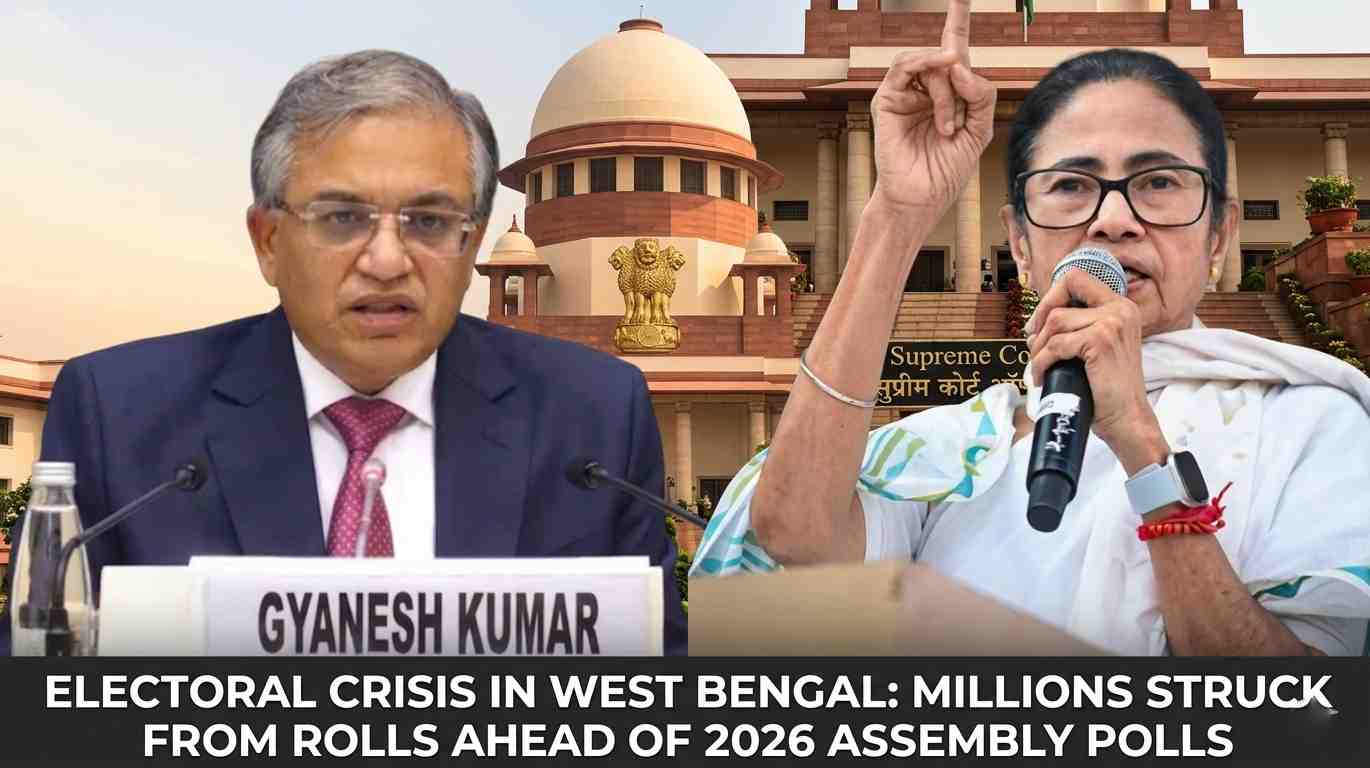
Electoral Crisis in West Bengal: The political landscape of West Bengal is currently embroiled in an unprecedented administrative and legal storm. As the state gears up for the 2026 State Assembly Elections, the Election Commission of India (ECI) has concluded its Special Intensive Revision (SIR) process—a move that has resulted in the deletion of millions of names from the electoral rolls.
This exercise, aimed at purifying voter lists, has instead ignited a massive controversy involving the ruling Trinamool Congress (TMC), the Bharatiya Janata Party (BJP), and the Supreme Court of India. With voting scheduled to begin in late April, the fate of nearly 90.8 lakh voters hangs in the balance, creating an atmosphere of anxiety, anger, and legal uncertainty.
Electoral Crisis in West Bengal The Scale of the SIR Exercise: By the Numbers
The Special Intensive Revision (SIR) is one of the most significant electoral purges in India’s recent history. According to data published by the ECI, the scope of the adjudication process in West Bengal is staggering.
Total Adjudicated Electors: 6,006,675 (approx. 6 million) individuals were put through a rigorous verification process.
Total Names Struck Off: Across all categories, an estimated 90.8 lakh (9.08 million) names have been removed from the rolls.
Ineligible Voters: Out of the 6 million specifically adjudicated, 45% (roughly 27.1 lakh) have been deemed ineligible as voters.
Restored Voters: Only about 32.6 lakh have been cleared as valid voters and restored to the list.
Pending Decisions: As of early April, the fate of 22,163 electors remains undecided.
This mass deletion is the second-highest in the country, trailing only Tamil Nadu, which saw the removal of 97 lakh names.
Political Flashpoints: The Battle for Bhabanipur
The stakes could not be higher for the state’s leadership. Chief Minister Mamata Banerjee recently filed her nomination for the Bhabanipur assembly constituency, where she faces a high-stakes rematch with BJP leader and Leader of Opposition, Suvendu Adhikari.
Addressing the media after filing her nomination, the Chief Minister issued a stern warning to the ECI and the central government. She asserted that the TMC would move to court if the names of valid voters were not restored immediately. Banerjee has characterized the SIR as a targeted attempt to disenfranchise her support base.
The BJP, meanwhile, maintains that the revision is a routine and necessary process to remove deceased voters and, crucially, illegal immigrants who they claim have been shielded by the ruling party for electoral gains.
The Supreme Court’s Firm Stance
The legal battle has already reached the highest levels of the judiciary. On April 7, 2026, the Supreme Court of India declined to grant interim relief to those whose names were deleted.
Key Judicial Takeaways:
No Interim Inclusion: The Court refused to allow deleted voters to be added back to the rolls simply because their appeals are pending.
The “Earlier Mapped” Argument: Justice Joymalya Bagchi clarified that the Court cannot order the inclusion of persons merely because they were previously on the list if they failed the current verification by judicial officers.
Appellate Process: While acknowledging that the tribunal process takes time, the Court emphasized that judicial rigor cannot be bypassed for the sake of the upcoming election dates.
The Court also took a grim view of the breakdown of law and order during the revision process. Recently, seven judicial officers were held hostage for nine hours in Malda by angry residents whose names had been deleted. The Top Court warned the state government, stating: “If the state machinery fails to protect the officers, the process cannot proceed fairly.”
Impact on Key Districts: A Demographic Analysis
The HT and NDTV data analysis highlights a concerning trend: the deletions are heavily concentrated in districts with significant minority populations. These areas were instrumental in the TMC’s landslide victory in 2021.
The “Four District” Concentration
Four districts—Murshidabad, Malda, North 24 Parganas, and South 24 Parganas—account for approximately 30.4 lakh of the adjudication cases.
| District | Muslim Population % | Impact Summary |
| Murshidabad | 66% | Massive deletions; TMC won 20/22 seats here in 2021. |
| Malda | 51% | Scene of violent protests; TMC won 8/12 seats in 2021. |
| N. 24 Parganas | 26% | High concentration of “deleted” complaints; industrial & border belt. |
| S. 24 Parganas | 36% | Rural heartland; critical for the TMC’s seat count. |
Between these four districts alone, 12.2 lakh names have been removed. In 2021, these regions provided the TMC with 75 seats, accounting for 35% of their total strength in the Assembly. If these voters remain ineligible, it could significantly alter the arithmetic of the 2026 polls.
Voices from the Ground: Anger and Despair
Behind the statistics are millions of individuals like Nadia Mondal, a homemaker from North 24 Parganas. Despite living in the same house for 27 years and submitting her Aadhaar and other documents, her name was struck off.
“I am a resident of Duttapukur… I submitted all the necessary documents during the hearing but now I find my name in the list of deleted voters,” Mondal told reporters.
Her frustration is echoed by Bagbul Mallik, a small-business owner in Deganga. Mallik’s family remains on the roll, but he has been removed, highlighting what many call the “arbitrary” nature of the deletions.
The sentiment on the ground is one of betrayal by the entire political class. While the TMC claims to be fighting for them, and the BJP claims to be “cleaning” the system, voters like Mondal feel caught in a “false fight” between “Didi and Dada.”
The Road to April 23: Can the Tribunals Keep Up?
The ECI released a final supplementary list on Monday, restoring some names after successful challenges. However, for the 27.1 lakh deemed ineligible, the only remaining path is through special tribunals supervised by the Calcutta High Court.
With the first phase of voting scheduled for April 23 and the second for April 29, the window for legal redress is closing fast. The logistical challenge of hearing millions of appeals in less than two weeks is near-impossible, leading to fears that a significant portion of the population will be effectively disenfranchised.
Election Schedule Recap:
Phase 1 (152 seats): April 23, 2026
Phase 2 (142 seats): April 29, 2026
Results Declaration: May 4, 2026
Conclusion: A Test for Indian Democracy
The Special Intensive Revision in West Bengal has moved beyond a routine administrative update. It has become a flashpoint for debates on citizenship, federalism, and the integrity of the democratic process.
If millions of valid residents are unable to exercise their right to vote due to bureaucratic errors or systemic delays, the legitimacy of the 2026 election results may be questioned. Conversely, if the ECI’s claims of removing “ineligible” voters hold true, this exercise represents a massive shift in the state’s political demographics.
As the queues outside District Magistrate offices grow longer and the rhetoric between the TMC and BJP sharper, all eyes remain on the Calcutta High Court and the Tribunals. Will the “valid voters” get their names back in time, or will the 2026 election be remembered for the voters who were left behind?