
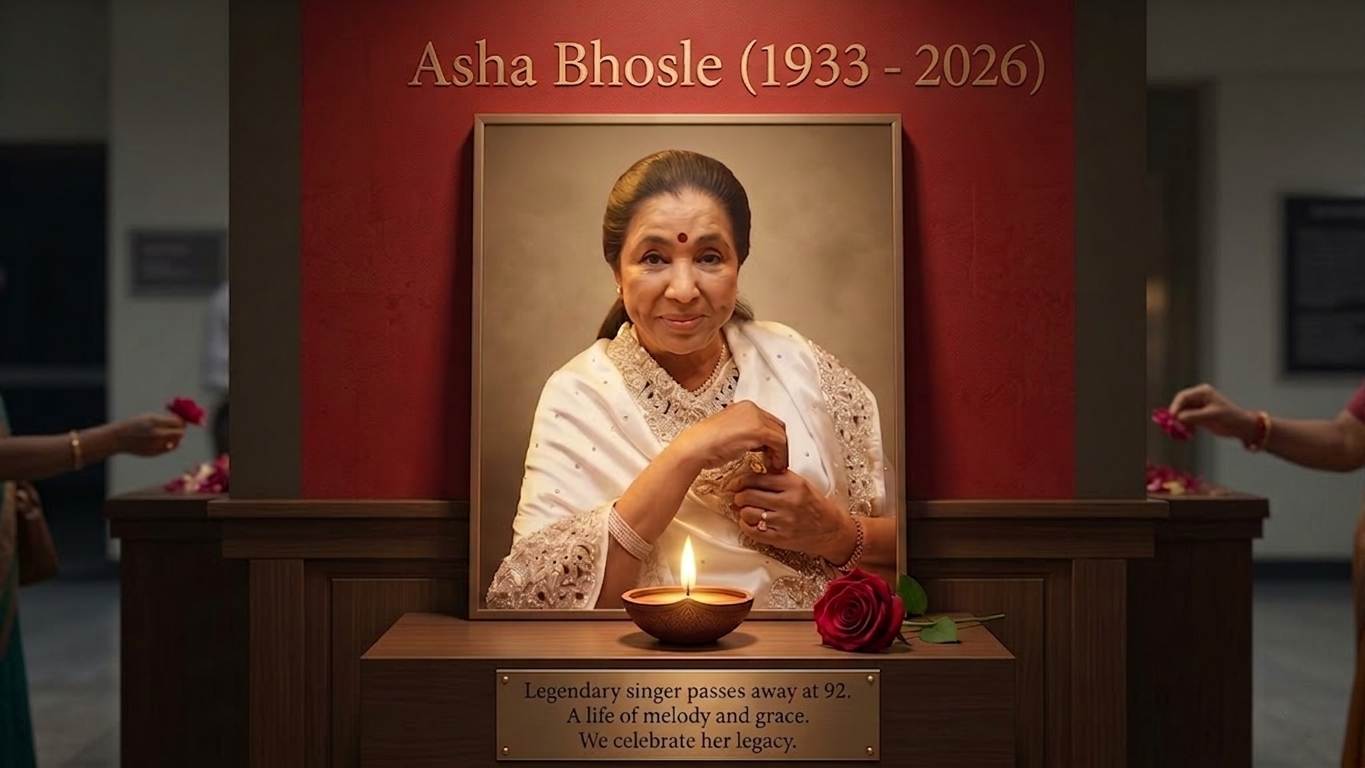
The melody that defined the heartbeat of a nation has finally fallen silent. Legendary playback singer Asha Bhosle, a name synonymous with the evolution of Indian cinema and the soul of Bollywood music, passed away on Sunday, April 12, 2026. She was 92.
The news was confirmed by her son, Anand Bhosle, outside Mumbai’s Breach Candy Hospital, where the singer had been battling health complications. Her departure marks the conclusion of an era that spanned over eight decades, leaving a void in the global music industry that can never truly be filled.
Asha Bhosle Passes Away at 92 : The Final Hours A Nation Prays
Asha Tai, as she was affectionately known by millions, was admitted to the hospital on the evening of Saturday, April 11. Reports indicate she had been struggling with exhaustion and a persistent chest infection for the past few months. Despite being placed in the Intensive Care Unit (ICU) and receiving the best possible medical attention, her condition deteriorated rapidly.
According to hospital officials, the legendary vocalist suffered a cardiac arrest followed by multi-organ failure. Her son, Anand, addressed the waiting media with a heavy heart, confirming that she breathed her last on Sunday afternoon.
Funeral Arrangements:
The family has announced that the mortal remains will be kept at her residence on Monday, April 13, at 11:00 AM for fans and well-wishers to pay their final respects. The last rites are scheduled to take place at 4:00 PM at Shivaji Park, a location often reserved for the farewell of Maharashtra’s greatest icons.
1. The Phenomenal Journey of a Musical Prodigy
Born in 1933 in Sangli, Maharashtra, Asha was born into the illustrious Mangeshkar family. The daughter of Pandit Deenanath Mangeshkar, a classical singer and theater actor, music was quite literally in her blood. However, her journey was far from easy.
Following the untimely death of her father, a young Asha, only nine years old, began singing alongside her elder sister, the late Lata Mangeshkar, to support their family. While Lata Didi quickly established herself as the voice of the “pure” Indian heroine, Asha had to fight tooth and nail to carve out her own identity.
Breaking the Stereotype
In the early days of her career, Asha was often relegated to songs that other singers refused—typically cabaret numbers, jazz-influenced tracks, or songs for the “vamp” or the supporting actress. Rather than being discouraged, she took these “discarded” opportunities and infused them with a level of sensuality, energy, and technical brilliance that the industry had never seen.
By the 1950s and 60s, she had become the go-to voice for composers like O.P. Nayyar, R.D. Burman, and Khayyam. She proved that she wasn’t just a “backup” to her sister, but a versatile powerhouse capable of handling any genre thrown her way.
2. The Versatility That Defined a Century
If Lata Mangeshkar was the “Ganges” of Indian music—pure and serene—Asha Bhosle was the “Ocean”—vast, deep, and unpredictable. Her ability to modulate her voice allowed her to transition seamlessly between genres.
The Cabaret Queen: Tracks like Piya Tu Ab To Aaja and Dum Maro Dum redefined the sound of the 70s.
The Ghazal Maestro: In 1981, she surprised the world with the soundtrack of Umrao Jaan. Under the baton of Khayyam, she sang ghazals like Dil Cheez Kya Hai with such depth and classical precision that she won her first National Award.
Pop and Indipop: Even in her 60s and 70s, she stayed relevant by collaborating with artists like Boy George and the Kronos Quartet, and releasing hit albums like Janam Samjha Karo.
3. A Record-Breaking Legacy
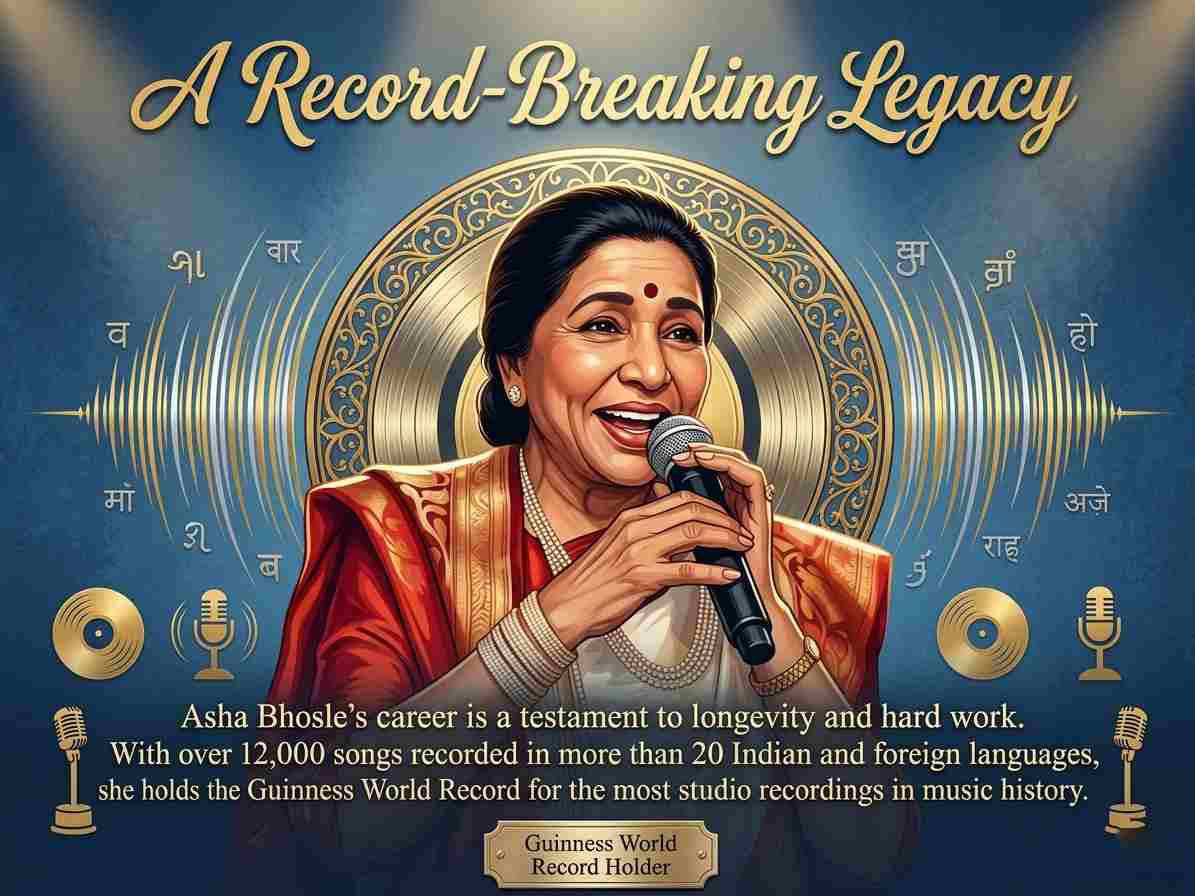
Asha Bhosle’s career is a testament to longevity and hard work. With over 12,000 songs recorded in more than 20 Indian and foreign languages, she holds the Guinness World Record for the most studio recordings in music history.
Major Awards and Accolades:
| Award | Details |
| National Film Awards | 2-time winner (Umrao Jaan, Ijaazat) |
| Filmfare Awards | 7-time Best Female Playback winner (retired in 1977 to encourage new talent) |
| Dadasaheb Phalke Award | Received in 2000 for her outstanding contribution to Indian cinema |
| Padma Vibhushan | India’s second-highest civilian honor, awarded in 2008 |
4. Her Views on Contemporary Music
In one of her final detailed interactions with the media in 2023, Asha Bhosle remained candid about the state of the modern music industry. While she praised the talent of singers like Sunidhi Chauhan and Rahat Fateh Ali Khan, she admitted to finding the lyrical quality of today’s songs lacking.
“To be honest, I don’t really listen to today’s songs. If I have to listen to music, I turn to the classical greats like Bhimsen Joshi. I listen to ghazals to polish my own craft. I improvise and practice even today because there is always something new to learn.”
This dedication to her craft, even at the age of 90, is what separated her from her peers. She was a perpetual student of music, never resting on the laurels of her past success.
5. The Emotional Void: Industry in Mourning
As news of her passing spread, the Indian film industry and political leaders expressed their profound grief. From veteran actors who performed to her tunes to young musicians who viewed her as a North Star, the tributes have been pouring in.
Asha Bhosle was more than just a singer; she was a symbol of resilience. She faced personal tragedies, including the loss of her children and her husband, the legendary R.D. Burman, with a smile and a song. Her zest for life, her love for cooking, and her sharp wit made her a beloved figure even beyond the recording studio.
6. Why the World Will Never Forget Asha Bhosle
The impact of Asha Bhosle’s voice transcends borders. Whether it was the playful flirtatiousness of Chura Liya Hai Tumne Jo Dil Ko or the haunting melancholy of Mera Kuch Saamaan, she had a unique ability to touch the human soul.
She was the bridge between the classical traditions of the past and the experimental sounds of the future. She taught generations that it was okay to be different, to be “rebellious” in art, and to constantly reinvent oneself.
As we prepare to bid her a final farewell at Shivaji Park, we don’t just mourn a singer; we celebrate a life that was lived in full melody. Her physical presence may be gone, but as long as a radio plays in a small tea stall in Mumbai or a smartphone streams a classic hit in London, the voice of Asha Bhosle will live on.
Rest in peace, Asha Tai. The heavens just gained their most versatile voice.