Israel-Iran-U.S. War : The geopolitical landscape of the Middle East has shifted from a state of fragile tension to a high-stakes naval standoff. As of Monday, April 13, 2026, the deadline set by U.S. President Donald Trump for a comprehensive naval blockade of Iranian ports has officially passed. With peace talks in Islamabad failing to produce a signature on a dotted line, the focus has shifted from the negotiating table to the volatile waters of the Persian Gulf and the Strait of Hormuz.
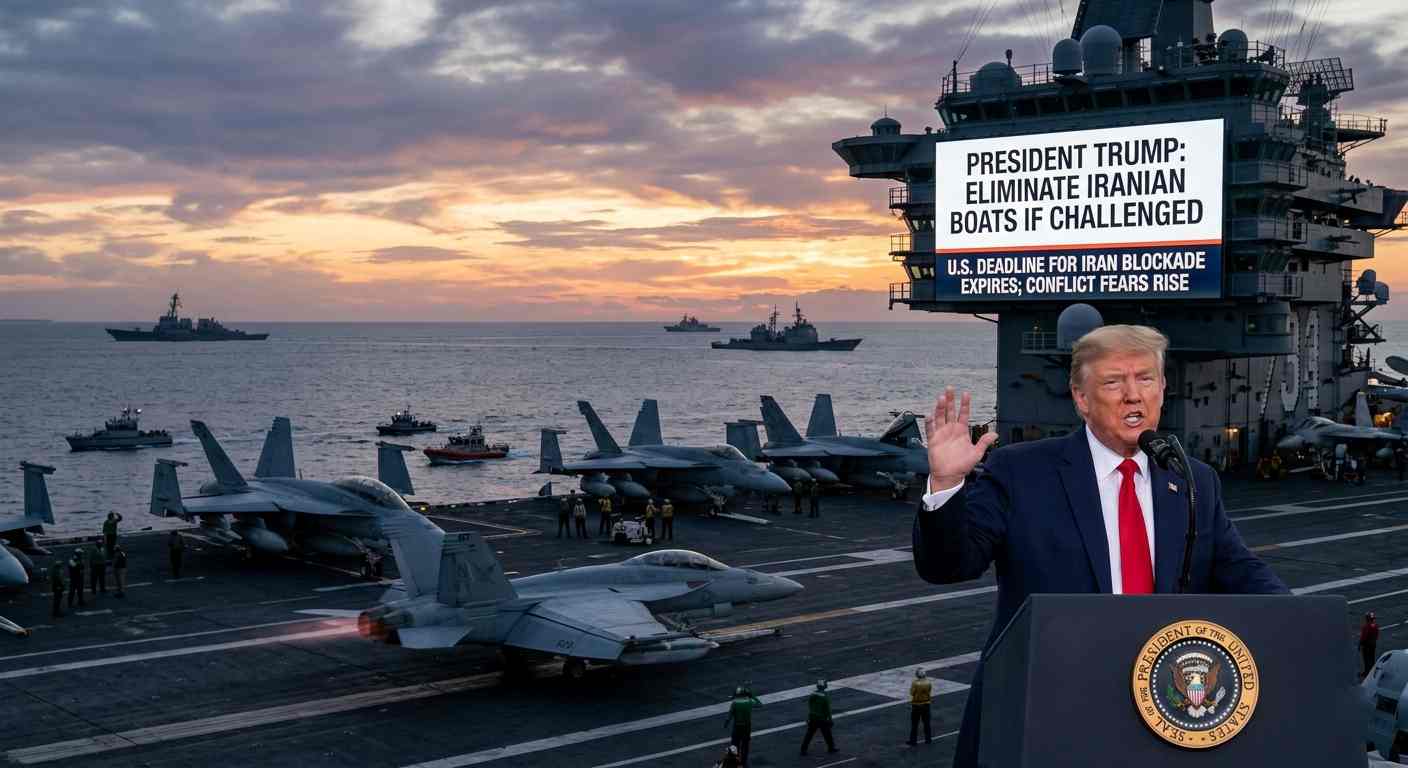
In a series of aggressive statements that have sent shockwaves through global energy markets, President Trump has made it clear: the era of tactical restraint is over. The U.S. naval blockade, aimed at crippling the Iranian economy and forcing a nuclear concession, is now in full effect, and the rules of engagement have been drastically redefined.
Israel-Iran-U.S. War The “Elimination” Directive: Trump’s Truth Social Ultimatum
President Trump took to his Truth Social platform to issue a “Warning” that left no room for ambiguity. He stated that any Iranian “fast attack ships” attempting to breach or even approach the American naval blockade would be “immediately ELIMINATED.”
The President’s rhetoric was particularly sharp, comparing the potential engagement to the aggressive air strikes used against narcotics traffickers off the Venezuelan coast.
“Warning: If any of these ships come anywhere close to our BLOCKADE, they will be immediately ELIMINATED,” Trump posted. He further asserted that much of Iran’s conventional navy had already been “completely obliterated” during the preceding 40 days of conflict, suggesting that only small, guerrilla-style fast boats remain a threat.
This directive signals a “shoot-on-sight” policy for vessels that exhibit hostile intent or attempt to disrupt the blockade, a move that international legal experts warn could lead to a catastrophic escalation if an accidental engagement occurs.
The Islamabad Stalemate: Why Diplomacy Failed
The escalation comes immediately after the collapse of historic peace talks in Islamabad, Pakistan. For 21 hours, U.S. Vice President JD Vance and Iranian officials—including Foreign Minister Abbas Araqchi—engaged in the highest-level direct dialogue since the 1979 Islamic Revolution.
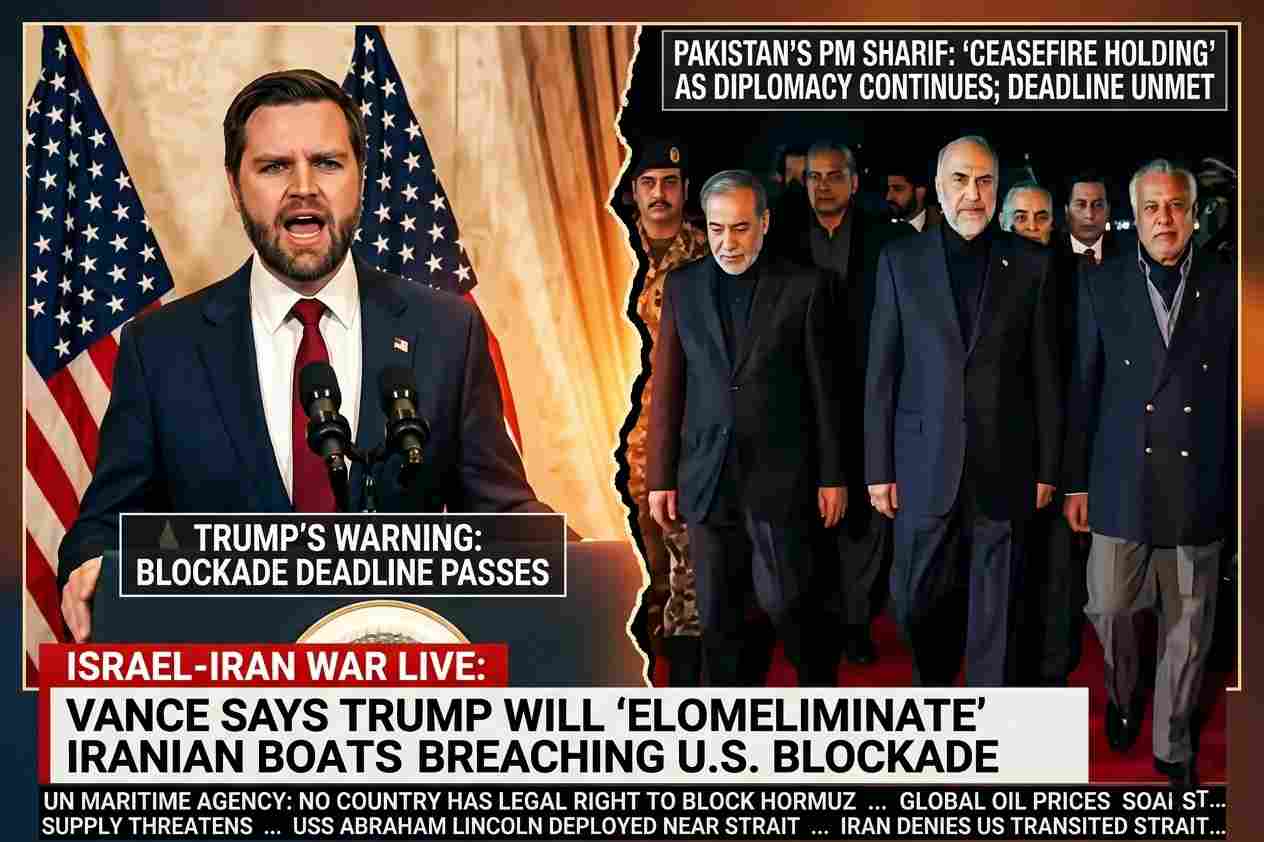
Despite the presence of high-profile mediators like Pakistan’s Prime Minister Shehbaz Sharif and Army Chief Asim Munir, the talks hit a brick wall.
The Nuclear Sticking Point: The U.S. demanded an “affirmative commitment” that Iran would permanently abandon its nuclear enrichment program.
The Hormuz Crisis: Iran refused to relinquish its claim of control over the Strait of Hormuz, viewing it as their primary lever of influence against the West.
As the delegations left Islamabad, the temporary truce was replaced by the looming shadow of the blockade
Shehbaz Sharif’s “Hold” on Hope
Despite the aggressive rhetoric from Washington and the breakdown of formal talks, Pakistan’s Prime Minister Shehbaz Sharif remains the most vocal proponent of a peaceful resolution. During a cabinet meeting on Monday, Sharif noted that while a deal was not reached, the “ceasefire” between the two nations was technically “holding.”
Sharif’s role has been described as a “diplomatic tightrope walk.” He confirmed that full efforts are still underway behind the scenes to resolve “outstanding issues.” Pakistan’s involvement is critical not just as a mediator, but as a regional power that would suffer immensely from a full-scale war on its doorstep.
However, the “holding” ceasefire is under immense pressure. With U.S. warships now actively blockading Iranian ports, the line between a “ceasefire” and “active containment” has become dangerously blurred.
The Battle for the Strait of Hormuz: International Law vs. Sovereignty
The Strait of Hormuz is the world’s most important energy artery. Approximately 20% of global oil supplies pass through this narrow choke point. Iran’s move to block the strait earlier in the conflict sent global oil prices into a tailspin, and the U.S. mission is now centered on “clearing” this path.
The IMO’s Legal Stand Arsenio Dominguez, the Secretary General of the International Maritime Organization (IMO), stepped into the fray on Monday. He reminded the warring parties that under international law, no country—neither the U.S. nor Iran—has the legal right to prohibit “innocent passage” or freedom of navigation through international straits.
The Reality on the Water
U.S. Operations: The U.S. military has begun a mine-clearing operation, claiming that two warships have already transited the strait to establish a “safe pathway” for commercial shipping.
Iranian Denials: Tehran has flatly denied that any U.S. ships crossed the strait, claiming their coastal defense systems successfully repelled the attempts.
Iran’s Ambassador to India, Mohammad Fathali, has warned that the consequences of this blockade will extend “well beyond the US and Iran,” hinting at a global economic crisis if the flow of energy is permanently disrupted.
The “Kill System”: A Controversial Methodology
One of the most striking aspects of President Trump’s recent warning was his reference to the “system of kill” used against drug cartels. By likening Iranian naval assets to criminal organizations rather than a sovereign military, the Trump administration is attempting to delegitimize Iran’s defensive maneuvers.
This strategy involves high-precision air strikes and drone technology designed to neutralize small, fast-moving targets before they can get within range of larger American destroyers. This “asymmetric” approach is meant to counter Iran’s famous “swarm” tactics, where dozens of small boats attempt to overwhelm a single large ship.
Economic Consequences: Oil and Global Markets
The world is watching the Persian Gulf with bated breath. The moment the Monday 1400 GMT deadline passed, oil futures saw increased volatility.
Supply Choke: If the blockade successfully stops Iranian exports, the global market loses a significant volume of crude.
Risk Premium: Shipping insurance rates for vessels operating in the Gulf have reached record highs, making every barrel of oil transported through the region significantly more expensive.
Inflationary Pressure: For countries like India and those in Western Europe that rely heavily on Middle Eastern energy, a prolonged naval war could trigger a new wave of global inflation.
The Domestic Pressure: Trump vs. The “Deep State”
Back in Washington, Trump’s aggressive stance is being framed as a fulfillment of his “America First” promise. He has accused Iran of “lying” about their intentions to open the strait, using this as justification for the immediate implementation of the blockade.
Critics, however, worry that the President is bypassing traditional diplomatic channels and moving toward a conflict that could last years. The involvement of non-formal advisors like Jared Kushner and Steve Witkoff in the Islamabad talks suggests that the Trump administration is running a highly centralized and personal foreign policy, often at odds with the cautious approach of the Pentagon’s “career” officials.
The “Martyrdom” Narrative in Tehran
In Iran, the atmosphere is one of defiance and mourning. The recent death of Supreme Leader Ayatollah Ali Khamenei has unified various factions within the Islamic Republic. The Iranian delegation in Islamabad made a point of dressing in black and carrying artifacts from a bombed school, signaling to the world that they view themselves as victims of “Western imperialism.”
Tehran’s demand for “war reparations” and the release of $6 billion in frozen assets shows that they are not willing to negotiate from a position of weakness. If the blockade continues to starve the Iranian economy, the regime may feel it has “nothing to lose,” leading to the very “never-before-seen” attack that Trump has threatened.
Conclusion: A World on the Edge
The passing of the April 13 deadline marks the beginning of a dangerous new chapter in the Israel-Iran war. With the U.S. now directly involved in a naval blockade and President Trump issuing “elimination” orders, the margin for error is zero.
Pakistan continues to hope for a miracle in the form of a “holding” ceasefire, but the reality in the Strait of Hormuz tells a different story. As warships maneuver and drones circle overhead, the fate of global energy security and Middle Eastern peace lies in the hands of leaders who seem increasingly unwilling to blink.
What to Watch Next:
Will Iran attempt a “swarm” attack on the U.S. blockade to test Trump’s resolve?
Will the U.S. successfully clear the mines in the Strait of Hormuz to allow Qatari and Saudi tankers to pass?
How will China, a major buyer of Iranian oil, respond to the U.S. naval interference?
The world remains in a state of “LIVE” uncertainty as the most powerful military on earth faces off against one of the most resilient regimes in the Middle East.