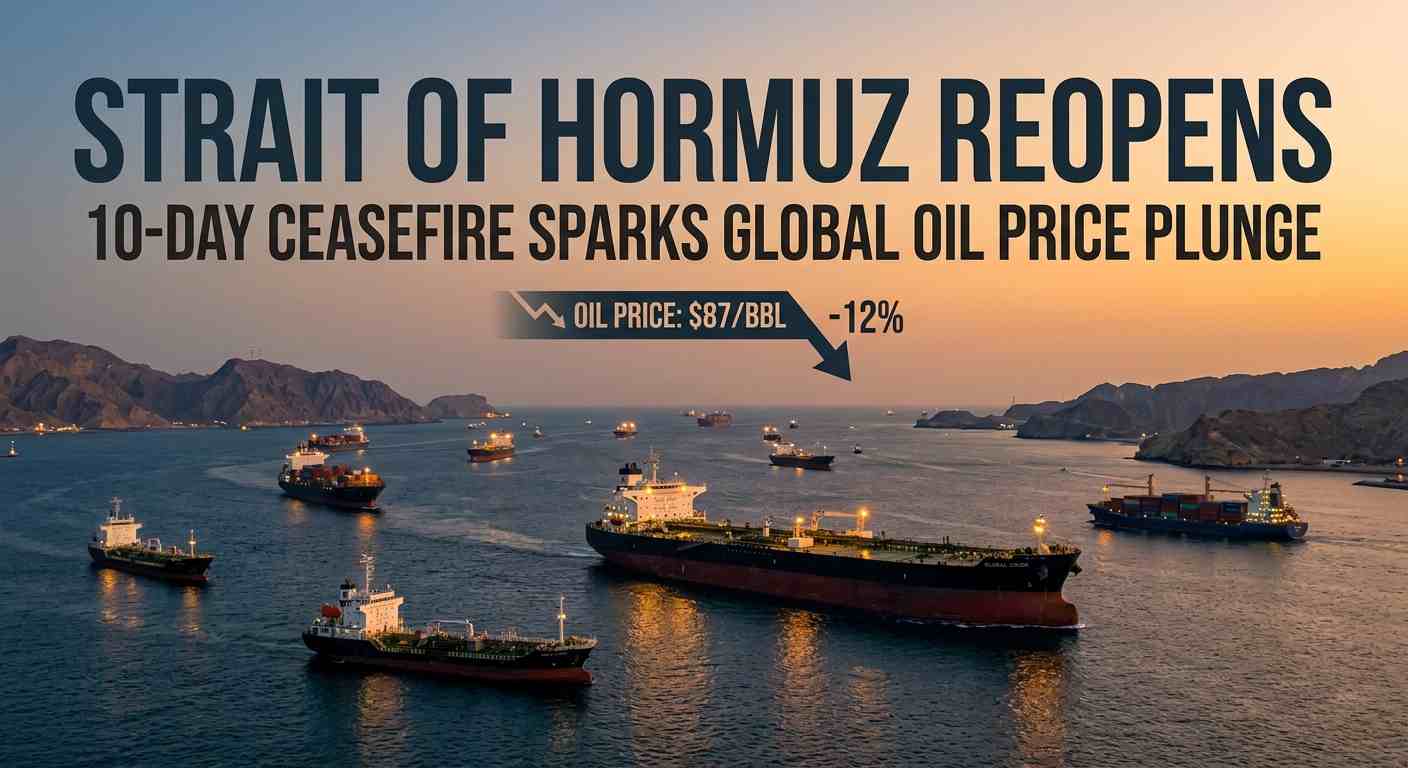
The world breathed a collective sigh of relief this Friday as the Strait of Hormuz, the planet’s most critical energy artery, was declared “completely open” for commercial transit. This seismic shift in Middle Eastern geopolitics follows a historic 10-day ceasefire brokered between Israel and Lebanon, a move many see as the first domino to fall in a broader peace transaction between Washington and Tehran.
Strait of Hormuz Reopens Great De-Escalation: Iran’s Strategic Pivot
In a post that immediately sent shockwaves through global commodity pits, Iranian Foreign Minister Abbas Araghchi announced that the passage is now clear for all commercial vessels. This marks a dramatic pause in what has been described as a “chokehold” on the waterway since hostilities escalated seven weeks ago.
According to Araghchi, the opening is strictly tied to the duration of the Lebanon ceasefire. Ships are instructed to follow a “coordinated route” managed by the Ports and Maritime Organisation of Iran. For weeks, the strait had been nicknamed the “Tehran Tollbooth,” with reports suggesting a staggering $2 million fee was being leveraged for safe passage. While it remains unclear if these fees are being waived, the sheer psychological impact of the opening has already done its work on the markets.
Trump’s “Art of the Deal” in the Middle East
U.S. President Donald Trump was quick to confirm the development, thanking Iran on social media while maintaining a characteristic tone of “maximum pressure.” While he celebrated the opening of the “Strait of Iran,” he was careful to clarify that the U.S. naval blockade remains in full force.
“The naval blockade will continue until the ‘transaction’ with Iran is complete,” Trump stated, signaling that this opening is a trial period rather than a permanent resolution.
The President’s optimism stems from what he calls “excellent” negotiations with Israeli Prime Minister Benjamin Netanyahu and Lebanese President Joseph Aoun. With a meeting scheduled at the White House within the next five days, the goal is clear: leverage the Lebanon truce into a comprehensive regional settlement.
Market Reaction: Crude Tumbles as Certainty Returns
The economic impact of the announcement was instantaneous and brutal for energy bulls. Brent crude plummeted 12%, settling around $87 a barrel. While this is still a far cry from the pre-war stability of $72, it is a massive correction from the $119 peak seen just last month.
| Market Index | Movement | Reason |
| Brent Crude | -12% | Reopening of the Strait of Hormuz |
| European Gas | -8.5% | Hopes of diplomatic resolution |
| DAX (Germany) | +2% | Reduced energy cost fears |
| FTSE 100 | +0.6% | Gains muted by BP/Shell losses |
While stock markets in New York and Europe rallied, energy giants like BP and Shell saw their share prices dip by over 5%, reflecting the sudden surplus of optimism—and eventually, oil—expected to hit the docks.
The Logistical Nightmare: 800 Ships in Limbo
Opening the gates is one thing; moving the traffic is another. Currently, an estimated 800 tankers are idling in the Gulf, with approximately 300 carrying high-value oil and gas loads. Before the crisis, the strait handled over 130 ships a day. Under the threat of the Revolutionary Guards, that flow had slowed to a mere trickle.
Shipping companies now face a harrowing dilemma. Do they trust the 10-day window?
Risk of Resumption: If the ceasefire fails, ships mid-transit could become targets.
Insurance Premiums: Maritime insurance remains at record highs despite the “open” status.
Logistical Bottlenecks: Coordinating 800 vessels through a narrow, “coordinated route” will require more than just a 10-day window.
International Skepticism: UK and France Demand More
In London and Paris, the mood is one of “cautious welcome.” UK Prime Minister Keir Starmer and French President Emmanuel Macron issued a joint sentiment: the reopening must be permanent and unconditional.
The two leaders are moving forward with plans for an international maritime security mission. Military planners are set to meet in London next week to ensure that regardless of the “transaction” between Trump and Tehran, the global economy isn’t held hostage by a single geographic chokepoint again.
Looking Ahead: The 10-Day Clock is Ticking
The world now watches the “10-day ceasefire” with bated breath. This isn’t just about a border dispute in Lebanon; it’s a litmus test for the global energy supply chain. If the “transaction” Trump alluded to falls through, the $2 million tollbooth could return, and oil prices could skyrocket once more. For now, the “Tehran Tollbooth” is open for business, and the world’s tankers are finally starting their engines.
FAQ: Everything You Need to Know About the Hormuz Reopening
1. Why is the Strait of Hormuz so important?
It is the world’s most important oil transit chokepoint. About 20-30% of the world’s total oil consumption passes through this narrow stretch of water daily.
2. Is the U.S. blockade over?
No. President Trump has explicitly stated that the U.S. naval blockade will remain in place until a final deal (the “transaction”) with Iran is signed.
3. Will gas prices go down immediately?
Wholesale gas and oil prices have already dropped by 8-12%. While it takes time for this to trickle down to the pump, the trend is finally moving in favor of the consumer.
4. What happens after the 10 days?
If a broader deal is not reached between the U.S., Israel, and Iran, there is a significant risk that the strait could be closed again, potentially causing a new spike in energy prices.