
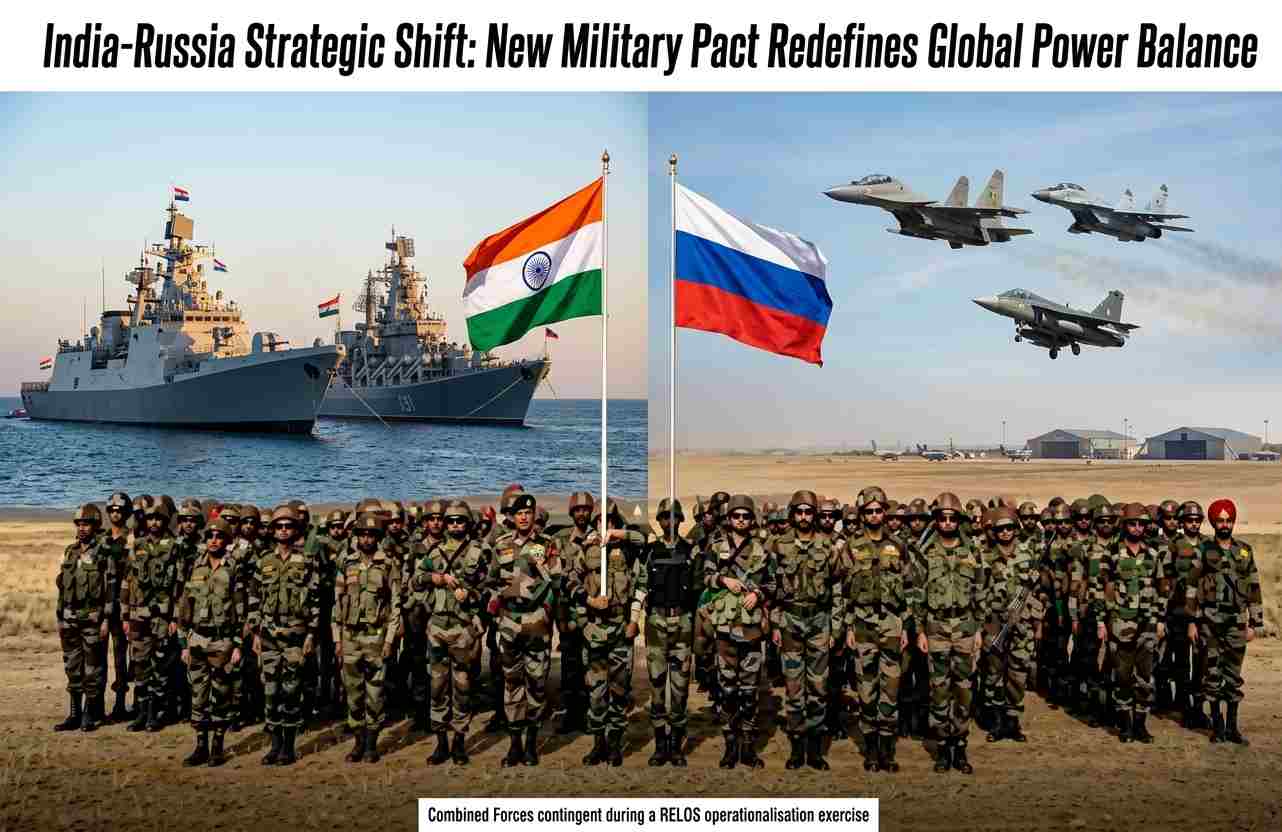
India-Russia Strategic Shift: The geopolitical chessboard is witnessing a monumental shift as New Delhi and Moscow formalize a groundbreaking defense partnership. The recently ratified India-Russia defense pact is not just another diplomatic handshake; it is a robust logistical framework that allows both nations to station troops, warships, and aircraft on each other’s soil.
Coming at a time of intense global polarization, this agreement—officially known as the Reciprocal Exchange of Logistics Agreement (RELOS)—marks a high-water mark in the “Special and Privileged Strategic Partnership” between the two nations.
India-Russia Strategic Shift : The Blueprint for Mutual Military Access
At its core, the RELOS(Reciprocal Exchange of Logistics Agreement) pact is designed to streamline the logistical hurdles that often complicate long-range military operations. By providing a legal and operational framework for mutual access to military facilities, India and Russia are effectively extending their strategic reach across the Indian Ocean and the Arctic.
According to details released via Russia’s official legal information portal and confirmed by Vyacheslav Nikonov, the First Deputy Chairman of the International Affairs Committee, the specifics of the deal are unprecedented:
Troop Presence: Up to 3,000 troops can be simultaneously stationed in the partner country.
Naval Assets: Permission for up to five warships to be docked at mutual ports.
Aerial Support: A fleet of ten military aircraft allowed at designated airbases.
Timeline: The agreement is set for an initial five-year duration, with an automatic provision for extension if both parties agree.
India-Russia Strategic Shift Breaking Down the Logistical Advantages
This isn’t just about “parking” military hardware; it’s about deep integration. The pact covers everything from the mundane to the mission-critical.
For the Indian Navy and Russian Fleet
The agreement ensures that warships receive comprehensive port services. This includes repair facilities, refueling, and the delivery of essential supplies like water, food, and technical resources. For India, this could mean easier access to Russian ports in the Northern Sea Route, while Russia gains a more permanent logistical footprint in the warm waters of the Indian Ocean.
For Military Aviation
The deal moves beyond simple landing rights. It encompasses:
Air Traffic Control (ATC): Seamless coordination between Indian and Russian flight controllers.
Aeronautical Data: Exchange of vital navigation and mapping information.
Flight Processing: Expedited handling of flight requests, ensuring that military missions—whether for training or humanitarian aid—aren’t bogged down by red tape.
The Timing: A Bold Statement Amid Global Conflict
The operationalization of this pact in 2025/2026 is particularly noteworthy. With Russia remaining deeply involved in the Ukraine conflict and India navigating its complex “multi-alignment” foreign policy, this deal sends a clear message to the West and regional rivals.
While India has signed similar logistics agreements with the United States (LEMOA), Japan, and Australia, the RELOS pact with Russia is distinct due to the sheer volume of personnel and assets involved. It reaffirms that despite pressure from the G7, New Delhi views Moscow as a foundational pillar of its national security architecture.
Beyond Logistics: Training and Humanitarian Missions
The scope of the deal extends into the “soft power” side of military cooperation. Both nations have committed to:
Joint Exercises: Increasing the complexity and frequency of the Indra series of war games.
Technical Training: Enhancing the skill sets of personnel on specialized Russian-made equipment used by the Indian Armed Forces.
Humanitarian Assistance and Disaster Relief (HADR): Coordinating responses to natural disasters in Eurasia and the Indo-Pacific.
“This pact reaffirms the mutual commitment to strengthen long-term military cooperation and enable longer deployments, providing a level of stability in an increasingly volatile global landscape.”
Why This Matters for the Future
As the world pivots toward a multipolar order, the India-Russia defense pact acts as a stabilizer. For India, it ensures that its largest supplier of military hardware remains a close logistical ally. For Russia, it secures a strategic partnership with the world’s most populous nation and a rising economic powerhouse.
The ability to station 3,000 troops and heavy naval assets is a game-changing development. It transforms the relationship from a “buyer-seller” dynamic into a genuine “operational-partnership.”
Conclusion The RELOS agreement is more than just paper and ink; it is a roadmap for the next decade of Eurasian security. As these two giants open their bases to one another, the ripples will be felt from the Baltic to the Bay of Bengal.