
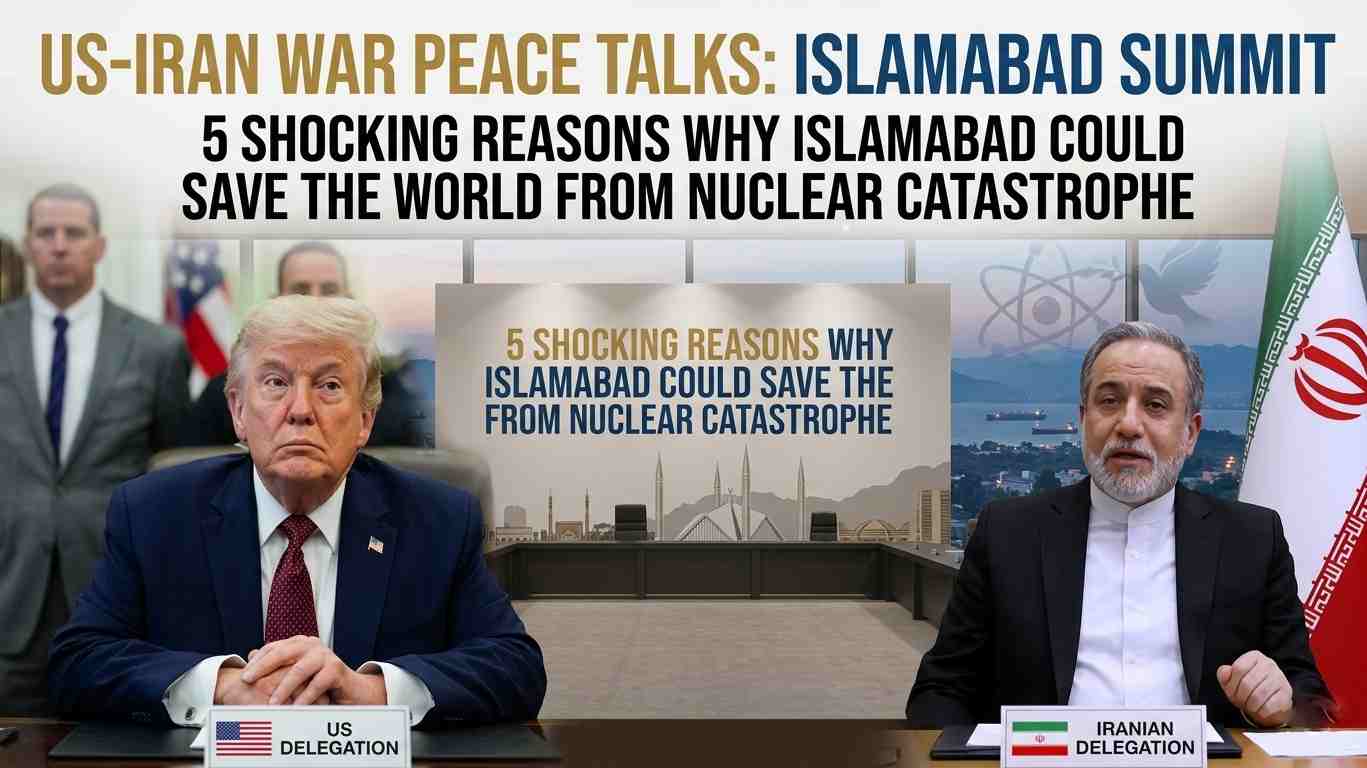
US-Iran War Peace Talks: The world holds its breath as the US-Iran War enters a pivotal, heart-stopping phase. In a move that has stunned global markets and sent diplomatic circles into a frenzy, US President Donald Trump has announced that a high-level US delegation will visit Islamabad this Monday. The mission? To engage in high-stakes peace talks with Tehran’s representatives in a desperate bid to prevent a regional skirmish from spiraling into a full-blown global disaster.
As the war enters its eighth week, the human and economic toll has become unbearable. With the Strait of Hormuz—the world’s most vital energy artery—effectively turned into a combat zone, the stakes have never been higher.
US-Iran War Peace Talks in Islamabad Summit: A Last-Ditch Effort for Peace
Pakistan has emerged as the unlikely but essential bridge between two sworn enemies. Islamabad is preparing for the arrival of a delegation led by Vice President JD Vance and top State Department officials. They are expected to meet with Iran’s top negotiator, Mohammad Baqer Qalibaf, who recently signaled that while “progress has been made,” a massive “gaps remain” over nuclear sovereignty and the management of the Strait.
For Trump, this isn’t just about foreign policy; it’s about stabilizing a global economy that is reeling from the highest oil prices in a decade.
“We are having very good conversations with Tehran,” Trump told reporters at the White House. “But let me be clear: we will not succumb to blackmail over the shipping channels. Either we find a deal that protects the world’s energy, or the pressure stays on.”
Why the Strait of Hormuz is the Ultimate Dealbreaker
The closure of the Strait of Hormuz has been the single most devastating weapon in this eight-week conflict. Before the war, this narrow waterway carried 20% of the world’s oil. Today, it is a graveyard of scorched tankers and naval blockades.
Iran’s Revolutionary Guard (IRGC) recently reimposed a strict closure, claiming that as long as the US blockade of Iranian ports continues, no ship—commercial or otherwise—will pass without “permission.”
The Iranian Stance: Qalibaf maintains that Iran has the “legal right” to charge tolls and regulate the passage as a matter of national security.
The US Stance: Washington views the waterway as international territory and has deployed CENTCOM minesweepers to begin clearing the path, a move Iran views as a direct act of war.
The Looming Shadow of the Nuclear Gaps
Beyond the water, the nuclear issue remains the “invisible wall” in these negotiations. Sources close to the talks suggest that the US is demanding the complete transfer of Iran’s enriched uranium to a third-party country (likely the US or a neutral European hub).
Tehran has flatly rejected this, calling it a “surrender of sovereignty.” Qalibaf’s rhetoric remains defiant: “If the American side is ready for a genuine agreement that grants the rights of the Iranian nation, we are ready. If they want a show, they will find us prepared to defend ourselves.”
A Fragile Ceasefire on Life Support
The upcoming Islamabad talks are happening against the backdrop of a fragile ceasefire set to expire within days. This temporary truce, mediated by Pakistan and Turkey, has barely held.
In the last 24 hours alone, reports of skirmishes between the IDF and Hezbollah in Lebanon—a key Iranian proxy—have threatened to pull the US back into the “hot” phase of the war. For the thousands of civilians caught in the crossfire and the millions more facing an energy-starved winter, the Monday meeting in Islamabad isn’t just a news headline—it’s a lifeline.
What Happens if the Talks Fail?
If the US delegation returns from Islamabad empty-handed, the consequences are predictable and terrifying:
Oil Prices Could Double: Analysts predict a spike to $200 per barrel if the Strait remains closed through May.
Extended Blockade: Trump has threatened to expand the blockade to “global proportions,” targeting any ship carrying Iranian oil anywhere in the world.
Resumption of Air Strikes: The US and Israel have already signaled they have a list of secondary targets, including Iranian energy infrastructure, ready for engagement the moment the ceasefire expires.
The Human Cost of Eight Weeks of War
While the world talks about “barrels” and “blockades,” the ground reality in the region is grim. State-run agencies in Tehran report over 3,400 deaths, many of them civilians caught in the initial waves of precision strikes. The economic infrastructure of Iran is buckling under the weight of the “Maximum Pressure 2.0” campaign, leading to widespread domestic unrest.
As the US delegation touches down in Pakistan, the message from the international community is clear: The time for “getting cute” is over. The time for peace is now.
Stay Updated with Our Live Blog
We will be providing minute-by-minute updates on the Islamabad summit starting Monday morning.
09:00 AM: Expected arrival of the US delegation at Nur Khan Airbase.
12:00 PM: Initial meetings with Pakistani PM Shehbaz Sharif.
03:00 PM: Face-to-face negotiations with the Iranian delegation.