
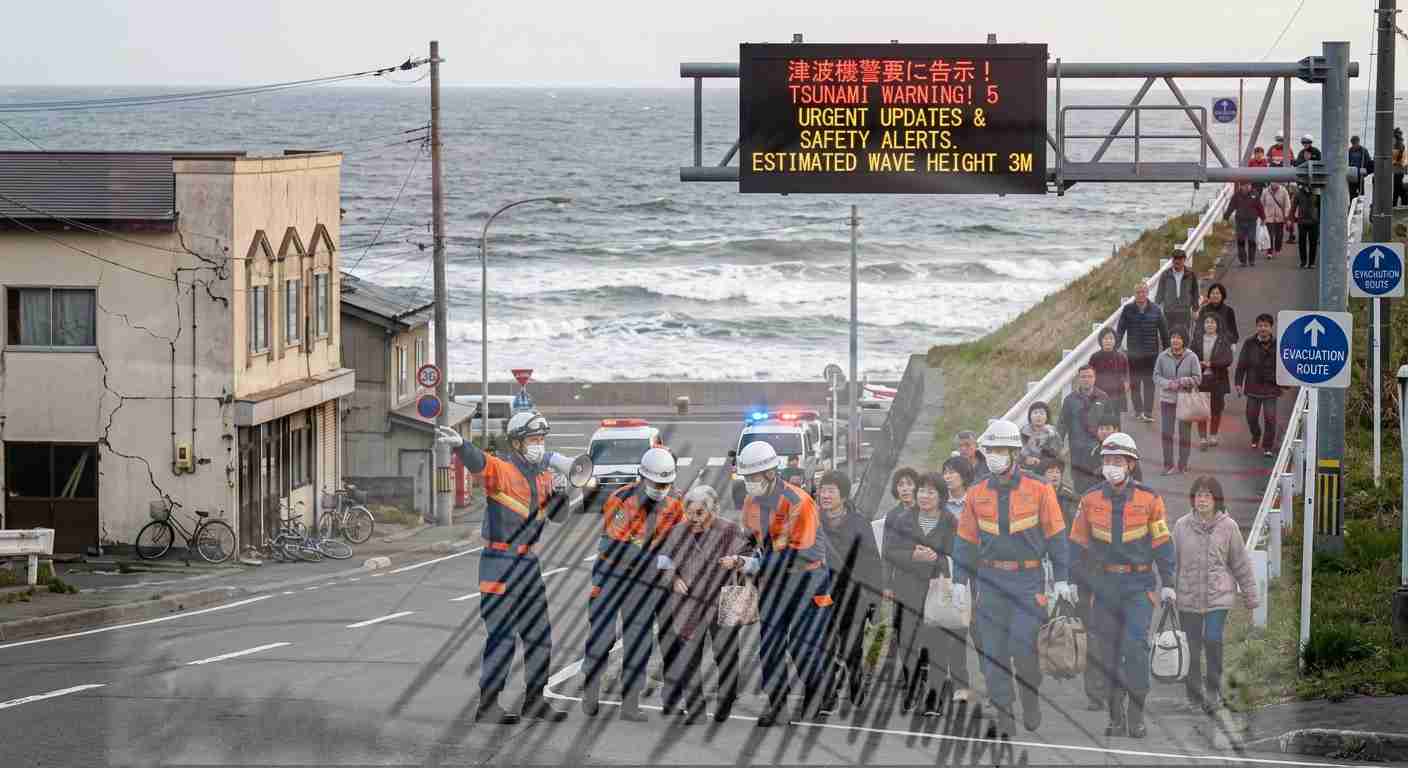
The Earthquake Crisis in Japan : The ground beneath northern Japan was shaken with terrifying intensity this Monday as a 7.4-magnitude earthquake struck off the coast of Iwate Prefecture. In a country that lives in the shadow of seismic giants, this latest tremor has triggered a national emergency, with Japan’s Meteorological Agency (JMA) issuing a life-saving tsunami warning for waves up to three meters (10 feet).
As the first surges begin to reach the shore, the message from authorities is blunt and unwavering: “Do not leave safe ground.”
The Moment the Earth Moved: 4:53 PM
The peace of a Monday afternoon was shattered at exactly 4:53 pm (0753 GMT) when the massive quake struck in the Pacific waters. The energy released was enough to sway skyscrapers in Tokyo, hundreds of kilometers to the south. Residents in the capital reported the distinct, sickening roll of a long-period earthquake, a reminder of the sheer power sitting just off the archipelago’s coast.
Within 40 minutes of the initial jolt, the sea began its dangerous advance. An 80-centimeter (31-inch) tsunami wave was officially recorded hitting the port of Kuji in Iwate. While 80 centimeters might sound manageable to the uninitiated, in the world of tsunami physics, a surge of that height carries enough force to sweep away vehicles and destroy coastal structures.
Government in Crisis Mode: Prime Minister Takaichi Speaks
Prime Minister Sanae Takaichi has moved with military precision, establishing a crisis management team within minutes of the first alert. Addressing the nation via televised broadcast, Takaichi urged citizens to prioritize their lives over their belongings.
“For those of you who live in areas for which the warnings have been issued, please evacuate to higher, safer places,” the Prime Minister stated.
The government is currently working around the clock to confirm reports of casualties or property damage. While NHK (Japan’s national broadcaster) footage currently shows several ports remaining structurally intact, the JMA warned that tsunami waves are “repetitive” and often grow in size after the initial impact.
The Earthquake Crisis in Japan – An Assessment of the Seismic Situation: Why is Japan the World’s Seismic Hub?
Japan is a marvel of modern engineering, but it is built on one of the most unstable geological foundations on Earth. The country sits at the intersection of four major tectonic plates along the western edge of the “Ring of Fire.”
| Statistic | Details |
| Annual Tremors | Approximately 1,500 jolts |
| Global Seismic Share | 18% of the world’s major earthquakes |
| Population | 125 Million people living in high-risk zones |
| Active Plates | Pacific, Philippine Sea, Eurasian, and North American |
The Shadows of the Past: From 2011 to 2024
For the people of Iwate, this 7.4-magnitude quake is not just a news headline; it is a trigger for deep-seated trauma. The region is still recovering from the 9.0-magnitude Great East Japan Earthquake of 2011, which triggered a tsunami that claimed 18,500 lives and caused the Fukushima nuclear meltdown.
More recently, the nation has been on high alert following the 2024 “megaquake” advisory related to the Nankai Trough. This 800-kilometer undersea trench is a ticking time bomb where the Philippine Sea plate is subducting under the continental plate. Experts suggest a full-scale Nankai quake could result in 298,000 deaths and $2 trillion in damages.
The Physics of the 7.4 Magnitude Event
The severity of today’s quake stems from its location in the Pacific waters. When a fault ruptures under the ocean, it displaces a massive column of water. Unlike a standard wind wave, a tsunami behaves more like a rising wall of water that does not “break” but continues to push inland.
Using the energy-magnitude formula above, where $M$ is the magnitude, we can see that a 7.4-magnitude event releases an astronomical amount of energy compared to the smaller tremors Japan feels daily.
5 Critical Steps for Survival During a Tsunami Warning
Authorities have reiterated that the window for survival is measured in minutes. If you are in a warning zone:
Head for High Ground Immediately: Do not wait for a visual confirmation of the wave.
Avoid Riverside Areas: Tsunami waves can travel up rivers faster than they move across land, flooding areas miles away from the coast.
Stay Away from the Coast: Never go down to the beach to “watch” the wave. If you can see it, you are already too close.
Listen to Official Channels: Rely on JMA and NHK updates. Do not trust unverified social media rumors.
Stay Put: A tsunami warning is not over after the first wave. The danger can last for hours or even days.
A Nation Built on Resilience
Despite the looming threats, Japan remains the world leader in disaster mitigation. From its “Megaquake” advisories in December 2025 to the rigorous building codes that keep Tokyo’s towers standing, the country is a testament to human preparation.
However, as the Prime Minister’s office continues to monitor the situation in Iwate, the world watches with bated breath. The next few hours will be critical in determining the full extent of the damage. For now, the priority is simple: Stay high, stay safe, and wait for the signal.