
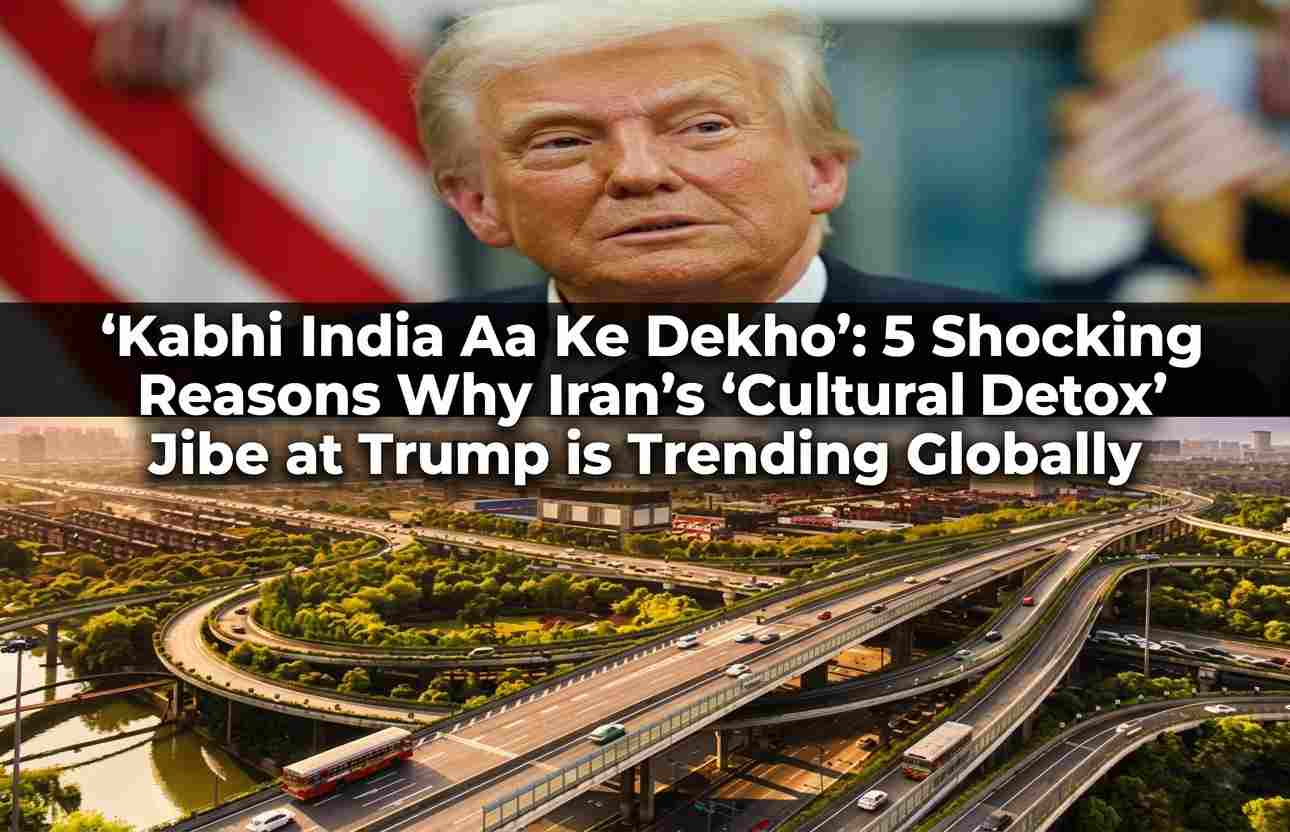
Iran’s “Cultural Detox” Jibe at Trump : The diplomatic corridors between New Delhi, Washington, and Tehran are currently witnessing a firestorm of rhetoric that has set social media ablaze. What started as a repost by U.S. President Donald Trump has escalated into a full-blown international “slugfest,” with Iran’s Consulate in Mumbai delivering a stinging, viral retort. If you’ve seen the phrase “Kabhi India Aa Ke Dekho” trending on your feed, here is the deep dive into the controversy that is redefining geopolitical banter in 2026.
The Spark: A “Hell-Hole” Remark and the Birthright Row
The controversy erupted when President Donald Trump shared a transcript and podcast link from conservative commentator Michael Savage. The content was a blistering critique of U.S. birthright citizenship laws, but it was the choice of words that sent shockwaves through the Asian continent.
In the shared transcript, Savage referred to India and China as “hell-holes,” alleging that immigrants from these nations utilize “birth tourism” to secure instant U.S. citizenship for their children. The rant didn’t stop there; it described Indian and Chinese immigrants as “gangsters with laptops” and questioned their loyalty to the United States.
For a leader who has often touted his “great chemistry” with Indian leadership, the endorsement of such derogatory language was seen by many as a massive diplomatic faux pas.
Iran’s “Cultural Detox” Jibe at Trump: Viral “Cultural Detox” Prescription
In an unexpected twist, the Iranian Consulate General in Mumbai jumped into the fray, utilizing the power of social media to “troll” the U.S. President. Taking to X (formerly Twitter), the consulate shared a high-definition video showcasing the dual soul of Maharashtra—from the high-octane infrastructure of Mumbai’s highways to the serene, misty mountains of the Western Ghats.
The caption was nothing short of legendary:
“Maybe someone should book a one-way cultural detox for Mr. Trump, it might just reduce the random bakwaas [nonsense]. Kabhi India aa ke dekho, phir bolna (Come to India and see for yourself before you speak).”
The Hyderabad consulate of Iran joined in as well, reminding the world that India and China are “cradles of civilization,” while suggesting that the true “hellhole” is where leaders threaten to decimate entire cultures.
India’s Official Response: “Uninformed and In Poor Taste”
New Delhi did not take the “hell-hole” comment lightly. The Ministry of External Affairs (MEA), represented by spokesperson Randhir Jaiswal, issued a firm rebuttal. While the statement avoided naming Trump directly, it pulled no punches.
The Critique: The MEA labeled the remarks as “uninformed, inappropriate, and in poor taste.”
The Relationship: Officials emphasized that the India-U.S. partnership is built on “mutual respect,” a sentiment that these remarks clearly contradicted.
The Domestic Heat: Back home, the opposition Congress party urged Prime Minister Narendra Modi to register a formal, strong objection, calling the statement “extremely insulting to every Indian.”
The 180-Degree Turn: Trump’s Damage Control
Recognizing the potential fallout in a critical election year and the strategic importance of the Quad alliance, the U.S. Embassy in New Delhi quickly shifted into damage-control mode.
Christopher Elms, spokesperson for the US Embassy, relayed a direct clarification from the President:
“India is a great country with a very good friend of mine at the top.”
This pivot was clearly aimed at soothing ruffled feathers in New Delhi, but for many, the “gangsters with laptops” remark remains a bitter pill to swallow.
Statistical Deep Dive: The Reality of Indian Immigrants in the USA
To understand why the “hell-hole” and “loyalty” remarks have caused such outrage, one must look at the actual data. The narrative of “unproductive immigrants” falls apart when faced with the economic reality of the Indian diaspora in 2026.
1. Economic Contribution
Indian-Americans make up roughly 1.5% of the U.S. population but contribute approximately 6% of all personal income taxes. This group has the highest median household income of any ethnic group in the United States, hovering around $150,000 annually.
2. The “Laptop” Workforce
While the term “gangsters with laptops” was meant as an insult, the “laptop” part is statistically accurate in a positive sense. Indian immigrants lead the way in STEM (Science, Technology, Engineering, and Math) fields.
CEOs: Over 15% of Silicon Valley startups were founded by Indians.
Healthcare: 1 in every 7 doctors in the U.S. is of Indian descent.
3. Birthright Citizenship Trends
Contrary to the “ninth-month” narrative, data from the Pew Research Center indicates that unauthorized immigration and “birth tourism” from India have seen a statistical plateau as legal professional visa pathways (H1-B) remain the primary route for Indian nationals.
| Metric | Indian Diaspora | General U.S. Avg |
| Median Household Income | ~$150,000 | ~$75,000 |
| Bachelor’s Degree or Higher | 79% | 34% |
| Poverty Rate | 6% | 13% |
Why Iran’s Intervention Matters
Iran’s decision to defend India is more than just “internet trolling.” It reflects a shifting geopolitical landscape where:
Regional Solidarity: Middle Eastern and Asian nations are increasingly calling out “Western-centric” rhetoric.
Soft Power: By using Hindi phrases like “Bakwaas” and “Kabhi India aa ke dekho,” Iran is attempting to build a rapport with the Indian public.
Counter-Narrative: It highlights the “Cultural Detox” as a necessary tool for leaders who view the Global South through an antiquated, derogatory lens.
Conclusion: The Need for “Cultural Detox” in Diplomacy
Whether you view Trump’s repost as a deliberate political statement or a careless share, the fallout is real. Iran’s invitation for a “Cultural Detox” serves as a reminder that in 2026, no country—regardless of its economic or military might—is immune to the scrutiny of the global digital public.
India is no longer a country that simply listens; it is a nation that, as the consulate suggested, invites the world to “Come and see” before they judge. As the dust settles on this diplomatic spat, the lesson remains: in the age of viral tweets, “random bakwaas” has high-stakes consequences.
Stay tuned to our blog for more updates on the India-US relationship, automotive trends, and global news curation.