
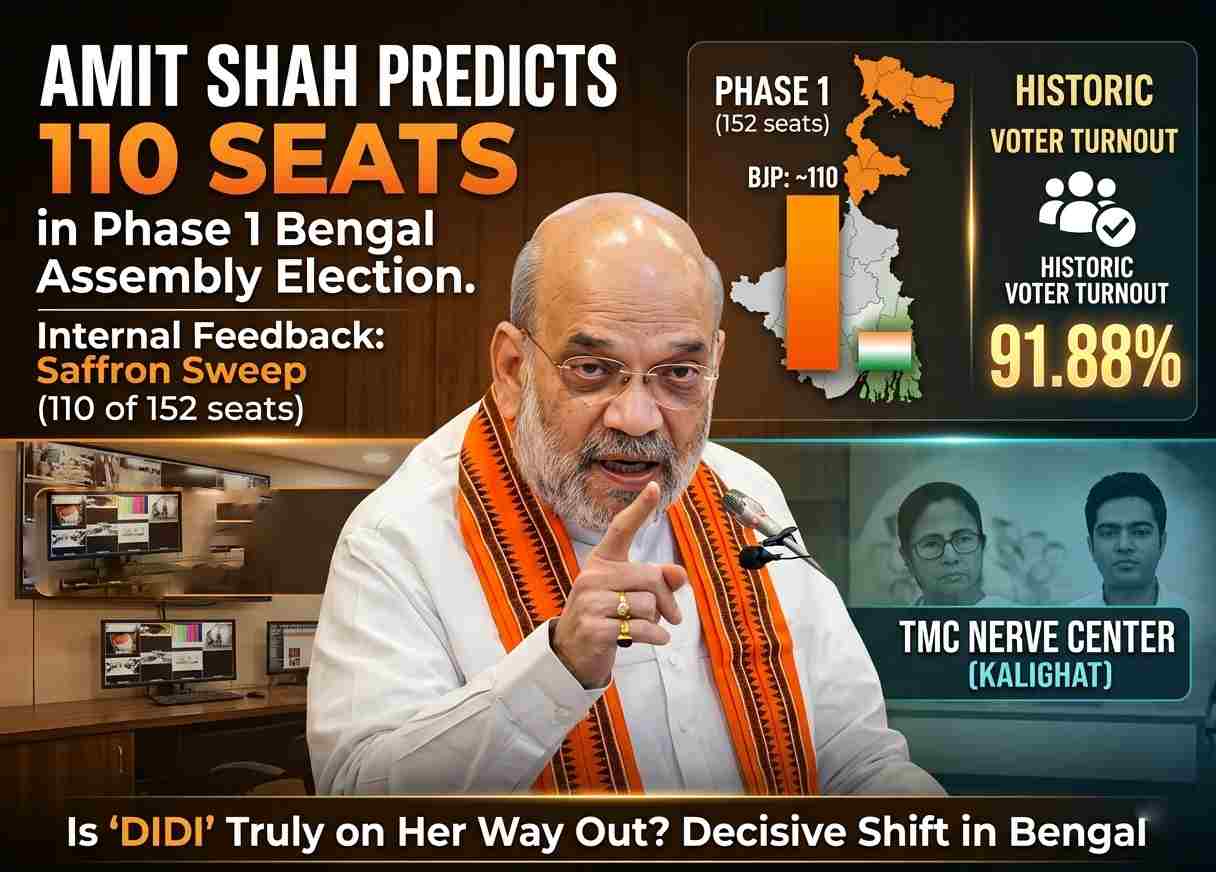
Amit Shah Press Conference the air in West Bengal is thick with political tension, and if the latest claims from the Union Home Ministry are any indication, the winds of change are blowing at gale force. On Friday, April 24, 2026, a visibly confident Amit Shah addressed a packed press conference in Kolkata, delivering a bold prediction that has sent shockwaves through the Trinamool Congress (TMC) camp.
Following a historic voter turnout in the first phase of the Assembly elections, Shah asserted that the Bharatiya Janata Party (BJP) is not just winning, but is poised to sweep 110 of the 152 seats that went to the polls on April 23.
Amit Shah Press Conference:A Historic Turnout The Numbers Behind the Noise
The first phase of the 2026 West Bengal Assembly Election will likely go down in history books for one primary reason: the sheer volume of voters. Recording a staggering 91.88% turnout—the highest since India’s independence—the enthusiasm at the booths was undeniable.
For Amit Shah, these numbers aren’t just statistics; they are a mandate. “The high voter turnout clearly says that Didi is on her way out,” Shah stated, using the popular moniker for Chief Minister Mamata Banerjee. He argued that when people turn out in such massive numbers, it typically signals a deep-seated desire for a change in administration rather than a vote for the status quo.
“Based on the feedback we have received, the people of Bengal have decided their future in the first phase itself. This land has chosen development under the leadership of Narendra Modi,” Shah added.
The Battle of the War Rooms: Salt Lake vs. Kalighat
While voters were lining up in the sun, the real battle was being fought in two high-tech “war rooms” separated by just a few miles of Kolkata traffic.
The BJP Command Center (Salt Lake): Union Home Minister Amit Shah personally took the reins at the Salt Lake office. Surrounded by senior leaders like Bhupender Yadav, Shah operated a data-driven, centralized command. Every percentage point of voter turnout and every booth-level report was analyzed in real-time. The focus remained heavily on North Bengal, a region the BJP considers its strongest fortress in the quest to conquer the state.
The TMC Nerve Center (Kalighat): In the heart of the city, Mamata Banerjee and her nephew, Abhishek Banerjee, steered the Trinamool ship. Their strategy relied on a decentralized but fiercely loyal grassroots network. For the TMC, the day was about “guarding the turf.” Mamata remained vigilant against any potential EVM glitches or “outsider” interference, a recurring theme in her campaign speeches.
The contrast was stark: one side using corporate-style data analytics, the other relying on a battle-hardened network of local party workers.
“Anga, Banga, and Kalinga”: A Saffron Vision for East India
Perhaps the most provocative part of Shah’s address was his vision for the broader region. He predicted a “saffron sweep” that transcends the borders of West Bengal. By mentioning “Anga, Banga, and Kalinga”—the ancient names for regions encompassing modern-day Assam, Bengal, and Odisha—Shah signaled that the BJP expects to hold power across the entire eastern belt by May 5.
“After the 5th, ‘Anga, Banga and Kalinga’, all three places will be ruled by the BJP and lotus. This is a good sign for our entire East India,” he remarked. This statement serves as a morale booster for party workers not just in Bengal, but in neighboring states where the BJP is looking to consolidate its footprint.
The Promise of a “Son of the Soil”
One of Mamata Banerjee’s most potent campaign weapons has been the “outsider” (Bohiragoto) tag she frequently pins on the BJP leadership. Shah addressed this head-on during the press conference, attempting to dismantle the narrative once and for all.
He assured the electorate that if the BJP comes to power, the next Chief Minister will be:
Born and educated in Bengal.
Fluent in the Bengali language.
A dedicated BJP worker, not a product of dynasty.
“The only difference,” Shah quipped with a sharp jab at the TMC leadership, “is that her nephew will not be in power.”
The Definition of “Asol Poriborton” (Real Change)
What does a BJP-led Bengal look like according to the Home Minister? Shah outlined a vision centered on ending what he called a “reign of terror.” His checklist for change included:
An infiltration-free Bengal.
Freedom from corruption, appeasement, and extortion (often referred to as ‘syndicate raj’ in local parlance).
Priority on women’s safety and job opportunities for the youth.
Despite the optimism in the BJP camp, the day wasn’t without its shadows. Reports of sporadic clashes, intimidation, and even assaults on BJP candidates emerged from several pockets. This highlights the volatile nature of Bengal’s political landscape, where every inch of ground is fought for with intense passion.
What’s Next? The Road to May 4
With the first phase concluded and the BJP claiming a massive lead, all eyes now turn to the second phase on April 29.
If Shah’s internal assessments are even remotely accurate, the TMC faces an uphill battle to retain its majority. However, Mamata Banerjee is known for her tenacity and her ability to fight back from the brink. In the corridors of Kalighat, the mood remains defiant, with party insiders suggesting that the high turnout is actually a sign of the “silent majority” coming out to protect the daughter of Bengal.
The final verdict will be unveiled on May 4, when the boxes are opened and the fate of the “Sonar Bangla” dream is decided. For now, the BJP is riding high on confidence, while the TMC prepares to double down on its grassroots defense.
The question remains: Will the lotus bloom in the ponds of Bengal, or will Didi prove the pollsters wrong once again?