
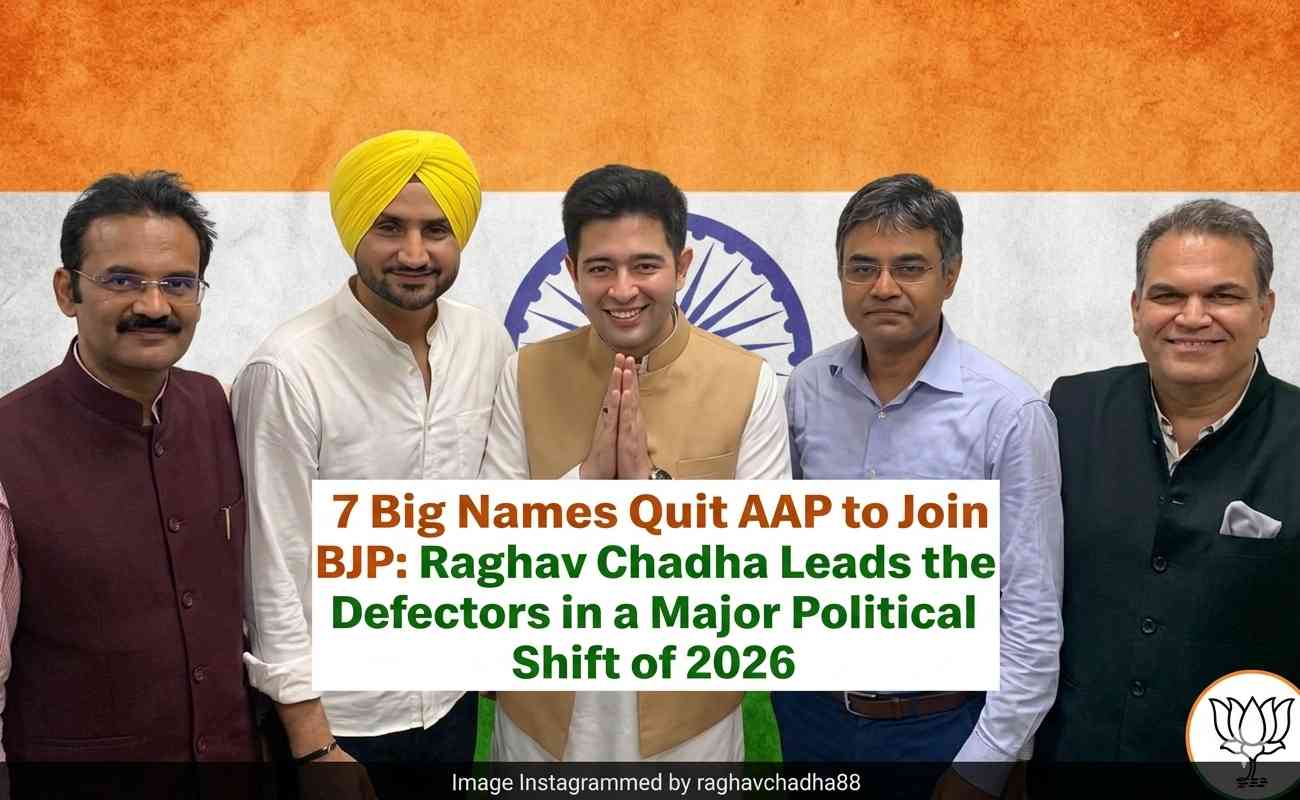
7 Big Names Quit AAP to Join BJP The Indian political landscape has been rocked by a seismic shift that few saw coming with such clinical precision. In a move that feels like a high-stakes political thriller, Raghav Chadha, once the poster boy and the articulate face of the Aam Aadmi Party (AAP), has officially jumped ship to the Bharatiya Janata Party (BJP).
But he didn’t go alone. In what can only be described as a surgical strike on AAP’s parliamentary strength, Chadha has led a pack of seven Rajya Sabha MPs into the saffron fold, effectively invoking constitutional merger clauses to bypass the dreaded anti-defection law.
7 Big Names Quit AAP to Join BJP:How the “Two-Thirds” Rule Changed Everything
Political defections in India are usually messy affairs involving lone wolves losing their seats. However, Chadha—a seasoned chartered accountant with a sharp legal mind—played this by the book. Under the Tenth Schedule of the Constitution, a member of a House is protected from disqualification if their original political party merges with another, provided that at least two-thirds of the members of the legislative party agree to the merger.
With AAP holding 10 seats in the Rajya Sabha, the magic number was 7. By rallying Swati Maliwal, Harbhajan Singh, Sandeep Pathak, Ashok Mittal, Rajinder Gupta, and Vikram Sahney, Chadha reached that exact threshold.
“We have submitted a formal letter to Rajya Sabha Chairman C.P. Radhakrishnan,” Chadha told a packed room of reporters. “This is a legitimate constitutional merger. We are not just leaving a party; we are choosing a new direction for the nation.”
“Right Man in the Wrong Party“: Raghav Chadha’s Emotional Outburst
For years, Raghav Chadha was seen as Arvind Kejriwal’s closest confidant, the man who managed the Punjab elections and represented the party’s sophisticated, urban appeal. Seeing him stand behind a BJP podium is a visual many voters are still struggling to process.
Chadha’s explanation was scathing. He claimed that the party he “nurtured with blood and sweat” for 15 years had become a shadow of its former self.
The Drift from Honesty: Chadha alleged that AAP has abandoned the “honest politics” born out of the Anna Hazare movement.
The Power Struggle: Insiders suggest the rift began weeks ago when Chadha was unceremoniously stripped of his role as Deputy Leader in the Rajya Sabha, replaced by Ashok Mittal (who, ironically, has joined him in defecting).
National Interest vs. Personal Gain: “I felt like the right man in the wrong party,” Chadha remarked. “The current leadership is working for personal benefits rather than the national interest.”
The Seven Who Shook the Boat
The list of defectors reads like a “Who’s Who” of AAP’s elite. The inclusion of Harbhajan Singh, the legendary cricketer, and Swati Maliwal, the former DCW chief who has recently had a very public and volatile fallout with the party leadership, adds significant weight to the move.
| MP Name | Background/Role |
| Raghav Chadha | Former Deputy Leader, Punjab strategist |
| Swati Maliwal | Former Delhi Commission for Women Chief |
| Harbhajan Singh | Former International Cricketer |
| Sandeep Pathak | AAP’s National General Secretary (Org) |
| Ashok Mittal | Chancellor of Lovely Professional University |
| Vikram Sahney | Entrepreneur and Philanthropist |
| Rajinder Gupta | Prominent Industrialist (Trident Group) |
AAP Hits Back: “Operation Lotus” and the Betrayal of Punjab
The Aam Aadmi Party isn’t taking the hit lying down. Senior leader Sanjay Singh held a fiery press conference shortly after the news broke, labeling the defectors as “traitors” to the people of Punjab.
“The BJP, under Modi and Shah, has launched yet another ‘Operation Lotus’,” Singh claimed. He argued that the BJP is terrified of the progress being made by the Bhagwant Mann government in Punjab—specifically in health and education—and is using “cheap politics” to destabilize them.
Singh’s message to the defectors was clear: “The people of Punjab will never forgive you.” He emphasized that the party gave these individuals everything—fame, power, and a seat in the Upper House—only for them to “flee into the lap of the BJP” when the going got tough.
What This Means for Arvind Kejriwal and the Future of AAP
This is, without a doubt, the biggest crisis AAP has faced since its inception in 2012.
Loss of Voice in Parliament: With only 3 MPs left (Sanjay Singh, ND Gupta, and Balbir Singh Seechewal), AAP’s ability to influence national discourse or block legislation in the Rajya Sabha has been decimated.
Punjab Governance: While the Punjab Assembly remains secure for now, the defection of key strategists like Sandeep Pathak and Raghav Chadha leaves a massive vacuum in the party’s administrative and organizational machinery.
Optics and Credibility: AAP’s core USP was its “identity” as an alternative to the two main poles of Indian politics. Seeing its top brass join the BJP damages the narrative of “Ek Kattar Imaandar Party” (A fiercely honest party).
The BJP’s Strategic Masterstroke
For the BJP, this is a massive win. Not only does it weaken a vocal critic in the Rajya Sabha, but it also gains faces that have significant appeal in Punjab and among the youth. By welcoming Chadha and Pathak, the BJP gains insiders who know AAP’s playbooks, their digital strategies, and their grassroots vulnerabilities.
Chadha has already begun echoing the BJP line, praising Prime Minister Narendra Modi for “strong decisions” on terrorism and the economy—decisions he claimed the previous leadership was too “hesitant” to take.
Conclusion: A New Chapter in Indian Politics
As Raghav Chadha, Sandeep Pathak, and Ashok Mittal prepare to meet BJP leadership to formalize their entry, the dust is far from settling. This move isn’t just about seven seats in the Rajya Sabha; it’s about the shifting soul of Indian politics.
Is this a case of ambitious leaders seeking a bigger platform, or is it a genuine disillusionment with the “Kejriwal model” of governance? Only the upcoming elections and the reaction of the voters in Delhi and Punjab will provide the final verdict.
One thing is certain: The political landscape of 2026 has just been rewritten.