
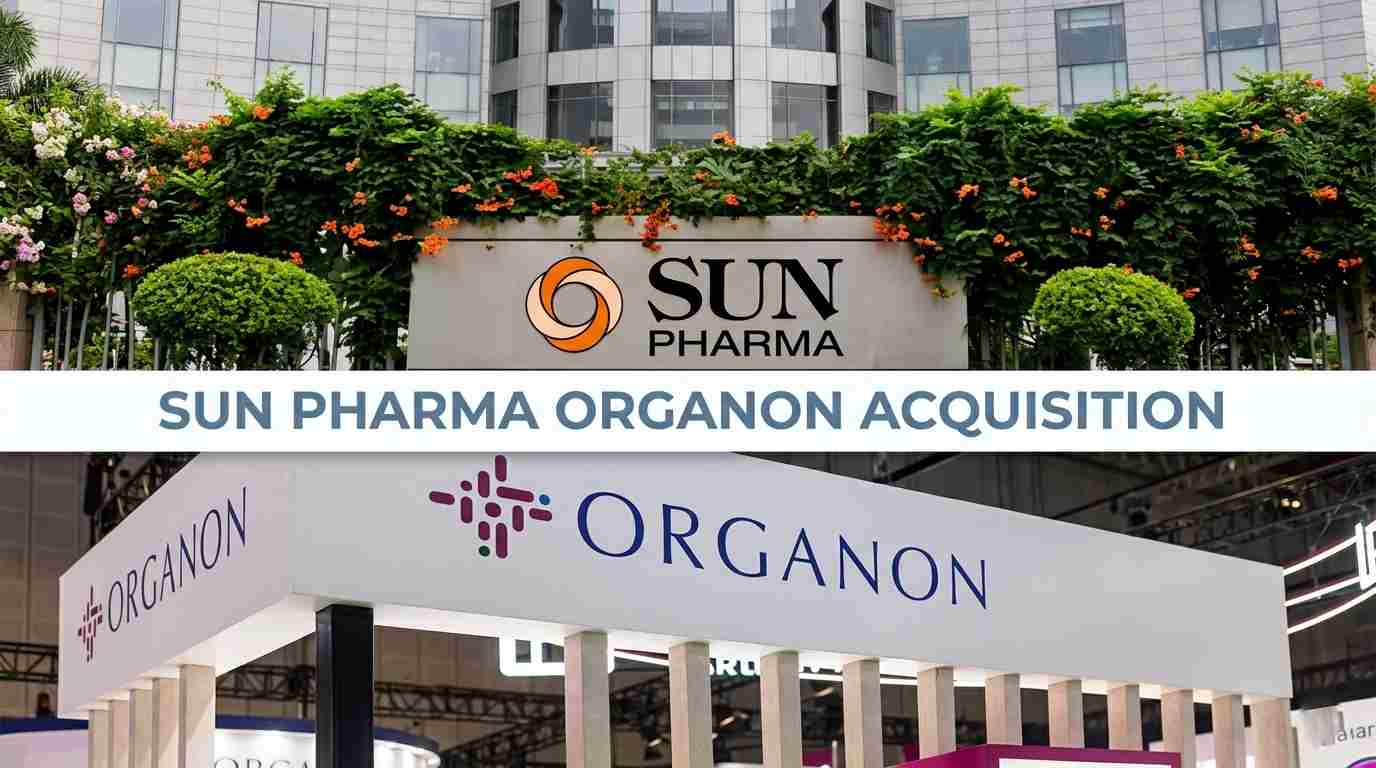
The global pharmaceutical landscape witnessed a tectonic shift this Monday as the Sun Pharma Organon acquisition was officially announced, sending ripples through both Dalal Street and Wall Street. In what is being hailed as the largest overseas buyout by an Indian pharmaceutical company to date, Sun Pharmaceutical Industries Ltd. has agreed to acquire the New Jersey-based Organon & Co. in an all-cash deal valued at a staggering $11.75 billion.
The market’s reaction was swift and celebratory. Shares of Sun Pharma surged by over 5.5%, hitting an intraday high of ₹1,709 on the NSE. This rally didn’t just make it the top gainer on the Nifty 50; it signaled a massive vote of confidence from investors who see this as a “logical next step” for a company that has long dominated the generics space but is now hungry for more.
The Anatomy of the $11.75 Billion Deal
At its core, the Sun Pharma Organon acquisition is a masterclass in strategic expansion. Under the terms of the agreement, Sun Pharma will buy all outstanding shares of Organon for $14.00 per share. While the equity value sits at approximately $3.99 billion, the total enterprise value reaches $11.75 billion when including Organon’s existing debt.
To fund this gargantuan purchase, Sun Pharma is dipping into its healthy cash reserves ($2-2.5 billion) while securing committed financing of nearly $9.75 billion from global banking giants like Citigroup, JPMorgan Chase, and MUFG Bank.
Key Deal Figures at a Glance
| Feature | Detail |
| Total Enterprise Value | $11.75 Billion |
| Offer Price per Share | $14.00 |
| Total Equity Value | Approx. $3.99 Billion |
| Combined Revenue Goal | $12.4 Billion |
| Global Rank (Projected) | Top 25 |
1. A Quantum Leap into Innovative Medicines
For years, Sun Pharma has been known as a “Generics Giant.” However, the Sun Pharma Organon acquisition is the definitive proof that the company is pivoting toward Innovative Medicines.
As defined by the European Medicines Agency, innovative medicines contain active substances never authorized before. Currently, Sun’s innovative portfolio is focused on dermatology, ophthalmology, and onco-dermatology. Before this deal, these high-margin products accounted for roughly 20% of Sun’s total sales. With Organon in the fold, that number is expected to jump to 27%, significantly boosting the company’s “topline” and profitability.
2. Dominating the Women’s Health and Biosimilars Niche
Organon was spun off from Merck (MSD) in 2021 with a very specific mission: to lead in Women’s Health. With a portfolio of over 70 products sold across 140 countries, Organon brings a ready-made global infrastructure to Sun Pharma.
By acquiring Organon, Sun Pharma isn’t just buying a company; it’s buying a leadership position in:
Reproductive Medicine: Cutting-edge solutions for fertility and contraception.
Biosimilars: Highly complex biological products that are essential for the future of affordable healthcare.
Established Brands: A steady stream of revenue from trusted names that already have high physician loyalty.
3. Cracking the Code of the U.S. Market
The U.S. has always been the “Holy Grail” for Indian pharma companies, but it is also a graveyard for those who cannot navigate its complex regulatory and insurance landscape. The Sun Pharma Organon acquisition provides Sun with six manufacturing facilities across the EU and other emerging markets, alongside a massive commercial footprint in the U.S., Europe, China, Canada, and Brazil.
Kirti Ganorkar, Managing Director at Sun Pharma, noted that the U.S. remains a key market. Organon’s existing relationships with stakeholders, hospitals, and pharmacies in America provide Sun Pharma with a “fast-track” to scaling its products without the usual growing pains of organic expansion.
The Financial Ripple Effect: What Investors Need to Know
While the stock jumped 5%, savvy investors are looking at the long-term debt profile. Sun Pharma management has been transparent about their plan to focus on debt repayment as quickly as possible.
The stock’s Relative Strength Index (RSI) currently sits above 80, which technically suggests the stock is “overbought.” However, in the context of such a transformative deal, traditional technical indicators often take a backseat to fundamental growth stories.
“This transaction offers compelling and immediate value to Organon stockholders,” said Carrie Cox, executive chair at Organon.
For Sun Pharma, the “value” isn’t just immediate; it’s generational. They are no longer just an Indian success story; they are a global powerhouse.
The Road Ahead: Integration and 2027 Projections
The acquisition is expected to wrap up in early 2027, pending regulatory approvals and Organon stockholder consent. The integration phase will be the true test for Dilip Shanghvi and his leadership team.
Merging two distinct corporate cultures—one rooted in Indian entrepreneurial agility and the other in a Merck-legacy American structure—is no small feat. However, Sun Pharma has a history of successful integrations, most notably its acquisition of Ranbaxy years ago.
Conclusion
The Sun Pharma Organon acquisition is more than just a line item on a balance sheet. It is a bold statement of intent. It tells the world that Indian pharma is ready to move beyond “copying” medicines to “creating” and “owning” them on a global scale.
As Sun Pharma climbs into the ranks of the Top 25 global pharma companies, it isn’t just raising its revenue to $12.4 billion—it’s raising the bar for the entire Indian industry. For the patient, this means better access to innovative treatments. For the investor, it means a seat at the table of a global healthcare leader.
Disclaimer: This blog post is for informational purposes only and does not constitute financial advice. Please consult with a certified financial advisor before making any investment decisions.