
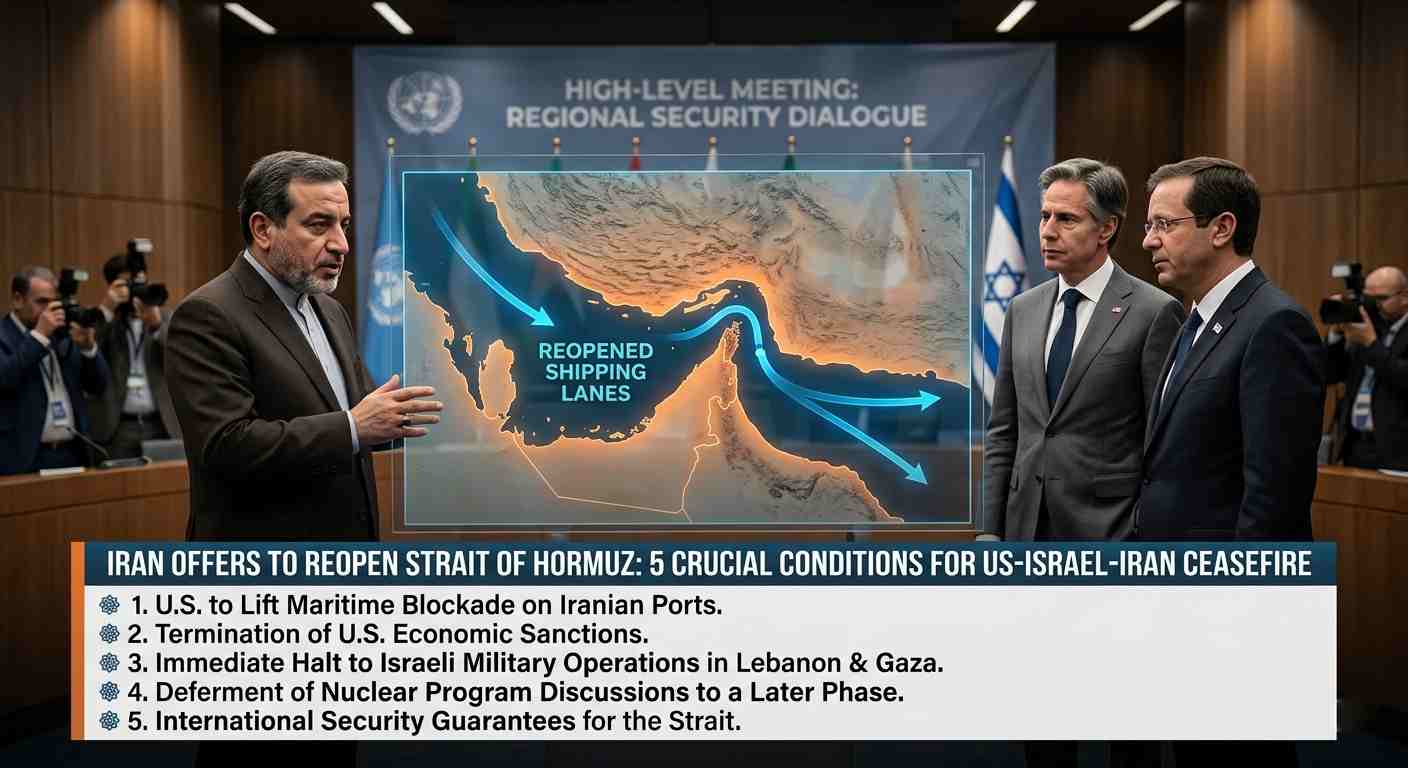
The US-Israel-Iran Ceasefire negotiations have reached a dramatic turning point as Tehran signals a willingness to de-escalate maritime tensions in exchange for significant American concessions. On Monday, regional officials confirmed that Iran has proposed ending its blockade of the Strait of Hormuz, a vital global energy artery, provided the United States lifts its own suffocating economic and maritime blockade on Iranian ports.
This high-stakes diplomatic gambit comes as Iranian Foreign Minister Abbas Araghchi touched down in Saint Petersburg to meet with Russian President Vladimir Putin. The visit follows a whirlwind tour of Pakistan and Oman, highlighting a desperate international push to prevent a total regional conflagration.
The St. Petersburg Summit: Russia’s Role in the US-Israel-Iran Ceasefire
As Araghchi landed in Russia, the atmosphere was thick with the scent of stalled diplomacy. The Foreign Minister wasted no time in pointing the finger at Washington, blaming the Trump administration for the collapse of recent talks.
“We were prepared for constructive dialogue in Islamabad,” Araghchi told reporters. “But the unilateral decision by Washington to scrap the latest round of negotiations has forced us to seek counsel with our strategic partners in Moscow.”
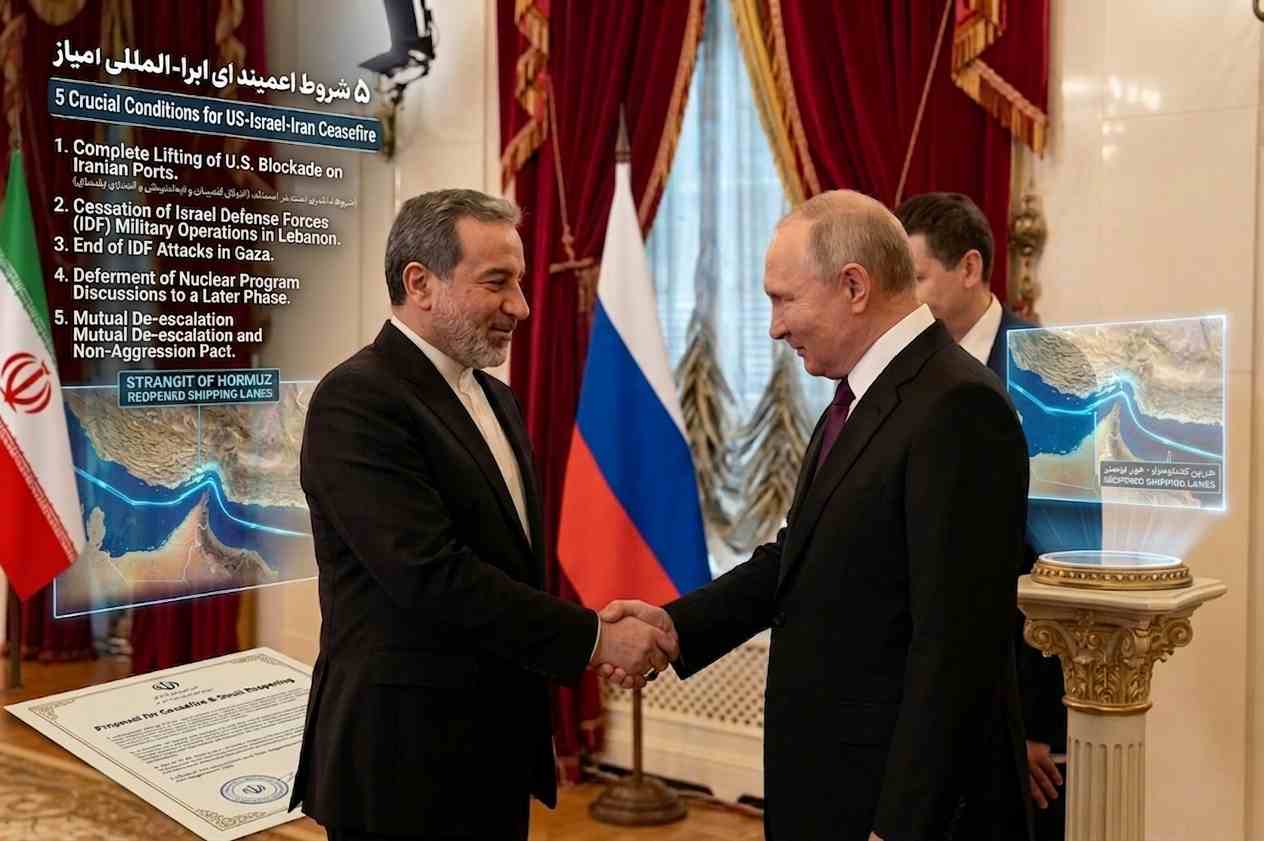
President Vladimir Putin, receiving Araghchi in St. Petersburg, expressed a cautious hope that “peace will prevail,” though the reality on the ground suggests a much grimmer trajectory. With Brent crude prices jumping over 2% in response to the uncertainty, the global economy is effectively holding its breath.
The “Hormuz for Blockade” Trade: A New Peace Proposal
The core of the new proposal revolves around the Strait of Hormuz. By offering to reopen this passage, Iran is playing its strongest card. The conditions reported by regional officials include:
Lifting of the US Maritime Blockade: Immediate cessation of US Navy operations targeting Iranian merchant vessels.
Comprehensive Sanctions Relief: A return to the pre-war economic status quo.
End of Hostilities in Lebanon and Gaza: Tehran insists that any US-Israel-Iran ceasefire must include a cessation of Israeli strikes in neighboring territories.
Nuclear Program Deferment: Iran has proposed moving discussions regarding its nuclear enrichment to a “later phase,” focusing instead on immediate military de-escalation.
Security Guarantees: Third-party monitoring of the Strait to ensure no further disruptions to global shipping.
The Trump Factor: Why Talks Stalled in Islamabad
The diplomatic momentum gained in Islamabad—the site of the first round of unsuccessful talks—was abruptly halted when US President Donald Trump scrapped a planned visit by envoys Steve Witkoff and Jared Kushner. The move was seen by Tehran as a sign that the US is not yet ready to abandon its “maximum pressure” campaign.
While the US military continues to maintain a blockade that has forced dozens of Iranian vessels to change course, the humanitarian and economic toll is mounting. Israeli forces have also intensified strikes near Kafra, severing key access routes and complicating the delivery of aid.
Market Instability and Global Impact
The lack of progress in the US-Israel-Iran ceasefire has sent ripples through the energy sector. Analysts warn that if the Strait of Hormuz remains a point of contention, oil prices could see a sustained rally, potentially breaching the $100 per barrel mark.
The Iranian proposal to reopen the Strait is a calculated move to gain international sympathy, particularly from European and Asian nations reliant on Middle Eastern oil. By framing the conflict as a choice between “total blockade” and “free trade,” Tehran is testing Washington’s resolve in the eyes of the global community.
What’s Next for the Region?
As Araghchi concludes his talks with Putin, the world looks toward the White House. Will the Trump administration accept the Iranian olive branch—contingent as it is—or will the maritime “cold war” turn into a hot one?
The US-Israel-Iran ceasefire remains a fragile possibility. For now, the Strait of Hormuz stands as both a symbol of global commerce and a potential flashpoint for the next world-defining conflict.