
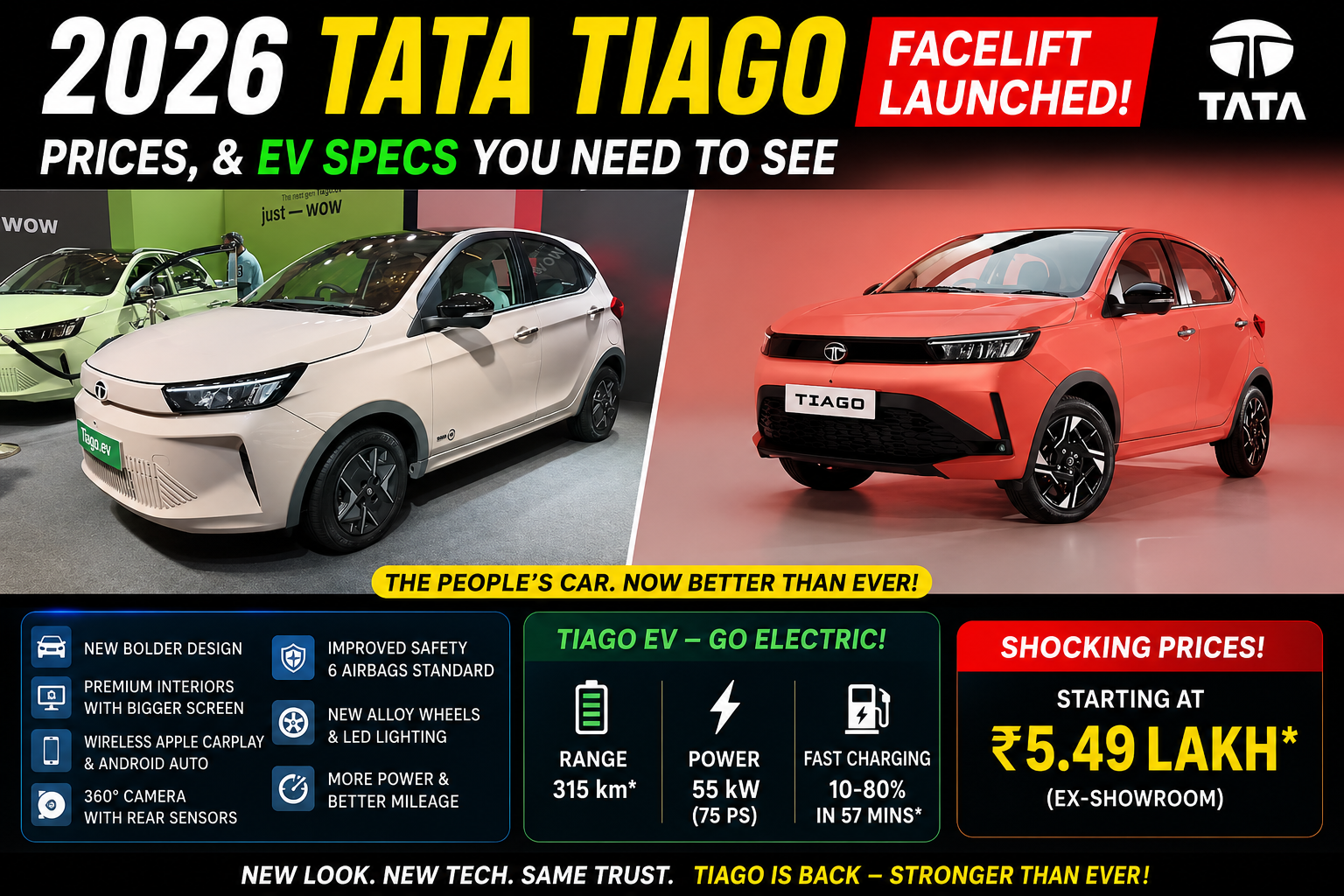
Tata Motors Passenger Vehicles has officially shaken up India’s entry-level car segment today with the simultaneous launch of the 2026 Tata Tiago and the 2026 Tata Tiago EV facelifts. As compact cars face stiff competition from compact SUVs, Tata Motors has responded not by cutting corners, but by heavily premiumizing its most accessible nameplate.
This comprehensive launch report breaks down everything you need to know about the new 2026 Tata Tiago petrol, CNG, and electric variants—covering prices, striking design revisions, segment-first features, and mechanical specifications.
2026 Tata Tiago Price in India and Variant Strategy
Tata Motors has maintained an incredibly aggressive pricing structure for the dual overhaul, positioning the hatchbacks as high-value alternatives to micro-SUVs.
The standard internal combustion engine (ICE) lineup continues to offer a mix of petrol and factory-fitted twin-cylinder CNG options, while the Tiago EV retains its positioning as an accessible city electric vehicle.
Estimated Ex-Showroom Launch Prices
2026 Tata Tiago Petrol/CNG: Starts from ₹4.50 Lakh (Ex-showroom)
2026 Tata Tiago EV Facelift: Starts from ₹8.00 Lakh (Ex-showroom)
Note: On-road prices will vary across states depending on local RTO registration fees, insurance packages, and applicable state-level EV subsidies.
2026 Tata Tiago ICE Variant Wise Price List (Manual Transmission)
Tata Motors has initially detailed the pricing structure for its 5-speed manual transmission trims across six distinct choices. The 5-speed AMT variants will have their exact step-up pricing detailed shortly.
| Variant Trim | 1.2L Petrol MT Price (Ex-Showroom) | 1.2L iCNG MT Price (Ex-Showroom) |
| Smart | Rs 4.69 Lakh | Rs 5.79 Lakh |
| Pure | Rs 5.49 Lakh | Rs 6.49 Lakh |
| Pure+ | Rs 5.99 Lakh | Rs 6.99 Lakh |
| Pure+ A | Rs 6.49 Lakh | Rs 7.49 Lakh |
| Creative | Rs 6.99 Lakh | Rs 7.99 Lakh |
| Creative+ | Rs 7.29 Lakh | To Be Announced |
The Competitive Landscape
The 2026 Tata Tiago ICE lineup directly defends its turf against established market rivals including the newly updated Maruti Suzuki Swift, the Hyundai Grand i10 NIOS, the Maruti Suzuki Wagon R, and the Maruti Suzuki Celerio.
Meanwhile, the 2026 Tata Tiago EV goes head-to-head in the budget electric vehicle space against the MG Comet EV and the Citroen eC3, leveraging its massive technology and safety upgrade to secure a distinct competitive advantage.
Exterior Design: A Tale of Two Faces
The 2026 design updates mark the first comprehensive aesthetic overhaul for the Tiago platform in several years. Instead of applying a uniform look across the board, Tata’s design studio has given the ICE and EV models distinct visual identities.
The Petrol and CNG Models (ICE)
The conventional petrol and CNG variants adopt a confident, mature stance drawing heavy inspiration from the larger Altroz and Punch stablemates:
Revised Front Fascia: A larger, more pronounced front grille finished in high-gloss black.
Aero LED Headlamps: Sleeker headlight clusters housing integrated, eyebrow-style LED Daytime Running Lights (DRLs).
Connecting Elements: A bold gloss-black applique strips across the front nose to visually link the two headlamp units, widening the car’s visual track.
Reworked Bumpers: Sharper creases around the fog lamp housings and a wider lower air dam.
The Tiago EV Facelift
The all-electric Tiago receives a much larger evolutionary leap, firmly distancing itself from its fossil-fueled sibling:
Closed-Off Grille: A completely smooth, body-colored blanked-off grille assembly that instantly signals its zero-emission powertrain.
Slimmer Optics: Noticeably sharper and slimmer LED projector headlamps.
Connected Tail Lamps: The rear profile is completely transformed by a futuristic, full-width connected LED light bar running across the tailgate.
EV-Specific Wheels: Brand new aero-optimized wheels designed specifically to reduce aerodynamic drag and maximize driving range.
Interior Revolution: Segment-First Tech and Premium Cabin
Step inside either the 2026 Tiago or the Tiago EV, and the generational leap becomes immediately apparent. Tata has completely binned the old layered dashboard architecture in favor of a clean, minimalist, flat-horizontal layout. The cabin swaps the previous “chirpy” accents for a sophisticated, grown-up light grey and deep black dual-tone palette.
The center configuration is dominated by tech features that were previously reserved for vehicles positioned two segments higher.
Key Interior and Comfort Features
10.25-Inch Free-Floating Touchscreen: A massive, high-definition central infotainment system supporting wireless Apple CarPlay and Android Auto.
Digital Driver’s Display: A fully digital, free-standing instrument cluster behind the steering wheel providing real-time telemetry, trip data, and media layouts.
Two-Spoke Steering Wheel: Borrowed directly from the premium Safari and Harrier models, featuring a sleek finish with illuminated branding (featuring specific Tata.ev backlighting on the electric model).
360-Degree Camera System: A segment-first addition providing a seamless birds-eye view for stress-free parking in tight urban spaces.
Added Conveniences: Dedicated rear AC vents for balanced cabin cooling, a wireless smartphone charging pad on the center console, and fast-charging Type-C USB ports in both rows.
1. 2026 Tata Tiago Petrol & CNG Specifications

Mechanically, Tata Motors has played it safe with the internal combustion engine versions. By utilizing a highly proven, reliable mechanical package, Tata has focused investment on cabin technology and structural safety without driving up ownership or maintenance costs.
The 1.2-liter, three-cylinder naturally aspirated Revotron engine remains the heart of the ICE lineup. It features Tata’s innovative Twin-Cylinder CNG technology, which places two smaller gas cylinders beneath the luggage floor to fully preserve usable boot space.
| Mechanical Attribute | 1.2L Naturally Aspirated Petrol | 1.2L Revotron Petrol + Bi-Fuel CNG |
| Engine Displacement | 1,199 cc (3-Cylinder) | 1,199 cc (3-Cylinder) |
| Maximum Power (Petrol Mode) | 86 PS @ 6,000 RPM | 86 PS @ 6,000 RPM |
| Maximum Power (CNG Mode) | N/A | 73.4 PS @ 6,000 RPM |
| Peak Torque (Petrol Mode) | 113 Nm @ 3,300 RPM | 113 Nm @ 3,300 RPM |
| Peak Torque (CNG Mode) | N/A | 95 Nm @ 3,500 RPM |
| Transmission Options | 5-Speed Manual (MT) / 5-Speed AMT | 5-Speed Manual (MT) / 5-Speed AMT |
| Fuel Tank Capacity | 35 Liters | 35 Liters (Petrol) / 60 Liters (Water Capacity Equivalent) |
Key Takeaway for ICE Buyers
The 2026 updates do not include a turbocharger or a hybrid option. The mechanical experience remains highly pragmatic, offering reliable daily performance with the unique benefit of an automatic transmission option on the factory-fitted CNG variant—a feature that remains highly popular among urban commuters.
2. 2026 Tata Tiago EV Specification and Range Options

The 2026 Tata Tiago EV Facelift continues to target the accessible electric vehicle market with its two familiar lithium-ion battery pack choices. While Tata Motors has optimized the battery management software for better thermal efficiency and consistent real-world range, the core cell capacities and motor profiles remain unchanged.
Both options utilize a single permanent magnet synchronous electric motor driving the front wheels, utilizing Ziptron high-voltage architecture.
| EV Performance Metric | Medium Range (MR) Battery Pack | Long Range (LR) Battery Pack |
| Battery Pack Capacity | 19.2 kWh | 24.0 kWh |
| Claimed MIDC Range | 223 km per full charge | 293 km per full charge |
| Number of Electric Motors | 1 (Front-Wheel Drive) | 1 (Front-Wheel Drive) |
| Maximum Power Output | 61 PS | 75 PS |
| Peak Torque Output | 110 Nm | 114 Nm |
| Fast Charging Time (DC) | ~58 minutes (10% to 80%) | ~58 minutes (10% to 80%) |
| Ingress Protection (IP) Rating | IP67 Certified (Water & Dust Resistant) | IP67 Certified (Water & Dust Resistant) |
Key Takeaway for EV Buyers
With its revised closed-off front grille, connected rear LED lights, and dual free-standing digital displays, the Tiago EV finally sheds its image as an adapted petrol car. It now stands on its own as a crisp, purpose-built electric vehicle packed with high-end tech.
3. What About a Diesel Engine Option?
For buyers wondering about a diesel powertrain: Tata Motors has not introduced a diesel engine option for the 2026 Tiago facelift.
The manufacturer permanently discontinued small-capacity diesel engines in its compact hatchback portfolio following the implementation of stricter BS6 and Real Driving Emissions (RDE) compliance norms. Small diesel engines require highly complex, expensive exhaust after-treatment systems (like lean NOx traps and particulate filters) that would drastically drive up the retail price, making a budget hatchback financially unviable.
Instead, Tata Motors is positioning its Twin-Cylinder iCNG models as the direct alternative for high-mileage highway drivers, and the Tiago EV as the optimal solution for low-running-cost city commutes.
Historical Context: How the “Tiago” Name Was Born
The Tiago brand holds an interesting place in Indian automotive history. When it was initially introduced to the public in late 2015 as the successor to the Tata Bolt, it was originally christened the Tata Zica—a clever shorthand for its “Zippy Car” driving dynamics.
However, just as the car was preparing for its commercial debut, the global outbreak of the mosquito-borne Zika virus made international headlines. Recognizing the negative association, Tata Motors made the responsible decision to completely rebrand the vehicle before its official 2016 commercial release.
To find a replacement name, Tata Motors collaborated with their global brand ambassador at the time, football legend Lionel Messi. The company ultimately took inspiration from Messi’s eldest son, Thiago, modifying the spelling slightly to fit the Indian market. Thus, the “Tiago” nameplate was born, going on to become one of the most successful turn-around stories in Tata’s passenger vehicle history.
Summary Verdict: Changing the Entry-Level Math
The entry-level hatchback segment has contracted over the last few years as consumer preferences have shifted toward micro-SUVs like the Tata Punch and Maruti Suzuki Fronx. With this 2026 dual refresh, Tata Motors’ strategy is clear: instead of chasing raw sales volume with stripped-out base models, they are turning the Tiago into a premium tech showcase.
By trickling down features like a 10.25-inch infotainment screen, a digital driver display, and a 360-degree camera system into a sub-₹10 lakh hatchback, Tata is offering small-car buyers a premium cabin experience without forcing them into a larger vehicle footprint. If Tata maintains tight control over variant-wise pricing as deliveries commence, the 2026 Tiago and Tiago EV are well-positioned to become the most feature-dense hatchbacks on Indian roads.
Disclaimer: Expected prices are based on industry estimates and are subject to change upon official announcement. Views expressed are informational; please consult your nearest Tata Motors dealership for actual on-road pricing and availability.