
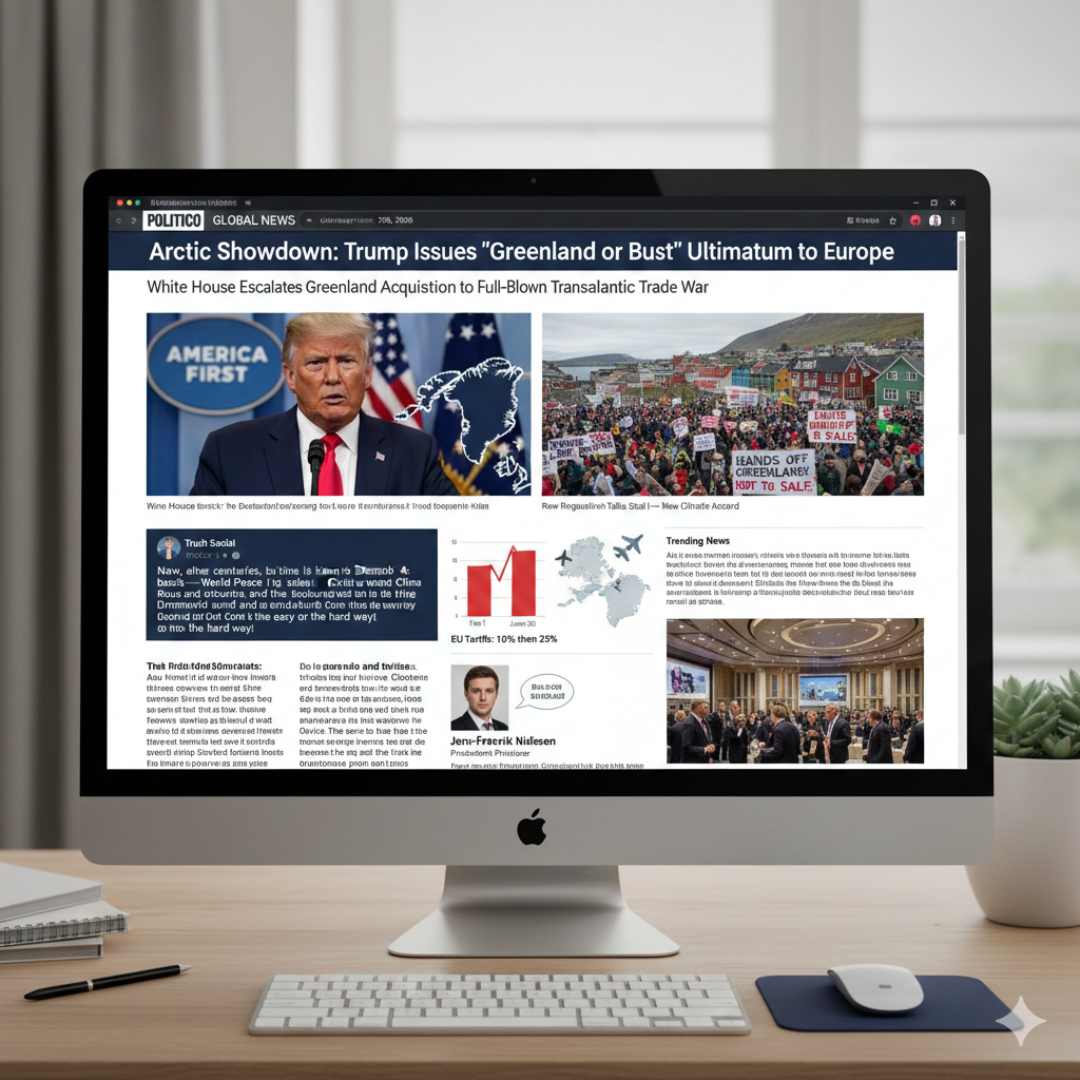
Trump Issues “Greenland or Bust” Ultimatum to Europe :NUUK/WASHINGTON – What began as a speculative whisper in the summer of 2019, dismissed by many as a quirky presidential tangent, has, under the renewed political climate, escalated into a full-blown international crisis. President Donald Trump’s audacious ambition to acquire Greenland, the world’s largest island, has now moved beyond mere negotiation, transforming into a high-stakes geopolitical poker game with the Arctic as its table and global alliances hanging in the balance.
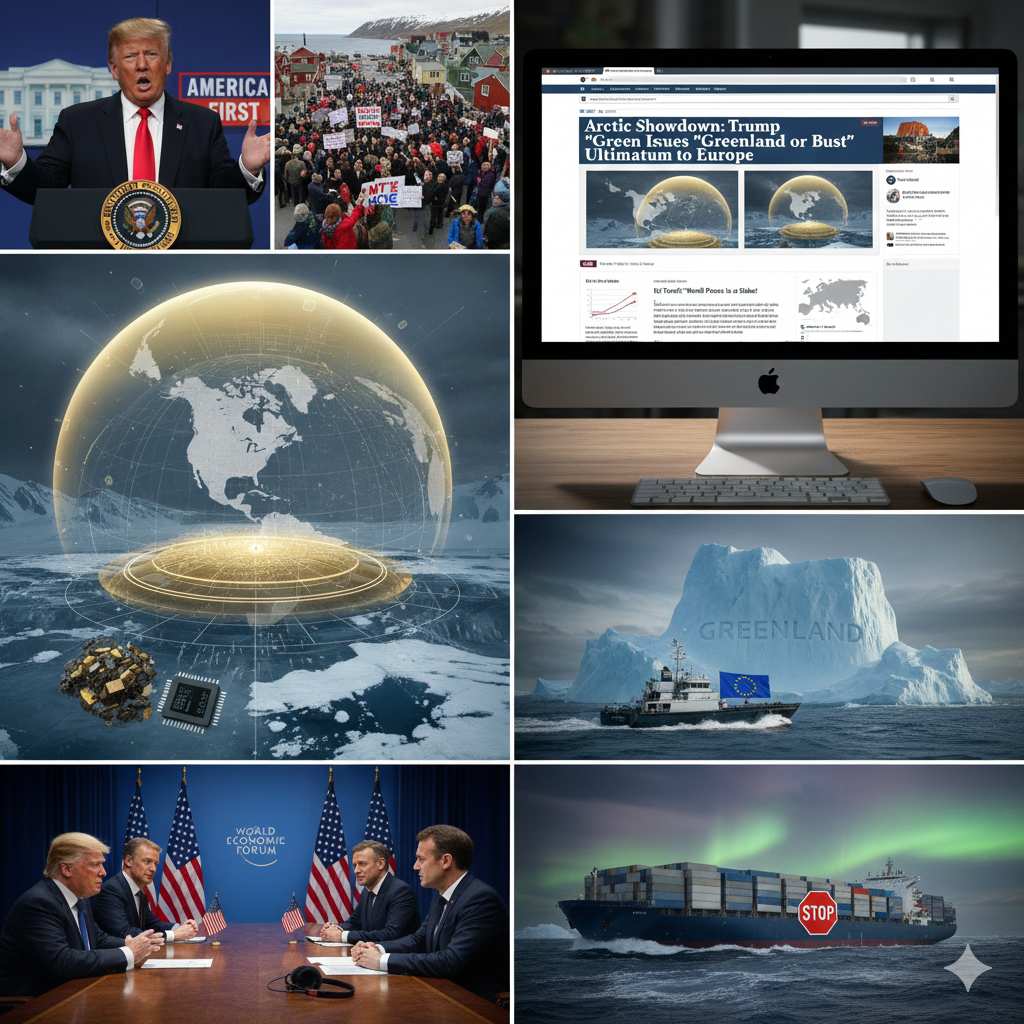
As of January 19, 2026, in a series of dramatic pronouncements and executive actions, President Trump has issued a stark ultimatum to the Kingdom of Denmark and, by extension, to its European allies. The message is unequivocal: Denmark must engage in “immediate and comprehensive negotiations” for the “complete and total transfer of sovereignty” over Greenland to the United States. Failure to comply, the administration warns, will trigger an unprecedented wave of economic sanctions and trade penalties that promise to redraw the map of transatlantic relations.
From Whimsical Interest to Geopolitical Imperative
The initial reports of Trump’s interest in Greenland were met with widespread amusement and bewilderment. Was it a real estate deal gone wild? A quirky historical footnote inspired by President Truman’s own failed bid? The Danish government, initially polite, quickly dismissed the idea as “absurd.” Yet, as with many of Trump’s unconventional overtures, what started as a seemingly outlandish proposition has calcified into a cornerstone of his foreign policy doctrine.
Fast forward to the present, and the “Greenland Gambit” is no longer a laughing matter. Speaking from a hastily arranged press conference at the White House over the weekend, flanked by grim-faced economic advisors, President Trump reiterated his conviction that U.S. ownership of Greenland is not merely desirable but an “absolute, non-negotiable necessity” for the security of the United States and, by extension, the free world. His rhetoric, delivered with characteristic force, painted a picture of a world teetering on the brink, with Greenland as the lynchpin.
“For too long, Denmark has been sitting on one of the greatest strategic assets on Earth, doing nothing with it, while our adversaries plot and plan,” Trump declared, his voice echoing through the East Room. “Now, after centuries, it is time for Denmark to give back. World Peace is at stake! China and Russia want Greenland, and there is not a thing Denmark can do about it. We can do it the easy way, or we can do it the hard way. And believe me, the hard way is going to be very, very hard for a lot of people.”
The “hard way,” it appears, has already begun. The Trump administration has announced the immediate implementation of a 10% tariff on a wide array of exports from eight key European nations—Denmark, Germany, France, the United Kingdom, Sweden, Norway, the Netherlands, and Belgium. These tariffs, which target agricultural products, luxury goods, and precision machinery, are set to take effect on February 1st. The accompanying threat is even more severe: if what the White House terms a “good faith agreement” for Greenland’s transfer isn’t reached by June 30th, those tariffs are scheduled to spike to a crippling 25% across the board, potentially triggering a full-scale trade war with America’s oldest allies.
The Arctic Jewel: Why Greenland Matters So Much Now
The shift in the administration’s posture from casual interest to fervent demand is underpinned by two increasingly urgent strategic considerations, magnified by rapid geopolitical changes and the undeniable impact of climate change.
1. Critical Minerals, Future Wars: Beneath Greenland’s rapidly melting ice sheets lies one of the planet’s largest, and largely untapped, reserves of rare earth elements (REEs) and other critical minerals. Substances like Neodymium, Dysprosium, Praseodymium, and Terbium – vital components in everything from electric vehicle batteries and smartphones to advanced missile guidance systems, F-35 fighter jets, and renewable energy technologies – are predominantly controlled by China. The U.S. currently relies heavily on Chinese imports for these crucial materials, a dependency that successive administrations have sought to reduce. Greenland offers a path to genuine mineral independence, promising to resupply America’s industrial and defense sectors for centuries. The strategic importance of these deposits cannot be overstated in an era defined by technological competition.
Economic Impact: Tariffs, Bullion, and the “Big Bazooka”
The financial fallout of the “Greenland or Bust” ultimatum has been instantaneous and severe. In the hours following President Trump’s Truth Social post, global markets entered a period of intense volatility. On Monday, January 19, 2026, the Nasdaq 100 futures plummeted 1.1%, while European indices like the French CAC 40 and German DAX braced for drops of up to 2.1%.
The core of the economic crisis lies in the “staircase” tariff structure announced by the White House:
- Stage 1: A 10% tariff starting February 1, 2026, targeting exports from Denmark, Norway, Sweden, France, Germany, the UK, the Netherlands, and Finland.
Stage 2: An escalation to 25% by June 1, 2026, if a “Total Purchase” agreement is not reached.
Investors have scrambled for safe-haven assets. In India, silver prices breached a historic ₹3 lakh per kg milestone, while spot gold in the U.S. jumped over $70 to reach $4,667 an ounce.
In Brussels, the response is shifting from shock to retaliation. EU diplomats have convened emergency meetings to discuss the “Anti-Coercion Instrument” (ACI)—often referred to as the “Big Bazooka.” This policy would allow the EU to freeze U.S. companies out of public tenders and impose a retaliatory €93 billion ($108 billion) tariff package on American goods, effectively ending the trade truce established last summer.
NATO Reactions: An Alliance on the Brink
The Greenland crisis has moved beyond trade into a fundamental threat to the Western security architecture. NATO, which has stood as the bedrock of transatlantic security since 1949, is currently facing what experts call its “darkest hour.”
The Military Stand-off: Operation Arctic Endurance
The tension is no longer purely rhetorical. Denmark, backed by eight NATO allies, has launched Operation Arctic Endurance, deploying military reinforcements to Greenland to safeguard its sovereignty. On January 19, Denmark announced a “substantial” further deployment of battle-ready troops to the Joint Arctic Command in Nuuk.
The Diplomatic Rift
The split within the alliance is visible in the divergent tones of its leaders:
- France: President Emmanuel Macron has issued a stern warning of “unprecedented consequences,” framing the U.S. pressure as “blackmail.”
- United Kingdom: Prime Minister Keir Starmer labeled the use of tariffs against allies as “completely wrong,” though London remains cautious about immediate counter-sanctions.
- Germany: While initially deploying a small reconnaissance team, Germany has begun withdrawing its 15 soldiers to “de-escalate,” even as its leaders insist they will not be intimidated.
The Danish Intelligence Service (DDIS) has, for the first time in history, officially listed the United States as a threat to national security, placing it alongside Russia and China. This paradigm shift suggests that regardless of whether a “deal” is reached, the trust that once bound the NATO alliance may have permanently evaporated.
Would you like me to help you create an infographic of the specific tariffs or a timeline of the Greenland purchase attempts?
Trump’s Greenland Ambition and NATO Tensions This video provides a deep dive into the historical and strategic reasons behind the interest in Greenland and how it impacts modern international alliances.