
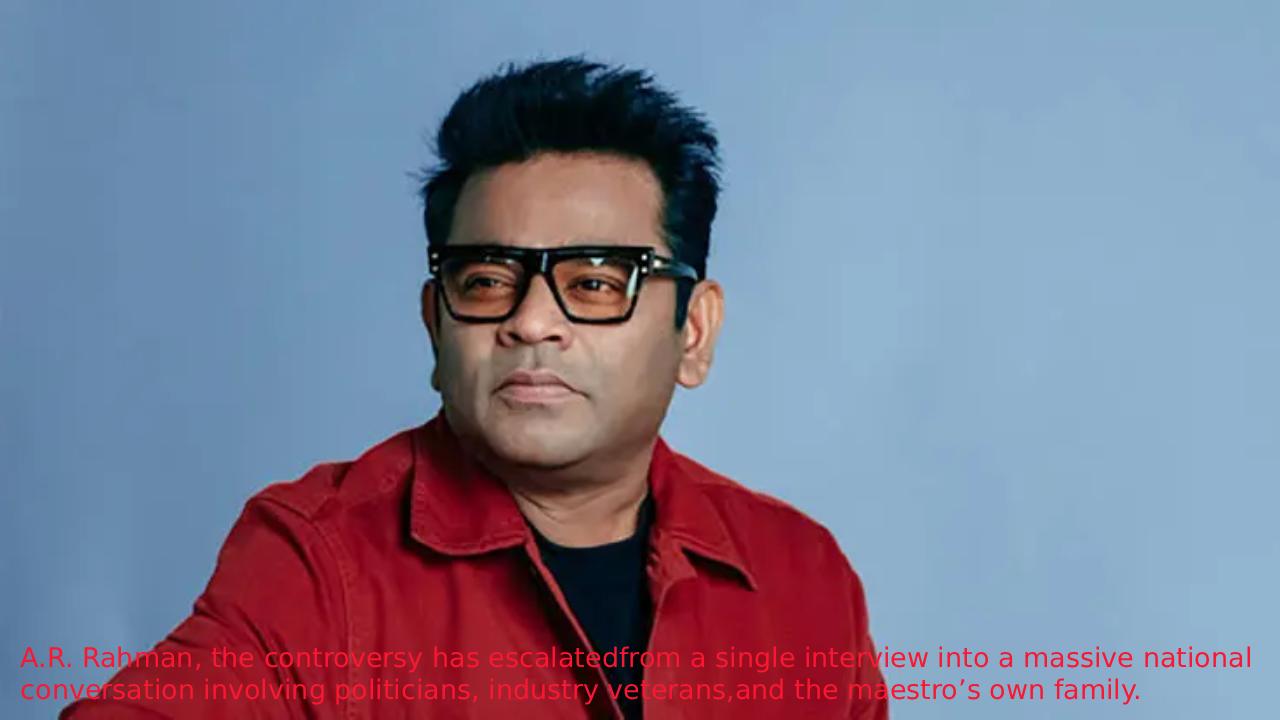
The Rahman Row: A Symphony of Silence or a “Communal” Cacophony? CHENNAI/MUMBAI The world of Indian cinema is rarely quiet, but this week, the music itself took a backseat to a polarizing debate. A.R. Rahman, the “Mozart of Madras” and a two-time Academy Award winner, has found himself at the center of a firestorm following remarks that hint at a “communal” undercurrent affecting his work in the Hindi film industry.

As of January 19, 2026, the controversy has escalated from a single interview into a massive national conversation involving politicians, industry veterans, and the maestro’s own family.
The Spark: “Chinese Whispers” and Power Shifts
The controversy ignited during a recent interview with the BBC Asian Network. When asked about the decline in his Hindi film projects over the last decade, Rahman suggested that the shift wasn’t just about musical trends, but about a deeper change in industry dynamics.
“People who are not creative have the power now to decide things,” Rahman stated. “And this might have been a communal thing also, but not in my face. It comes to me as Chinese whispers that they booked you, but the music company went ahead and hired their five composers.”
Rahman elaborated that while he never faced such prejudice in the 1990s, the “past eight years” have seen a power shift where creative control has moved away from artists and into the hands of corporate and non-creative entities.
The “Chhaava” Conflict: History vs. Divisiveness
The most explosive part of Rahman’s interview concerned the 2025 historical epic Chhaava, starring Vicky Kaushal as Chhatrapati Sambhaji Maharaj. Despite having composed the score, Rahman labeled the film “divisive.”
· Rahman’s Critique: He claimed the film “cashed in on divisiveness,” although its core was meant to show bravery. He even pointed out cliches in the film, such as the use of religious terms like ‘Subhanallah’ in scenes depicting negative events, calling such portrayals “cringe” and “manipulative.”
· The Social Media Backlash: Netizens have been divided. While some praised him for having a “spine,” many others felt betrayed. Critics argued that showing the historical reality of Aurangzeb’s reign isn’t “divisive”—it’s history. One viral post on X (formerly Twitter) noted: “I never saw Rahman through a religious lens… what he said about Chhaava feels like a personal betrayal.”
The Backlash: Industry and Political Fallout
The reaction was swift and sharp across the spectrum:
· Kangana Ranaut: The actor-politician accused Rahman of being “prejudiced and hateful,” claiming he refused to even meet her for her film Emergency, allegedly calling it “propaganda.”
· Taslima Nasreen: The author challenged Rahman’s claims by citing the immense success of stars like Shah Rukh Khan and Salman Khan as proof that the “rich and famous” do not face communal hurdles in Bollywood.
· The Support: Lyricist Varun Grover and veteran actor Paresh Rawal came to his defense. Grover stated that Rahman was being “attacked and abused” for stating a polite opinion based on his lived experience, forced into a clarification by a “toxic mob.”
Economic Impact: The Multi-Composer Trend
Rahman’s comments highlighted a technical shift in the industry: the “multi-composer” model. Modern Bollywood often hires five or six different composers for a single film to create a “jukebox” of hits. Rahman argues this serves corporate interests but dilutes artistic vision.
A Maestro’s Clarification
Facing an onslaught of criticism, Rahman released an emotional video message on January 18, 2026.
“India is my inspiration, my teacher, and my home… my purpose has always been to uplift, honour, and serve through music. I have never wished to cause pain.”
Looking Ahead: A Packed 2026 Calendar
Despite the noise, Rahman remains one of the busiest global icons. His 2026 slate includes some of the most anticipated projects in cinema history:
| Project | Role | Release Date |
| Ramayana (Part 1) | Co-Composer (with Hans Zimmer) | November 2026 |
| Peddi | Music Director | March 27, 2026 |
| Genie | Music Director | September 25, 2026 |
| Thalaivan Irukkindran | Music Director | April 2026 |
The Ramayana project, directed by Nitesh Tiwari and starring Ranbir Kapoor and Yash, is particularly notable as it pairs Rahman with Hollywood legend Hans Zimmer, signaling that his global influence remains untouched by local controversies.
The Final Verse
The “Rahman Row” reflects a deeper anxiety within the arts. Whether the “communal thing” is a systemic reality or a personal perception, the fact that a figure of Rahman’s standing felt the need to voice it suggests a fracture in the industry’s once-celebrated secular armor.
A.R. Rahman on Chhaava and Bollywood dynamics This video introduces the massive Ramayana project, showcasing the global scale of Rahman’s current work and his collaboration with world-renowned artists like Hans Zimmer.