
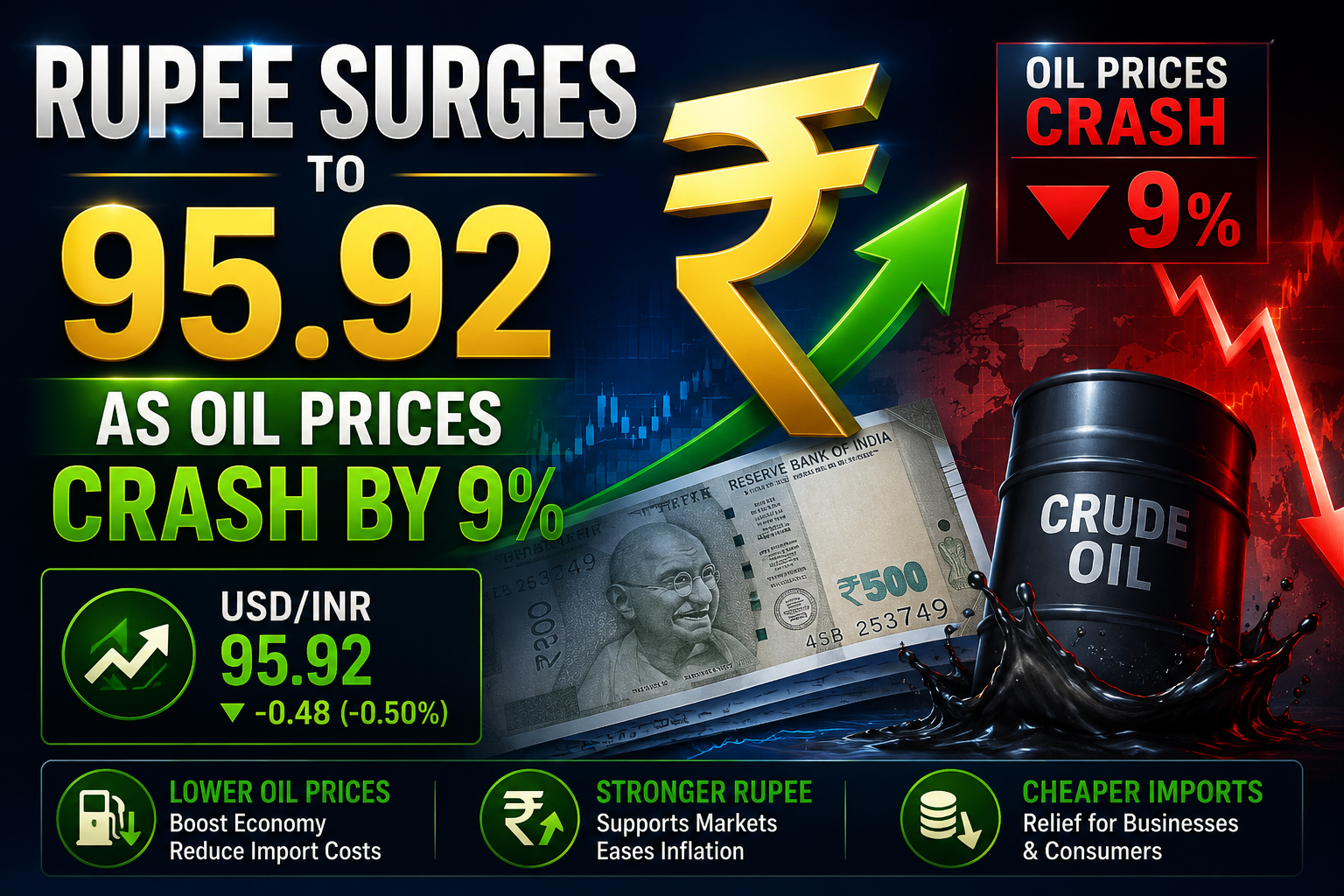
Rupee surges to 95.92 against the US Dollar in a dramatic Monday trading session that gave Indian financial markets their biggest breath of fresh air in weeks. The sudden relief came right after Washington and Tehran agreed to pause military strikes in West Asia, sending global crude oil benchmark prices into a tailspin.
For ordinary citizens, traders, and policymakers who spent the last fortnight watching energy prices spiral and foreign capital run for the exits, Monday offered a rare and welcome breather. But as the foreign exchange market settles down after a chaotic day, a crucial question remains: Is this sharp recovery the start of a genuine turnaround, or just a brief pause before market realities drag the currency back down?
What Drove the Massive 61-Paise Rally?
To understand how the Indian currency pulled off a sudden 61-paise recovery, you have to look at the three big forces that converged on the interbank foreign exchange market all at once.
1. The Sudden De-escalation in the Middle East
The biggest factor behind the market shift was a sudden geopolitical turn. After nearly two weeks of escalating military strikes between the United States and Iran, both sides abruptly signaled a willingness to step back and talk.
UN Ambassador Mike Waltz confirmed that diplomatic channels mediated by Oman were actively working behind the scenes. US President Donald Trump chose to give those peace negotiations room to breathe, pausing further strikes.
Because India imports more than 85 percent of its crude oil needs, any threat to the Strait of Hormuz acts as a direct hit on the Indian economy. When news broke that military action was on hold, Brent crude futures plummeted roughly 9 percent, dropping from last week’s dangerous high of over $102 per barrel down to the $88–$93 range. That massive drop instantly reduced fears around India’s import bill and current account deficit.
2. Strategic RBI Intervention
The Reserve Bank of India did not just stand on the sidelines and watch. Just days prior, on Friday, the local unit was teetering dangerously close to the psychological threshold of 97.00 per dollar—hitting an intra-day low near 96.86.
Forex dealers reported that the central bank stepped into the market aggressively, selling US dollars through state-run banks to stem the panic. On top of direct intervention, a series of recent policy measures announced by the RBI to streamline foreign capital inflows began to restore institutional confidence.
3. A Softer US Dollar and Green Domestic Screens
As geopolitical tensions cooled, the US Dollar Index—which measures the greenback against a basket of six major global currencies—slipped 0.20 percent down to 101.09. A weaker dollar naturally gives emerging market currencies room to push back.
At the same time, Indian benchmark equity indices rallied hard. The BSE Sensex jumped over 775 points (1.02 percent) to close at 76,835.78, while the broad-based Nifty 50 surged nearly 229 points to touch 23,995.95. A booming domestic stock market creates immediate demand for local currency assets, multiplying the rupee’s momentum.
Key Currency Movements During the Session
| Market Metric | Recorded Value | Context & Background |
| Previous Close | 96.53 | Recovered late Friday from record lows |
| Monday Opening | 96.18 / 96.15 | Gapped up sharply on weekend truce headlines |
| Intraday High | 95.78 | Peak strength reached during peak trading hours |
| Intraday Low | 96.27 | Brief selling pressure before buyers stepped in |
| Final Settlement | 95.92 | A net gain of 61 paise (Provisional) |
| Dollar Index (DXY) | 101.09 | Down 0.20% as safe-haven demand cooled |
| Brent Crude Oil | ~$88.12 – $93.02 | Fell between 4% to 9% in futures trade |
Why Crude Oil Controls the Indian Rupee’s Fate
It is almost impossible to discuss the USD/INR exchange rate without talking about oil. Crude is the single largest entry on India’s import invoice. When Brent crude crossed $100 per barrel last week, traders immediately began pricing in higher inflation, expanding trade deficits, and heavier fiscal burdens for New Delhi.
When oil prices jump, Indian oil marketing companies (OMCs) have to buy massive blocks of US dollars from the interbank market to pay for shipments. This sudden, non-negotiable demand for dollars floods the market, naturally driving down the value of the rupee.
Conversely, when Brent crude crashes by 8 to 9 percent in a single day—as it just did—the urgent commercial demand for dollars dries up. Importers hold off on purchases, exporters convert their foreign earnings, and currency traders scramble to close out short positions against the rupee. That exact dynamic triggered Monday’s 61-paise surge.
Equity Markets Join the Party: Sensex and Nifty Rally
The currency market did not operate in a vacuum. The Indian stock market staged an equally aggressive rebound as investors celebrated lower energy costs.
BSE Sensex: Surged 776.01 points (up 1.02%) to settle at 76,835.78.
NSE Nifty 50: Gained 228.50 points (up 0.96%) to hit 23,995.95.
This domestic equity rally provided essential secondary support to the local currency. However, underlying caution remains among institutional investors. Official exchange data showed that Foreign Institutional Investors (FIIs) net offloaded equities worth Rs 3,892.77 crore late last week.
While domestic retail and institutional investors bought the dip aggressively on Monday, sustained currency health will require foreign investors to stop selling and start bringing fresh foreign capital back into Indian stocks and bonds.
Expert Outlook: Temporary Relief or True Trend Reversal?
Despite the strong recovery, currency analysts and treasury managers urge caution. The 61-paise gain is impressive, but structural headwinds haven’t disappeared overnight.
The Short-Term Range
According to market analysts at leading research firms like Mirae Asset ShareKhan, the spot USD/INR pair is expected to consolidate within a defined band of Rs 95.50 to Rs 96.20 over the coming sessions. The rapid move from near 96.86 down to sub-96.00 levels satisfied a lot of pending buy orders, meaning the currency needs time to find a fresh baseline.
Seasonal Pressures and the Hawkish Fed
Forex strategists from CR Forex Advisors point out that broader macro trends still favor a stronger US Dollar over a longer horizon. August is historically a difficult month for the rupee due to seasonal trade flows, corporate dividend payouts to foreign investors, and mid-year import rebalancing.
Furthermore, the US Federal Reserve maintains a relatively hawkish stance on interest rates compared to other global central banks. If American economic data remains resilient, high US yields will continue pulling capital away from emerging markets.
The Geopolitical Wildcard
Everything hinges on whether the US-Iran pause evolves into a permanent diplomatic agreement or devolves back into open conflict. A few headlines suggesting talks have stalled could easily send Brent crude back toward $100, erasing the rupee’s gains overnight.
As seasoned forex traders note, a true rescue that permanently pushes the dollar below 95.00 will require concrete peace treaties—not just temporary pauses in drone and missile strikes. If geopolitical tensions flare up again, market targets of 97.00 to 97.50 remain very real possibilities before the end of the quarter.
What This Means for Everyday Consumers and Businesses
The sudden swing in the dollar-rupee rate carries real-world implications that extend far beyond trading floors in Mumbai.
For Importers: Companies importing electronics, machinery, and edible oils get temporary relief. A stronger home currency lowers the landed cost of goods, preserving corporate margins.
For Indian Students Abroad: Families transferring money overseas for tuition fees and living expenses face a slightly lower conversion bill today than they did on Friday.
For Exporters: IT services firms, textile exporters, and pharmaceutical companies see their rupee-denominated revenues dip slightly when the dollar softens, though most hedge their exposure to minimize volatility.
For Fuel Consumers: If crude oil stays settled around the $88–$90 mark, retail fuel prices and logistics costs will stabilize, helping keep consumer inflation within the Reserve Bank of India’s target comfort zone.
Final Thoughts
Monday’s dramatic currency rally showed just how fast sentiment can flip when geopolitical pressure eases. The Indian currency managed to bounce back from the brink of a historic breakdown toward 97.00, demonstrating the stabilizing power of lower oil prices and active central bank intervention.
However, calling an end to the rupee’s troubles would be premature. With seasonal headwinds around the corner, US interest rates remaining elevated, and Middle East diplomacy still fragile, market participants should prepare for continued two-way volatility. For now, the local currency has earned a well-deserved breather—but the road ahead remains tightly linked to global headlines.
What are your thoughts on the rupee’s sharp recovery? Do you expect the USD/INR exchange rate to drop further toward 95.00, or will geopolitical risks push it back toward record lows? Share your views in the comments below!