
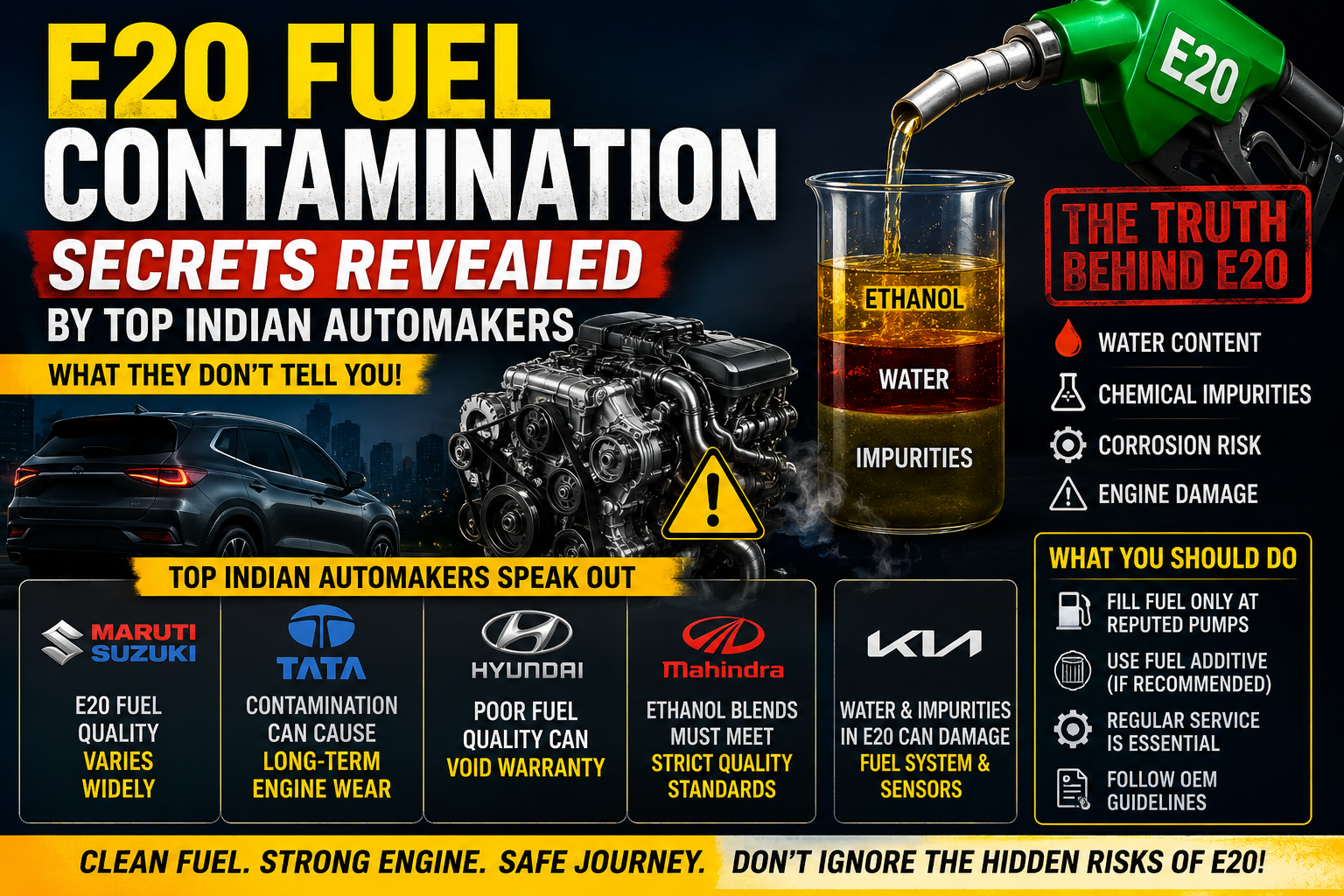
People who own vehicles in India are talking a lot about E20 fuel contamination. Many car owners have noticed that their cars are not giving them the mileage as before. They have also experienced engine stalling and parts of their cars are getting damaged fast.. It seems that there is a bigger problem that people did not know about.
The big car companies in India like Maruti Suzuki, Tata Motors and Mahindra were aware of the E20 fuel contamination problem before everyone else started talking about it. They knew that the E20 fuel was not good and could damage car engines.
Even though these companies are saying that E20 fuel is a thing because it is better for the environment private emails between top executives tell a different story. These emails show that the E20 fuel has chemicals and water in it. These bad things in the fuel can damage car engines quickly.
Let us take a look, at what the companies knew what they were talking about and what they found out about the E20 fuel contamination. E20 fuel contamination is an issue and people who own vehicles want to know what is going on with the E20 fuel contamination.
1. What Is the E20 Fuel Mandate?
To reduce carbon emissions and cut heavy crude oil import bills, the Indian government pushed forward an aggressive rollout of E20 petrol—a blend containing 20% ethanol and 80% fossil fuel.
By April 1, standard unleaded petrol was largely phased out at most pumps, making E20 the default choice for millions of drivers nationwide. While the move aligns with long-term renewable energy goals, ethanol’s chemical properties mean that fuel handling, storage, and quality control must be significantly tighter than with conventional petrol.
2. Private Concerns vs. Public Stances
While auto manufacturers publicly voiced support for the government’s green mobility vision, internal communications tell a distinct story. Executives at India’s top three carmakers—who collectively represent nearly two-thirds of the domestic passenger vehicle market—exchanged detailed technical concerns regarding E20 quality control.
| Aspect | Public Narrative | Internal Email Communications |
| Fuel Safety | Fuel is safe; issues are isolated or unverified. | Widespread sample testing flagged elevated contaminants. |
| Industry Action | SIAM retracted its initial formal letter to avoid misinterpretation. | Executives compiled sample data from 21 States and UTs. |
| Engine Impact | Normal wear and tear expected during fuel transition. | Warnings that organic chloride could cause failure within 200 km. |
3. The Sampling Study: What 250+ Fuel Tests Found
To understand why vehicles were experiencing premature part failures, major carmakers initiated a nationwide fuel-testing exercise over the course of a year.
Sample Size: More than 250 fuel samples collected directly from retail petrol pumps.
Geographic Spread: 21 States and Union Territories sampled across India.
Widespread Issues: Contamination spikes were detected in pumps across at least 18 states.
The compiled findings pointed directly to two major culprits: chloride and moisture.
4. The Organic Chloride Problem: Engine Risk Explained
The most alarming technical finding in the internal data involves organic chloride levels. Chloride is highly corrosive to metals used in modern fuel injection systems.
Permissible Government Limit : 3 ppm
Max Injection Tolerance      : 1 ppm (International Standard)
Actual Field Test Findings  : Up to 570 ppm
In private group emails, senior engineering executives noted that modern electronic fuel injectors can typically tolerate less than 1 ppm of chloride. Yet, test results from several key regions showed levels vastly exceeding those safety limits:
Rajasthan: Chloride levels measured between 6 ppm and 570 ppm.
New Delhi: Measured between 1.4 ppm and 420 ppm.
Maharashtra: Measured between 10 ppm and 357 ppm.
One senior fluids engineer noted in internal exchanges that organic chloride was the direct driver behind rapid vehicle breakdowns reported shortly after refuelling, warning it had the potential to ruin fuel systems in as little as 200 kilometres.
5. High Moisture Content in E20 Petrol
Ethanol is naturally hygroscopic, meaning it readily absorbs water from its surroundings. If underground storage tanks at petrol pumps or transport tankers are not meticulously maintained, moisture accumulates rapidly inside the fuel mix.
When water enters an ethanol blend beyond a critical point, it causes a phenomenon called phase separation—where the ethanol and water split away from the petrol and settle at the bottom of the tank.
Government Benchmark: Maximum 3,000 ppm (0.3%).
Andhra Pradesh Samples: Recorded up to 13,000 ppm.
Uttar Pradesh Samples: Recorded up to 12,500 ppm.
When an engine draws in this water-heavy layer from the bottom of a vehicle’s fuel tank, it can cause immediate stalling or complete engine immobilization right after leaving the pump.
6. The Retraction and Official Responses
Shortly after the Society of Indian Automobile Manufacturers (SIAM) sent an initial letter to the government raising these contamination findings, the complaint was formally withdrawn.
SIAM Statement: The industry body stated that the initial data set and sample sizes were insufficient to form definitive conclusions, noting that the letter had been sent inadvertently and that a more comprehensive scientific study would be undertaken.
In response to queries surrounding fuel safety:
Ministry of Petroleum & Natural Gas: Maintained that state-run oil marketing companies perform regular, rigorous quality checks across retail outlets.
Government Testing Findings: Official checks conducted across fuel pumps revealed only four isolated cases of contamination, assuring the public that the fuel supply remains safe.
Automaker Responses: Mahindra clarified that preliminary internal discussions do not represent a final position and maintained that it sees no inherent issues with E20 fuel standards, while other manufacturers opted not to comment publicly on internal exchanges.
7. The Retraction and Official Responses
For everyday drivers navigating the E20 transition, understanding how fuel quality impacts vehicle health is essential. Here are a few practical habits to protect your vehicle’s fuel system:
Use High-Volume Fuel Outlets: Busy, well-maintained petrol stations cycle through their fuel inventory quickly, reducing the chance of standing moisture accumulating in underground storage tanks.
Avoid Refuelling During Tanker Refills: Avoid filling up while a fuel tanker is actively unloading at the station, as this process stirs up sediment and water at the bottom of the main reservoir.
Inspect Your Fuel System Regularly: If your car experiences persistent misfires, sudden hesitation, or unusual sputtering right after a fill-up, have a technician inspect the fuel filter and injectors immediately.
Final Thoughts
The transition toward E20 petrol is a major milestone in India’s energy policy, but balancing ambitious renewable goals with real-world infrastructure readiness remains a complex challenge. While official government testing reports minimal issues, the internal exchanges among car manufacturers highlight just how critical strict storage, transportation, and quality assurance standards are for protecting consumer vehicles on the road.
Disclaimer: The views and analysis expressed in this article are derived from independent news sources and industry reports. Brand names and trademarks mentioned belong to their respective owners. This content does not constitute technical or legal advice.