
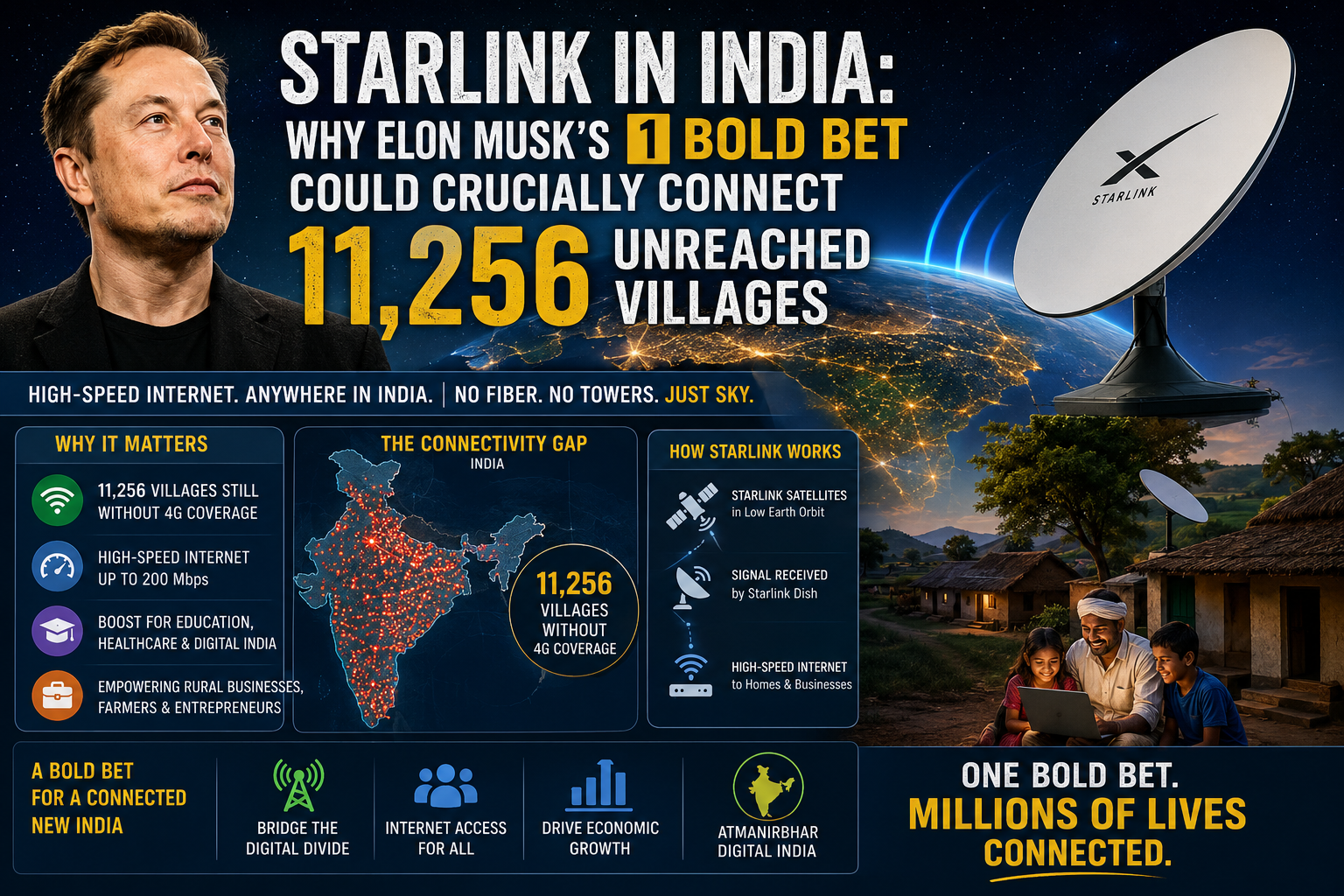
Starlink in India is rapidly becoming one of the most talked-about telecom debates in modern technology. At first glance, the idea that a foreign satellite internet provider is desperately needed in India might sound redundant. After all, the nation is home to a staggering 1.093 billion internet subscriptions, backed by aggressively priced 5G networks, expansive fiber cables, and ultra-cheap mobile data plans. Yet, tech billionaire Elon Musk continues to make a strong, persistent push to launch SpaceX’s satellite broadband network across the subcontinent.
Why would the world’s richest man focus so heavily on a market that seemingly already has over a billion connected devices?
The answer lies deep in the geography of rural India. Beneath the headline-grabbing numbers of India’s digital boom lies a stark reality: over 11,000 villages remain completely cut off from basic 4G connectivity, and over half of the rural population lacks reliable internet access. Musk recently brought this exact issue into the spotlight, reiterating that his Low Earth Orbit (LEO) satellite service isn’t aimed at taking away urban customers from local telecom giants. Instead, it is designed to deliver lifeline connectivity to the country’s most isolated and least served communities.
Starlink in India : Elon Musk’s Public Push for Rural Broadband
The newest spark in this continuing talk came when Elon Musk shared a post on X (formerly known as Twitter) from a well-known commentator called DogeDesigner (@cb_doge). The post explained the difference between Indias fast-growing cities with technology and its struggling countryside areas.
In reply to the post Musk said: “Starlink would help the people, in India who are least served in rural areas.”

SpaceX has a plan for this area. The thing is, Indian cities have fast internet and a lot of 5G towers.. It is very hard to build roads and towers in the mountains and forests and deserts. It costs a lot of money. It is very difficult for regular phone companies to do.
SpaceX is going to use a lot of satellites that go around the Earth to give people internet. These satellites are not far away from us. They can send internet to a dish on a roof in a village. This means that the whole village can get on the internet and talk to the rest of the world. Satellite internet does not need towers on the ground. A small dish is all you need to connect to the internet. SpaceX and satellite internet can help people in villages and towns get online. Satellite internet is a deal, for SpaceX.
Breaking Down the Numbers: The Indian Digital Divide
To truly understand why satellite broadband remains relevant, one has to examine official telecom data through a realistic lens. India’s digital revolution is undeniably impressive, but its distribution is remarkably uneven.
The Tale of Two Indias
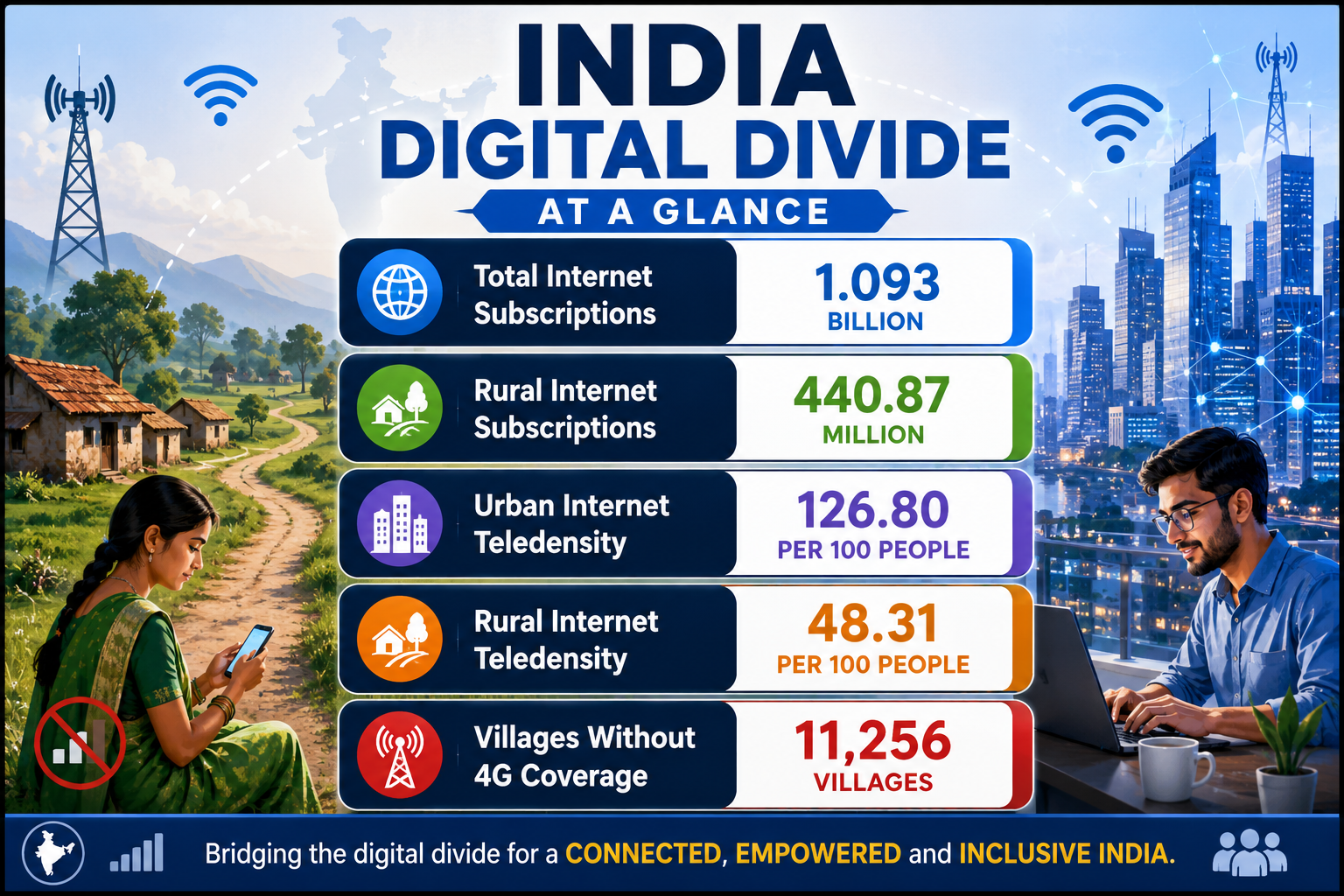
The Urban Surge: In cities the number of phone subscriptions is really high. It is 126.80 for every 100 people. Many people who live in cities have than one SIM card. They use home Wi-Fi and watch HD videos without any problems.
The Rural Reality: On the hand in rural areas the number of phone subscriptions is much lower. It is 48.31 for every 100 people. Out of than 1.4 billion people in India less than half of the people in villages have reliable and fast internet.
Also as of mid-2026 11,256 villages in India do not have any 4G coverage. In these places simple tasks, like making a payment using digital government websites applying for farming programs or joining online classes are almost impossible.
Government Efforts and the Missing Last Mile
The Indian government has made a lot of efforts to connect people in areas. They started the BharatNet project, which has laid an amount of optical fiber cable. Over 850,000 kilometers. To connect rural local bodies also known as Gram Panchayats. They have also set up than 80,000 Gram Panchayat Points of Presence which act as hubs for broadband internet.
Laying down optical fiber is only the first step. The real challenge is getting the internet to peoples homes, schools and clinics. This is called the ” mile” of connectivity. In areas it is very hard to get the internet to work because of the tough terrain.
When it rains heavily the cables that are buried under the ground get damaged. Landslides can also destroy the infrastructure in areas.. When there are power outages the cell towers stop working. This is where satellites can really help. Satellites do not need any cables on the ground and they need little power to work so they can keep working even when there are disasters or problems, with the terrain. The BharatNet project and the Gram Panchayats are important. The last mile of connectivity is still a big problem. Satellite constellations can help solve this problem because they are reliable and can work in conditions.
Regulatory Roadblocks and Security Hurdles
Despite Musk’s enthusiasm and clear demand in remote regions, bringing Starlink to Indian consumers has been anything but smooth sailing. SpaceX has spent months navigating a dense maze of regulatory checks, spectrum allocation debates, and strict national security protocols.

Key Bottlenecks In the Launch Process:
- Security Concerns: The Indian security agencies are being very careful about the equipment used for satellite communication. In the middle of 2026 it took some time to get clearance because of reports from countries about people using Starlink terminals in ways they should not be used like in Iran where there is conflict. The Indian authorities want to make sure that they can keep an eye on the terminals that are used in India and that they follow the laws of the country.
- IN-SPACe Rejections: The Indian National Space Promotion and Authorisation Centre, which is also known as IN-SPACe did not approve SpaceXs plan for its Gen 2 satellite system. They did not like some of the features and the radio frequency bands that SpaceX wanted to use, especially the part that lets smartphones connect directly to satellites without needing a special dish.
- Local Market Protection: The big telecom companies in India have been talking to the government about making sure the prices for using the satellite spectrum are fair. Even though the government decided to give out the spectrum instead of having a big auction the local companies want to make sure that foreign satellite companies like SpaceX do not get any special treatment and do not disrupt the existing networks on the ground.
SpaceX has sent in papers and updated its plans to make sure it meets the requirements of the Indian government, which shows that Musk really wants to make this project work for SpaceX, in India.
What Satellite Internet Means for Rural Development
If Starlink gets the okay for security it will be really good for people who live in the country. It does not mean that people in villages will stop using their phone plans but it can make a big difference in how public services work in areas that are not connected to the power grid.
1. Healthcare and Telemedicine
In hospitals in remote areas they often do not have doctors who are specialists. With Starlink nurses in these areas can use the internet to look at test results in quality talk to doctors in big cities in real time and keep track of patient records without the internet stopping all the time.
2. Education and Skill Building
Many schools in villages do not have teachers and their textbooks are old. If a school gets a Starlink dish it can help a lot of kids learn things from the internet watch live classes and use educational websites that they could not use before because their phones did not get a good signal.
3. Agriculture and Local Economies
Farming is getting more modern. It needs things, like weather forecasts, prices of crops and a way to track goods. If Starlink connects the people who work in farming they can sell their products directly to markets, which means they do not have to deal with people who take advantage of them and they can have more money and be more stable. Starlink can really help the people who live in the country. It can make their lives better.
The Verdict: Necessity or Luxury?
Is satellite internet a magic bullet for India? Not entirely. Cost remains a crucial factor. In its current global pricing structure, Starlink’s hardware and monthly subscription fees are significantly higher than local 4G or 5G data plans, which are among the cheapest in the world. For an individual rural household, paying premium rates for satellite internet is simply not realistic.
However, as a community-level solution—funded by government rural development funds, local businesses, schools, border posts, and disaster management agencies—Starlink fills a critical gap that terrestrial networks cannot reach anytime soon.
Elon Musk’s ambition for India isn’t about replacing Jio or Airtel in crowded metropolitan cities like Delhi or Bengaluru. It is about reaching the millions of people who live beyond the edge of the physical grid. Until the last of India’s 11,256 offline villages is brought into the digital fold, the argument for satellite broadband will remain compelling, relevant, and entirely necessary.