
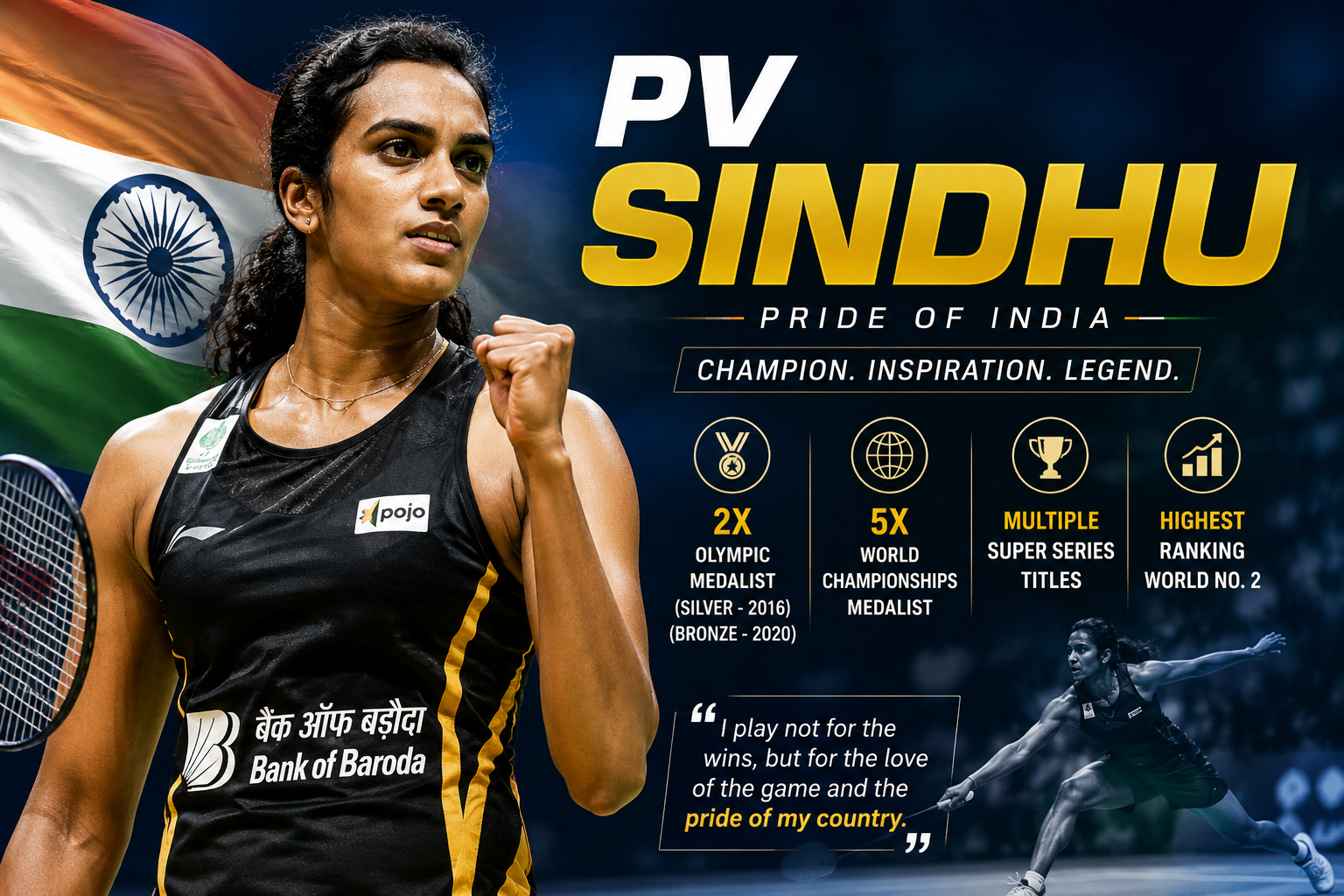
PV Sindhus performance is changing the way top badminton players deal with staying strong dealing with injuries and keeping their energy up at the level. At 31 the Indian badminton star PV Sindhu is not just staying in her place—she is completely changing how she plays. After a loss in the pre-quarterfinals at the World Championships in Delhi to the third seed from China Wang Zhi Yi the loss was hard to take but what happened after the match told a different story. Unlike in the past when she was very tired after matches Sindhu came out of the match feeling strong talking clearly and not all worn out after an 88-minute match that was very tough.
This big change in how she feels is because of a plan made by her head of performance Wayne Lombard along with sports physiotherapist Heera Mundluru, coach Irwansyah and a team of experts. Of making her train a lot the team tried a new way of working called “reverse engineering.”
Here is a look at how new science, careful movement, better rest and smart tools are helping PV Sindhu come back stronger.
PV Sindhu Performance New Plan: Changing How She Plays
The start of Sindhus change came at a moment in late 2025. After a break in her left foot after the 2022 Commonwealth Games and more problems with her hamstring Sindhu had a lot of questions, about how fast she could move and how strong she was.
Of trying to push through a busy competition schedule her team decided to stop her season completely in October 2025.
I see how Lombard’s strategy reversed the training model. Of adjusting physical conditioning to fit random workloads the team first isolated the exact movement demands of world‑class badminton and then built the conditioning plan backwards.
– Targeted Workloads: The team moved away, from endless multi‑shuttle drills and focused on hyper‑specific intensity windows.
– Integrated Support: The team combined strength and conditioning physiotherapy, nutrition timing and sleep tracking into one unified performance system.
– Quality Over Quantity: The team recognized that an experienced veteran needs targeted stimulus instead of large training volume.
12-Clock Movement Mapping & Data-Driven Training
Because indoor badminton arenas block satellite GPS signals Sindhus team used advanced accelerometer‑based inertial movement tracking. This technology records accelerations, deceleration rates, direction changes and player load metrics in time.
By mapping match movement patterns across a 360-degree clock directional system (from 1 to 12 o’clock), the team identified precisely how elite opponents—particularly top Chinese players and An Se-young—attempt to exploit her court coverage.
| Performance Metric | Data Value | Tactical Application |
| Peak Match Distance | 4.1 kilometers (Japan Open) | Establishes the maximum endurance threshold required for elite finals. |
| Player Load Rating | Composite index (acceleration + direction shifts) | Calibrates daily training sessions to mirror match strain. |
| Intensity Calibration | Target 85% to 100% match intensity | Ensures simulated rally stress directly reflects real-world tournament conditions. |
| Directional Profiling | 360-degree movement vectors | Highlights high-intensity directional weakness to eliminate opponent targeting. |
This precise calibration directly translated to on-court results, culminating in her triumph at the Japan Open—beating reigning world champion Akane Yamaguchi 21-17, 21-17 to claim her first Super 750 title since 2018.
Revolutionary Recovery: Why ‘Less is More’ Works
One of the most radical aspects of Lombard’s regime involves challenging traditional recovery dogma. Instead of relying constantly on post-training ice baths and artificial recovery modalities, the team deliberately withholding these interventions during specific training blocks.
“I want physiology to do the work. I want physiology to adapt to the training… We starved the body of some of these modalities, and then as we start adding them in, we start seeing how recovery actually improves.”
— Wayne Lombard, Head of Performance
By allowing the body’s natural inflammatory and adaptive processes to trigger without immediate chemical or thermal suppression, her biological baseline for recovery improved significantly.
The 10-Hour Circadian Sleep Strategy
Badminton tournament schedules are notoriously unpredictable, often featuring late-night match finishes followed by early afternoon fixtures. To combat sleep deprivation and circadian disruption, her team abandoned the standard rigid 8-hour nightly sleep model.
24-Hour Cumulative Target: Accumulate a total of 10 hours of high-quality sleep across a 24-hour cycle regardless of match timing.
Fixed Nap Intervals: Naps are strictly timed at either 30 minutes (to avoid sleep inertia) or 90 minutes (a complete REM/slow-wave sleep cycle).
Elimination of Mid-Zone Naps: Avoiding 45-to-60-minute naps, which induce grogginess caused by awakening mid-deep sleep.
Biometric Tracking: Wearables and Mental Resilience
To manage physical strain and prevent overtraining, Sindhu uses continuous biometric tracking through Whoop alongside experimental internal-load systems like Temple. These devices track:
Heart Rate Variability (HRV): Guiding daily training readiness and central nervous system recovery.
Strain Accumulation: Preventing cumulative fatigue before micro-tears turn into full-scale injuries.
Cognitive Load Monitoring: Measuring mental alertness and fatigue during multi-game matches.
This continuous feedback loop allows Sindhu to adapt her tactical execution based on her daily physiological capacity. On days where she operates at 60% physical capacity, her extensive match experience allows her to adapt her tactics, lengthen rallies, and rely on net play rather than forcing high-risk rear-court attacks.
Longevity and the 2027 Rule Changes
Sindhu forms part of a remarkable generation of veterans—alongside Akane Yamaguchi (29), Ratchanok Intanon (31), and Nozomi Okuhara (31)—who continue to dominate world badminton through tactical adaptation rather than raw physical output.
With the Badminton World Federation (BWF) approving a historic scoring system change set for January 2027—transitioning from best-of-three 21-point games to best-of-three 15-point games—the emphasis on explosive starts, movement economy, and tactical variety will become even more vital.
Through scientific workload management, data-backed movement drills, and strategic recovery, PV Sindhu has built a durable physical foundation designed not just to preserve her career, but to keep her competing for top titles on her own terms.