

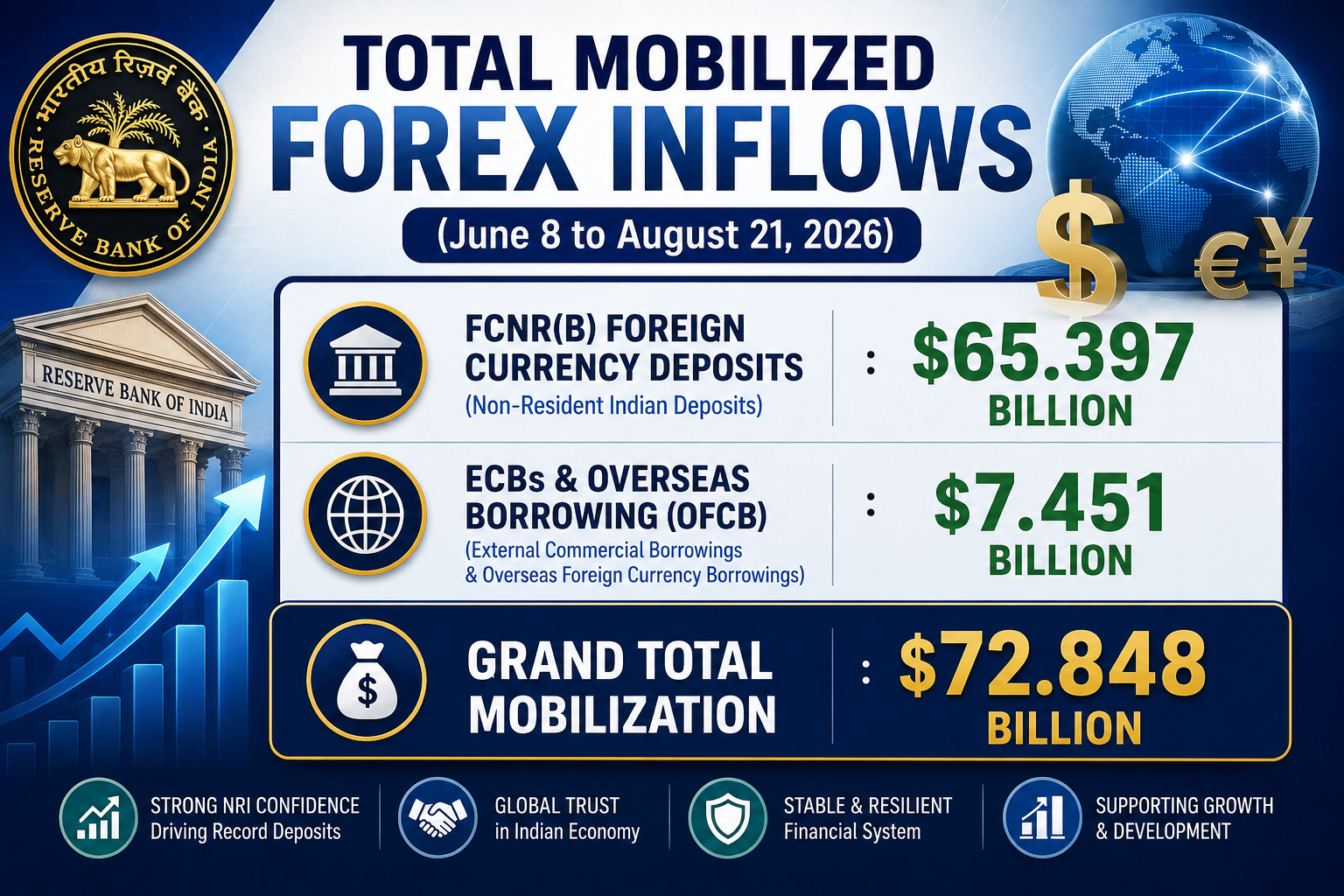
Foreign currency deposits across Indian financial institutions have surged past $65 billion in just 75 days, driven by thousands of global non-resident Indian investors moving money back home to capture elevated interest rates. Latest operational figures released by the Reserve Bank of India highlight that foreign currency non-resident, or FCNR(B), accounts reached $65.397 billion as of August 21, 2026. When combined with overseas foreign currency borrowing by banks and external commercial borrowings, total mobilization under the central bank’s special incentive window reached $72.85 billion.
This rapid inflow of capital comes after the central bank launched a dedicated forex swap mechanism on June 8, 2026. The program offered concessional swap facilities to commercial lenders to build foreign currency buffers and calm spot currency volatility. The rush by investors to lock in yields between 6.00% and 7.50% on foreign currency deposits of three-to-five-year tenors triggered an unprecedented influx from India’s estimated 35 million diaspora.
What Driven the Sudden Surge in NRI Capital Flow?
The momentum behind foreign currency deposits stems from a combination of global market rate differentials and bank-led leverage programs offered to NRI accounts. Between June 8 and August 21, depositors poured roughly $870 million per day into fixed foreign currency tenure options.
To make the scheme even more attractive, several domestic commercial lenders offered structured leverage products to overseas depositors. Under these frameworks, non-resident clients could leverage offshore holdings to park significantly larger sums into domestic foreign currency accounts. Banks then funded these operations by accessing overseas markets directly. RBI records show banks raised $4.860 billion through the Overseas Foreign Currency Borrowing (OFCB) channel during the same 75-day period.
As the original August deadline approached, deposit collection accelerated rather than slowed down. Indian banks mobilized $13.097 billion in the final eight days leading into August 21, building on top of $15.575 billion collected between August 1 and August 13.
RBI Strategic Policy Shifts and Early Swap Window Closure
Markets were caught off guard when Reserve Bank Governor Sanjay Malhotra announced that the central bank was moving forward the deadline for the concessional FCNR deposit swap facility by a full month, setting the new close date to August 31, 2026. Originally, the swap facility was scheduled to remain open through late September.
Governor Malhotra defended the decision during a press briefing, characterizing the move as a data-driven operational calibration rather than a policy reversal. He noted that while the announcement felt abrupt to market participants, financial institutions had received enough lead time to arrange their remaining books.
“Every additional dollar swapped through specialized central bank windows carries a diminishing marginal utility once primary liquidity goals are fulfilled,” Malhotra stated during the policy update.
Economic analysts echoed this reasoning. Saumya Kanti Ghosh, Group Chief Economic Advisor at State Bank of India, noted that the primary justification for closing the deposit window early was simply that the central bank’s internal target had already been hit. Ghosh projected that overall collections under the deposit route could touch $85 billion before all final settlements settle, providing India with a Balance of Payments surplus of around $50 billion and keeping the Current Account Deficit anchored near 1 percent of gross domestic product.
While the concessional facility for foreign currency deposits closes on August 31, the central bank confirmed that swap windows for External Commercial Borrowings (ECBs) and Overseas Foreign Currency Borrowing (OFCB) frameworks will remain open through December 31, 2026.
How Commercial Banks Tapped Overseas Bond Markets
Parallel to NRI deposit collection, major private sector banks launched large debt issuances abroad to take full advantage of foreign currency borrowing allowances under the August 14 guidelines.

HDFC Bank, Indias private sector lender finished a $1.75 billion bond issue in dollars through its Gujarat International Finance Tec-City (GIFT City) branch. This deal is HDFC Banks overseas debt fundraiser since the 2008 global financial crisis. HDFC Bank split the issue into two tranches:
- 3-Year Tranche: $500 million fixed-rate notes
- 5-Year Tranche: $1.25 billion fixed-rate notes
Other private lenders followed with new and larger debt offerings. IDFC First Bank finished a $500 million overseas bond sale while Kotak Mahindra Bank raised about $650 million in its 5-year dollar bond issuance. The money from these issuances gives lenders long‑term dollar liquidity and strengthens their capital buffers.
Currency Market Impact: Rupee Realities vs. 2013 Comparisons
I was surprised that the Indian Rupee has shown spot market appreciation despite the huge inflow of $72.85 billion in combined capital. The Indian Rupee has stayed near its early‑June trading levels, which baffles market participants who expected a currency rally, like previous dollar‑raising cycles.
When India ran an overseas dollar mobilization scheme during the tapering volatility of 2013 the Indian Rupee surged sharply as dollar supply flooded spot markets. In 2026 however spot markets have reacted with stability instead of a major rally.
Market traders attribute this price behavior to counterbalancing global market factors:
Active Central Bank Absorption: The RBI has aggressively absorbed incoming foreign currency deposits into official foreign exchange reserves rather than allowing excess liquidity to flood the spot exchange market.
Global Trade Deficit Adjustments: Steady import demand and ongoing global commodity price fluctuations have generated persistent underlying dollar demand from corporate importers.
External Realignment: Importers used the increased dollar availability to settle short-term trade credits, neutralizing immediate appreciation pressures on the rupee.
Rather than driving artificial currency appreciation, the $65 billion deposit surge has acted as a stabilizing cushion, keeping the rupee steady throughout seasonal market fluctuations.
Comparative Dynamics: 2013 vs. 2026 Mobilization
| Parameter | 2013 Dollar Mobilization | 2026 Foreign Currency Scheme |
| Primary Incentive | Crisis-driven emergency response | Proactive reserve calibration |
| Total FCNR Accumulation | ~$26 Billion | $65.39 Billion (75 Days) |
| Average Deposit Yields | 5.00% – 5.50% | 6.00% – 7.50% |
| Rupee Price Reaction | Sharp upward rally | Range-bound stability |
| Overall Forex Target | $30 Billion | $80 Billion – $85 Billion |
Looking Ahead: Final Outlook for Forex Inflows
With a few days left before the August 31 closure of the concessional FCNR swap window it looks like the total collections will go past the $80 billion goal that policymakers set.
A mix of yield foreign currency deposits, bank programs and lots of bonds from private lenders has helped make Indias external accounts much stronger. Even though the rupee did not jump up in price much the huge buildup, in foreign currency deposits means the financial sector will have plenty of foreign exchange reserves as we move into the final quarters of 2026.