
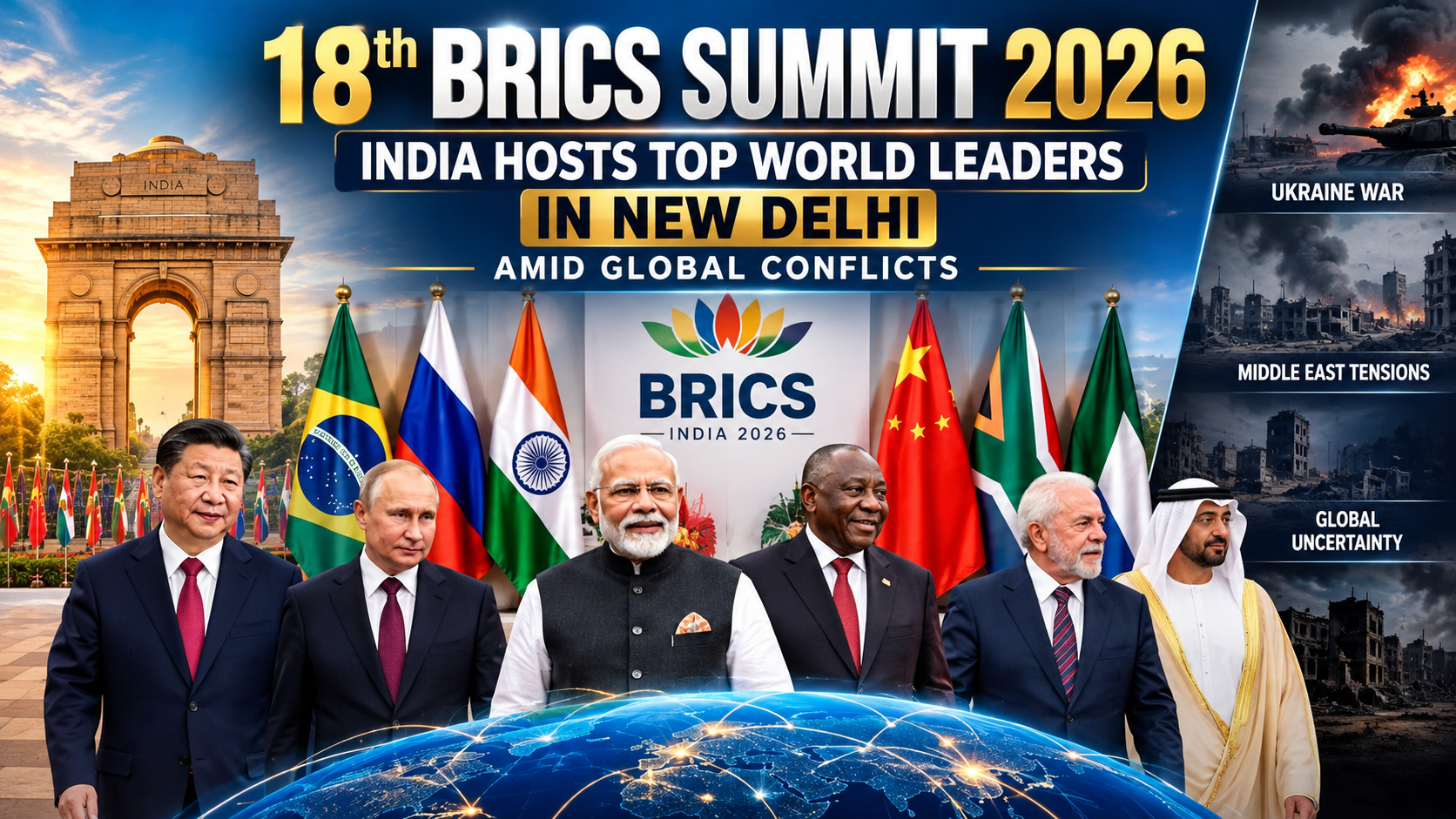
The 18th BRICS Summit 2026 officially began in New Delhi. Prime Minister Narendra Modi welcomed world leaders, including Russian President Vladimir Putin and Chinese President Xi Jinping for high‑stakes world politics and economic talks. The 18th BRICS Summit 2026 is being held with security at Bharat Mandapam. India is now at the heart of diplomacy as the 11‑member group looks for agreement amid major world conflicts, trade disputes and changes in the economy.
With than 15,000 security guards on duty, strict traffic detours across the capital and special airspace rules New Delhi has turned into a tight‑security fortress. Behind doors leaders are working on a huge agenda: bridging sharp internal world‑politics divisions increasing cross‑border trade, in local currencies and supporting the economic priorities of the Global South.
What Is the Agenda for the BRICS Summit 2026?
The expanded 11-member grouping—comprising Brazil, China, Egypt, Ethiopia, India, Indonesia, Iran, Russia, Saudi Arabia, South Africa and the United Arab Emirates—faces its complex diplomatic landscape since its inception in 2009.
As the 2026 BRICS Chair India has focused its presidency on a centric “people-first” development agenda. Throughout the year India hosted over 350 meetings covering food security, agricultural tech, healthcare, energy resilience and support for micro, small and medium enterprises (MSMEs).
Core Priorities on the Delhi Table
- Intra-Bloc Trade and Market Access: Unlocking bottlenecks facilitating faster customs clearances and expanding trade across member nations.
- Services Market Integration: Opening up services sectors, streamlining -border professional movement and establishing mutual recognition of qualifications.
- Agri-Tech Collaboration: Partnering on innovation and startup ecosystems to protect long-term food security.
- Local Currency Settlement: Expanding the scope of the New Development Bank (NDB) to finance projects using currencies and improving cross-border payment interoperability without completely abandoning established financial architectures.
- Reforming Multilateral Institutions: Driving voice and equity for emerging economies within financial institutions dominated by Western frameworks.
Addressing the BRICS Business Forum opening session Union Minister of Commerce and Industry Piyush Goyal emphasized the need, for economic integration:
“Let us also encourage our agri-tech startups to develop solutions together for farmers across the BRICS nations in the interest of food security for our people. Let us open our services markets to each other in a real sense.”
Who Is Attending the Summit in New Delhi?
The New Delhi summit brings together heads of state, top foreign dignitaries, and global institutional representatives.
| Country / Organization | Representative / Attendee | Designation |
| India | Narendra Modi | Prime Minister (Host) |
| Russia | Vladimir Putin | President |
| China | Xi Jinping | President |
| Iran | Masoud Pezeshkian | President |
| South Africa | Cyril Ramaphosa | President |
| Egypt | Abdel Fattah el-Sisi | President |
| Ethiopia | Abiy Ahmed | Prime Minister |
| Indonesia | Prabowo Subianto | President |
| Belarus | Alexander Lukashenko | President (Partner Country) |
| Kazakhstan | Kassym-Jomart Tokayev | President (Partner Country) |
| Malaysia | Anwar Ibrahim | Prime Minister (Partner Country) |
| Thailand | Anutin Charnvirakul | Prime Minister (Partner Country) |
| Brazil | Mauro Vieira | Foreign Minister |
| United Arab Emirates | Sheikh Khaled bin Mohamed bin Zayed Al Nahyan | Crown Prince of Abu Dhabi |
| United Nations | António Guterres | Secretary-General |
Key High-Stakes Bilateral Meetings on the Sidelines
The summit provides a neutral platform for critical side conversations among nations navigating complex bilateral relations.
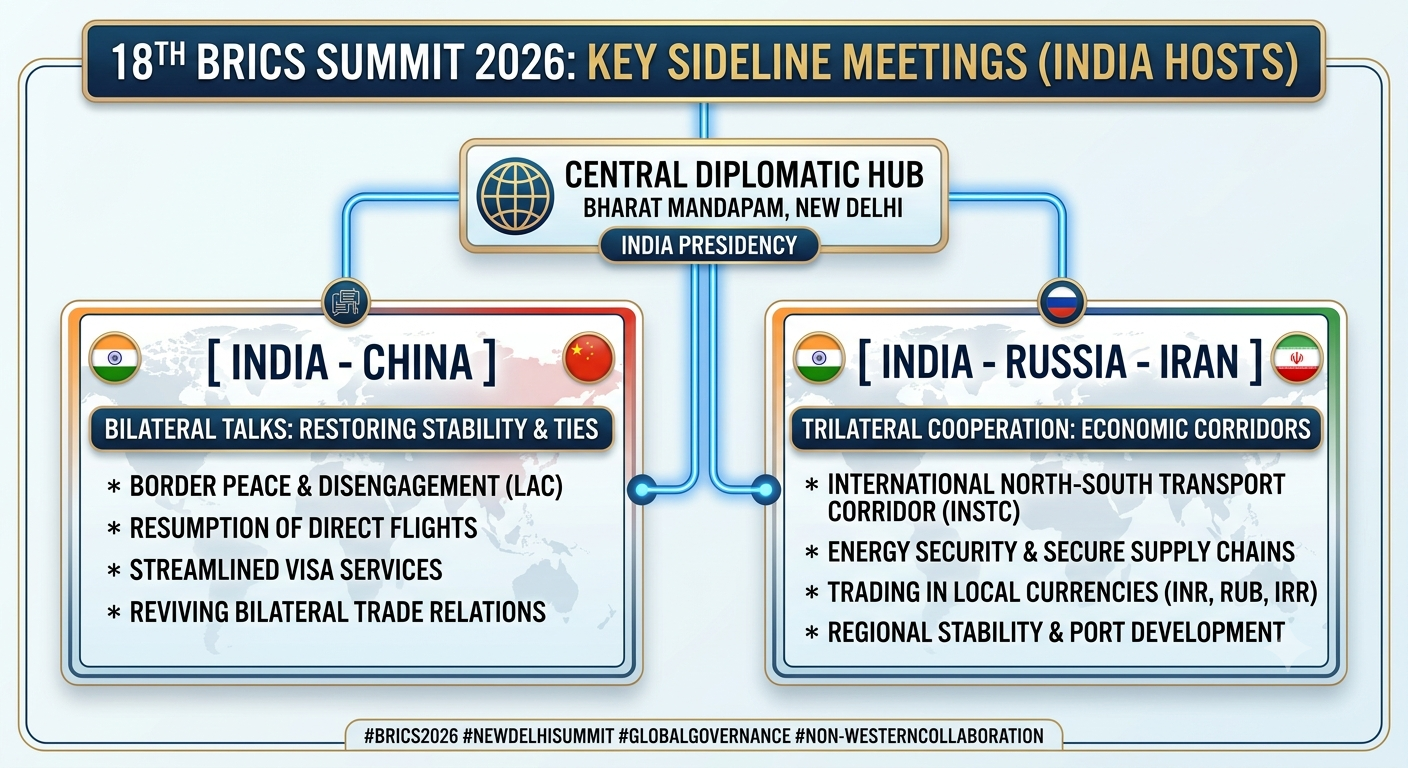
1. India–China Bilateral Warmth
Chinese President Xi Jinping’s visit marks his return to India after six years. Following the severe strain caused by the 2020 Galwan Valley border clashes, relations have gradually stabilized. Discussions focus on sustaining peace along the Line of Actual Control (LAC), expanding direct flight connectivity, restoring visa processing, and easing commercial restrictions between two of Asia’s largest economies.
2. India–Russia Strategic Talks
Russian President Vladimir Putin and PM Narendra Modi are holding dedicated discussions on expanding bilateral trade, securing energy supply chains, and resolving transaction mechanisms for ongoing defense and economic agreements.
3. India–Iran Energy and Corridor Discussions
Iranian President Masoud Pezeshkian and PM Modi are evaluating trade route resilience, specifically focusing on the operational development of the Chabahar Port and regional stability across trade sea lanes.
Complete 3-Day Event Itinerary
All primary diplomatic sessions, exhibitions, and plenary talks are taking place at Bharat Mandapam, New Delhi.
Friday, September 11, 2026
09:30 AM – 10:15 AM: Opening Session & Welcome Remarks
10:30 AM – 02:35 PM: Thematic Plenary Discussions
02:35 PM – 03:30 PM: Official Working Lunch
03:30 PM – 04:30 PM: “Showcasing India’s BRICS Journey” Exhibition
05:00 PM – 06:00 PM: Leaders’ Strategic Session
Saturday, September 12, 2026
02:00 PM: Arrival of BRICS Heads of State
02:35 PM: Closed Session: “Inclusive Global Governance and Strengthening Multilateralism”
04:25 PM: Delegation Tour: “Bharat Innovates Exhibition”
05:05 PM: Official BRICS Family Photograph
05:10 PM: Joint Ceremonial Tree Plantation
07:30 PM: Official Gala Dinner hosted by Prime Minister Modi
Sunday, September 13, 2026
09:55 AM: Arrival of BRICS Partner Countries & Outreach Invitees
10:35 AM: Extended Family Photograph
10:50 AM: Open Plenary Session: “Resilience, Innovation, Cooperation, and Sustainability: Shaping the Future for Inclusive Global Growth”
Massive Security Blanket and Capital Restrictions
To ensure seamless movement and maximum security for visiting VVIP convoys, New Delhi has put exhaustive logistics and monitoring plans into motion.
                   [ Delhi Security Infrastructure ]
|| Ground Deployment | Airspace Control | Surveillance Net |
| 15,000+ Police Personnel | 300-km Airspace Restriction Zone | 500+ High-Resolution CCTVs |
| 200 Paramilitary Units | Safdarjung Airport Closed | Facial Recognition & ANPR |
Airspace Restrictions
No-Fly Restrictions: The Airports Authority of India (AAI) has placed strict limits on non-scheduled flights within a 300-km radius of Delhi between 7:00 AM and 11:00 PM (Sept 11–13).
Commercial Exemption: Commercial scheduled flights remain operational, though subject to designated altitude limits (FL290 clearance 200 km out from Delhi).
Airport Status: Safdarjung Airport is closed for non-emergency operations; Rohini Helipad is fully closed. Over 35 VVIP charter flights are landing at IGI Airport.
Traffic and Transit Directives
Affected Corridors: Regulated movement and temporary holds apply to Mathura Road, Sardar Patel Marg, Shanti Path, Janpath, Ashoka Road, Tolstoy Marg, and APJ Abdul Kalam Road.
Public Transport: Delhi Metro services are running normally across all lines, offering the most reliable transit option for commuters across the National Capital Region (NCR).
Rail Operations: Northern Railway has implemented short-terminations, diversions, and temporary schedule changes around New Delhi Railway Station (NDLS).
Geopolitical Nuances: Balancing Non-Western Ambitions
The diplomatic challenge at this summit is clear: bringing together countries with different views on current conflicts. These nations are not all aligned in the way so finding common ground is not easy.
BRICS is not a group that openly opposes the West. Instead it is a forum for -Western countries to work together. Some members, like Russia and Iran face sanctions from Western nations.. Others, such as India, Brazil, South Africa and the UAE have strong economic relationships with both Western and non-Western powers. This difference makes unity harder to achieve.
Because of this mix of interests the final joint communique must be carefully worded. The language needs to reflect concerns about global conflicts without upsetting any member’s economic ties. With tensions affecting trade, around the world negotiators must balance firm stances with practical considerations. Their goal is to speak with one voice while still protecting the interests of every nation involved.
Key Takeaways for Global Markets
Trade Friction Reductions: Member countries are pushing to eliminate non-tariff barriers, speed up shipment clearances, and open cross-border services.
Payment Interoperability: A renewed emphasis on local currency trade settlements aims to lower foreign exchange risks for emerging markets.
South-South Cooperation: Strengthening supply chains in food, energy, and technology ensures emerging markets build resilience against broader geopolitical disruptions.
Suggested Next Steps
If you are following the geopolitical and economic outcomes of this event, consider exploring these deeper topics:
Joint Communiqué Analysis: Breakdown of the final signed New Delhi BRICS Declaration once released.
Bilateral Trade Outcomes: Details on specific agreements signed between India, China, and Russia on energy and technology.
Local Currency Payment Systems: How the New Development Bank (NDB) plans to expand trade settlements outside the US dollar.