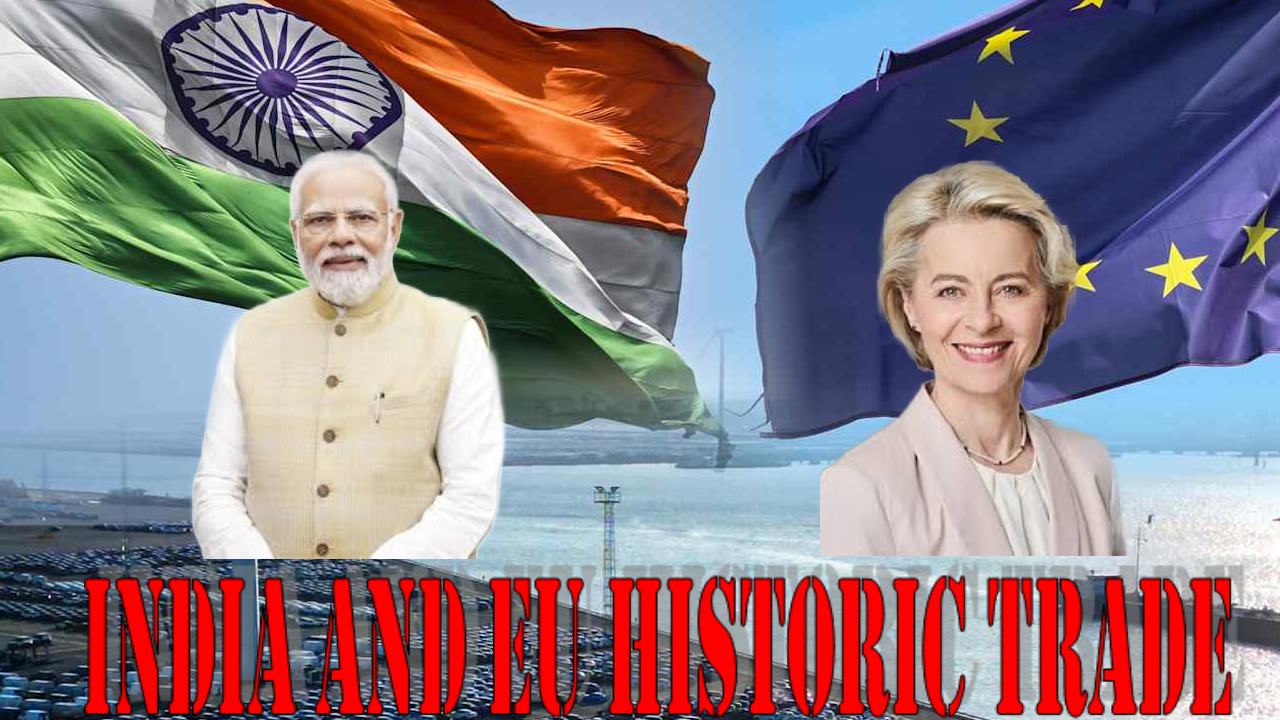
“Mother of All Deals”: India and EU Near Historic Trade Pact as Strategic Shield Against Trump’s Tariff Storm.European Commission President Ursula von der Leyen (left) with Indian Prime Minister Narendra Modi earlier this year. India and the EU have been negotiating a free trade deal on and off for nearly two decades.
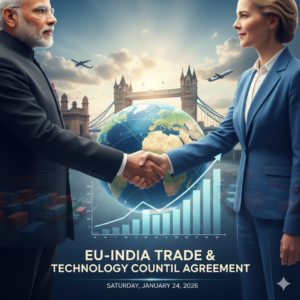
NEW DELHI — When European Council President António Costa and European Commission President Ursula von der Leyen take their seats as Chief Guests at India’s Republic Day parade this Monday, the display of tanks and cultural floats will be secondary to a much higher-stakes performance.
Behind the ceremonial banquets, the leaders of the world’s largest democracy and the world’s largest trading bloc are moving to finalize what Commerce Minister Piyush Goyal has dubbed the “mother of all deals.“ After 18 years of stalled negotiations and hard bargaining, the India-EU Free Trade Agreement (FTA) is reportedly on the cusp of completion, with a formal announcement expected at the high-level summit on January 27.
A Strategic Shield Against Washington
The timing of this diplomatic embrace is no coincidence. Both New Delhi and Brussels are navigating a “tumultuous” global trade environment defined by the protectionist policies of U.S. President Donald Trump.
- The India Hit: Washington has maintained a crushing 50% tariff on Indian exports—initially sparked by New Delhi’s refusal to halt Russian oil purchases—which has seen Indian merchandise shipments to the U.S. plummet.
- The EU Friction: Europe has faced its own “Trumpian” pressures, including threats of escalated trade wars over the U.S. administration’s pursuit of a Greenland takeover.
By accelerating this pact, Delhi is sending a clear signal of strategic autonomy. As Chietigj Bajpaee of Chatham House told the BBC:
“It sends a signal that India maintains a diversified foreign policy… and that it is not beholden to the whims of the Trump administration.”
Inside the ‘Mother of All Deals’
The scale of the agreement is staggering. Linking two economies representing nearly 2 billion people and 25% of global GDP, the deal aims to slash duties on everything from high-end European machinery and wines to Indian textiles and pharmaceuticals.
| Key Feature | Description |
| Market Access | EU seeks zero duties on 95% of goods; India is holding firm at roughly 90%. |
| Sensitive Sectors | Agriculture and dairy remain largely excluded to protect Indian farmers. |
| Professional Mobility | A key win for India, easing visas for IT and healthcare professionals. |
| Defense & Security | A first-of-its-kind Security and Defence Partnership (SDP) to be signed alongside the FTA. |
A Pivot Toward Reliability
For the EU, the deal is a cornerstone of its “de-risking” strategy, aimed at reducing a decades-long reliance on China. For India, it is a necessary pivot to offset the volatility of the American market.
Analysts suggest this deal marks the moment India finally sheds its “protectionist carapace” in favor of deep integration with reliable global partners. With India on track to overtake Japan as the world’s fourth-largest economy this year, the EU sees the subcontinent as the “economic powerhouse of the century.”
While the deal still faces “legal scrubbing” and a vote in the European Parliament, the political will in New Delhi this week suggests that after two decades of waiting, the finish line has finally been reached.
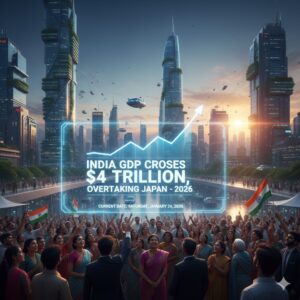
India is on track to cross $4tn in GDP, overtaking Japan this year
Beyond the handshake and the Republic Day parades, the impending Free Trade Agreement (FTA) between India and the European Union (EU) is a calculated strategic pivot. For both New Delhi and Brussels, the deal is less of a luxury and more of an economic necessity in an increasingly volatile global trade landscape.
Here is a breakdown of what is at stake for both parties as they prepare to finalize the pact on January 27, 2026.
For Europe: Access to the “Growth Engine of the Century”
The EU is betting on India’s massive domestic expansion to offset its own sluggish growth and trade tensions with the U.S. and China.
- A Market of 2 Billion: As European Commission President Ursula von der Leyen highlighted at Davos, joining forces creates a seamless market of two billion people, controlling 25% of global GDP.
- Overtaking Japan: India is currently the world’s fastest-growing major economy. Having crossed the $4.1 trillion milestone, it has officially overtaken Japan this year to become the world’s 4th largest economy.
- De-risking from China: For Brussels, India represents a reliable, democratic alternative for manufacturing and supply chains as the bloc moves to reduce its dependence on Beijing.
For India: Restoring Competitiveness and Diversifying Risk
For New Delhi, the deal is a vital lifeline for its exporters who have been squeezed by recent policy changes and American protectionism.
- Restoring GSP Benefits: A major driver for India is the restoration of the Generalised System of Preferences (GSP). As of January 1, 2026, the EU suspended these benefits for 87% of Indian industrial exports, meaning sectors like textiles, chemicals, and steel now face higher import duties. The FTA would effectively nullify these barriers.
- The “Trump Buffer”: With the U.S. maintaining a 50% tariff on many Indian goods, the EU (India’s largest trading bloc) offers an alternative destination for high-value exports like pharmaceuticals, machinery, and jewelry.
- Trade Surplus Potential: India currently enjoys a trade surplus with the EU (roughly $76bn in exports vs. $61bn in imports). The FTA aims to double this export volume over the next three years.
The “Phased” Compromise: Sensitive Sectors
While both sides want a deal, they are navigating deep-seated “red lines” through a phased approach:
| Sector | Strategy | Impact |
| Agriculture & Dairy | Excluded | India has kept these sectors off the table to protect millions of subsistence farmers. |
| Automobiles | Phased Reduction | High duties (often exceeding 100%) will likely drop to 10% over a 10-year period, mirroring the India-UK deal. |
| Wine & Spirits | Quota System | Gradual tariff cuts for premium European labels (France, Italy, Spain) while protecting local manufacturers. |
| Services (IT) | Mobility Focus | India is pushing for “Mode 4” access—easier visas for IT and healthcare professionals to work in the EU. |
The Bottom Line
The “Mother of All Deals” is more than a list of tariff cuts; it is a structural realignment. By moving the most sensitive issues to subsequent rounds, the two sides are prioritizing the geopolitical symbolism of the deal. At a time when Washington is turning inward, New Delhi and Brussels are choosing to prove that large-scale, rules-based multilateralism still has a future.
Disclaimer: This information is based on various inputs from news agency