
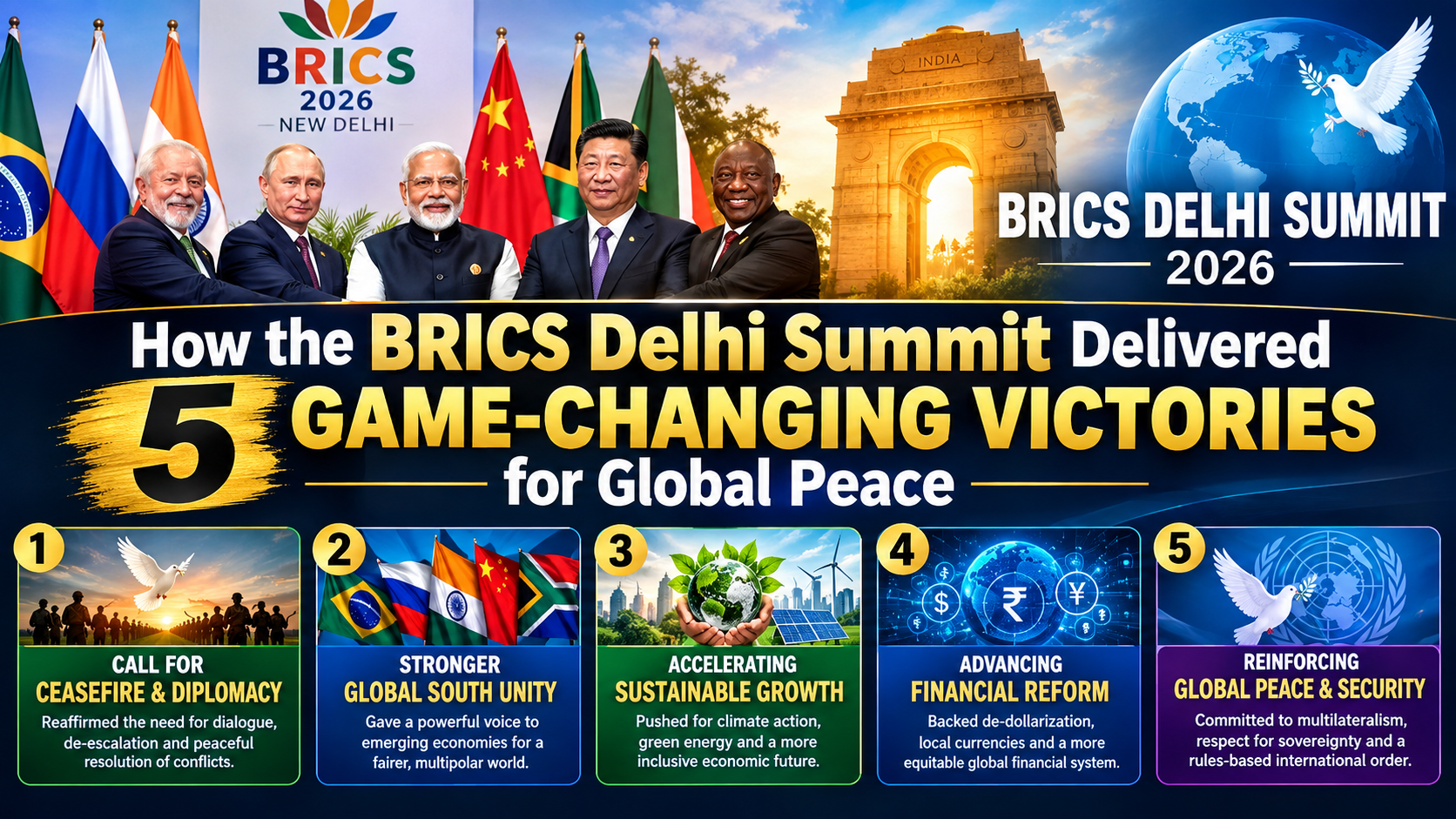
The Brics Delhi Summit was a test of global diplomacy. When leaders from around the world came together in New Delhi the situation in the world was very unstable. Two big wars were happening global supply chains were having problems and trade protectionism was increasing. Also the expansion of Brics from five countries to eleven brought different strategic goals together in one place.
This year big disagreements about West Asia stopped Brics foreign ministers from making joint statements—first in New Delhi in May and before that in Rio de Janeiro in April 2025. Because of that past a lot of people around the world wondered if the larger group of eleven members could even agree on anything.
Despite those doubts Prime Minister Narendra Modi and Indian diplomats managed to get all the member countries to agree on the New Delhi Declaration by complete agreement. By bringing people focusing on the problems of the Global South and stopping the group from becoming an anti-Western group India showed great skill, in handling international relations.
Here is a detailed breakdown of the five major victories India achieved at the historic summit.
1. New Delhi Provided the Stage for a Rare Iran-UAE Bilateral
The immediate challenge at the summit came from the ongoing conflict in West Asia. Since 2026 military actions across the region had pushed Iran and the United Arab Emirates into opposing sides. The situation had become so tense that Brics foreign ministers were unable to release a statement just a few months prior because they couldn’t agree on how to word their remarks about the US, Israel and regional security.
       [ Iran-UAE Geopolitical Rift ]
                     │
    (May 2026: Joint Statement Fails)
                     │
                     ▼
  [ New Delhi Summit: Diplomatic Bridge ]
                     │
    (Brics Consensus on Restraint)
                     │
                     ▼
 [ Historic Pezeshkian-Sheikh Khaled Meeting ]
India stepped in quietly to prevent disputes from disrupting the summit’s main goals. New Delhi offered a location with high visibility, which made it possible for the two nations to talk in a constructive way.
The result was a shared commitment to Restraint. Both Iran and the UAE signed the declaration. It called for diplomacy, respect for national sovereignty and protection of civilian infrastructure in West Asia.
There was also Direct Dialogue. On the sidelines of the summit Iranian President Masoud Pezeshkian met with Abu Dhabi’s Crown Prince Sheikh Khaled bin Mohamed bin Zayed Al Nahyan. This meeting was the highest-level encounter between the two countries since the conflict worsened.
By turning a source of tension into a space, for conversation Indian diplomacy helped keep the summit’s agenda on track.
2. India Restored Consensus and Safeguarded Brics’ Credibility
When Brics added six members, people who didn’t like the group said it would stop working properly. The fact that no official statement was made while Brazil was in charge in Rio de Janeiro in April 2025 made some concerns: could a bigger and more varied Brics work together as one?
India answered that question at the Brics Delhi Summit by creating a full agreement that was signed by all 11 countries in the group.
| Summit Dimension | Previous Challenge (2025–Mid 2026) | New Delhi Summit Outcome |
| Joint Consensus | Failed communiques; reliance on Chair statements | Full adoption of the New Delhi Declaration |
| Institutional Unity | Sharp splits on West Asia & global trade | Unanimous commitment to Brics economic framework |
| Global South Agenda | Fragmented focus across competing national priorities | Direct backing for multilateralism and UN reform |
The New Delhi Declaration was more than friendly words. It provided steps for:
Global Governance Reform: Asking for say for developing countries in the IMF, the World Bank and the UN Security Council.
Economic Resiliency: Making supply chains stronger improving public systems and working together on new ideas.
Future Technologies: Making rules for Artificial Intelligence (AI) and moving towards energy.
A known economist named Jeffrey Sachs said this was a big success. He said India did a job getting everyone to agree during a really tough time in world politics just like it did when it was, in charge of the G20.
3. Explicit Condemnation of the Pahalgam Terror Attack
Counter-terrorism has long been a foundational pillar of India’s foreign policy. Securing firm, explicit anti-terror language inside a multilateral declaration that includes China—a close strategic partner of Pakistan—is historically challenging.
During the summit, India successfully secured explicit collective condemnation of the April 22, 2025, Pahalgam terrorist attack in Jammu and Kashmir, which claimed 26 lives.
“The Brics members condemn in the strongest terms the terrorist attack in Jammu and Kashmir… all those involved in terrorist activities and their supporters must be held accountable and brought to justice.”
— Excerpt from the New Delhi Declaration
Key highlights of the summit’s counter-terrorism stance include:
Zero Tolerance Framework: The declaration calls for an absolute rejection of double standards when dealing with global terrorism.
Targeting Support Networks: It explicitly addresses cross-border movement, terror financing networks, and safe havens.
Diplomatic Alignment: By embedding the Pahalgam issue within the broader Brics security agenda, India focused the bloc on practical accountability without derailing general proceedings.
4. Keeping Brics Focused on a “Non-West” Agenda Rather Than an “Anti-West” Platform
With Russia under sanctions and China in a long‑term strategic rivalry with the United States there was strong pressure to pull Brics into a clear anti‑Western alliance.
India consistently pushed back against this push steering the bloc toward a “stance that gives priority to development instead of confrontation.
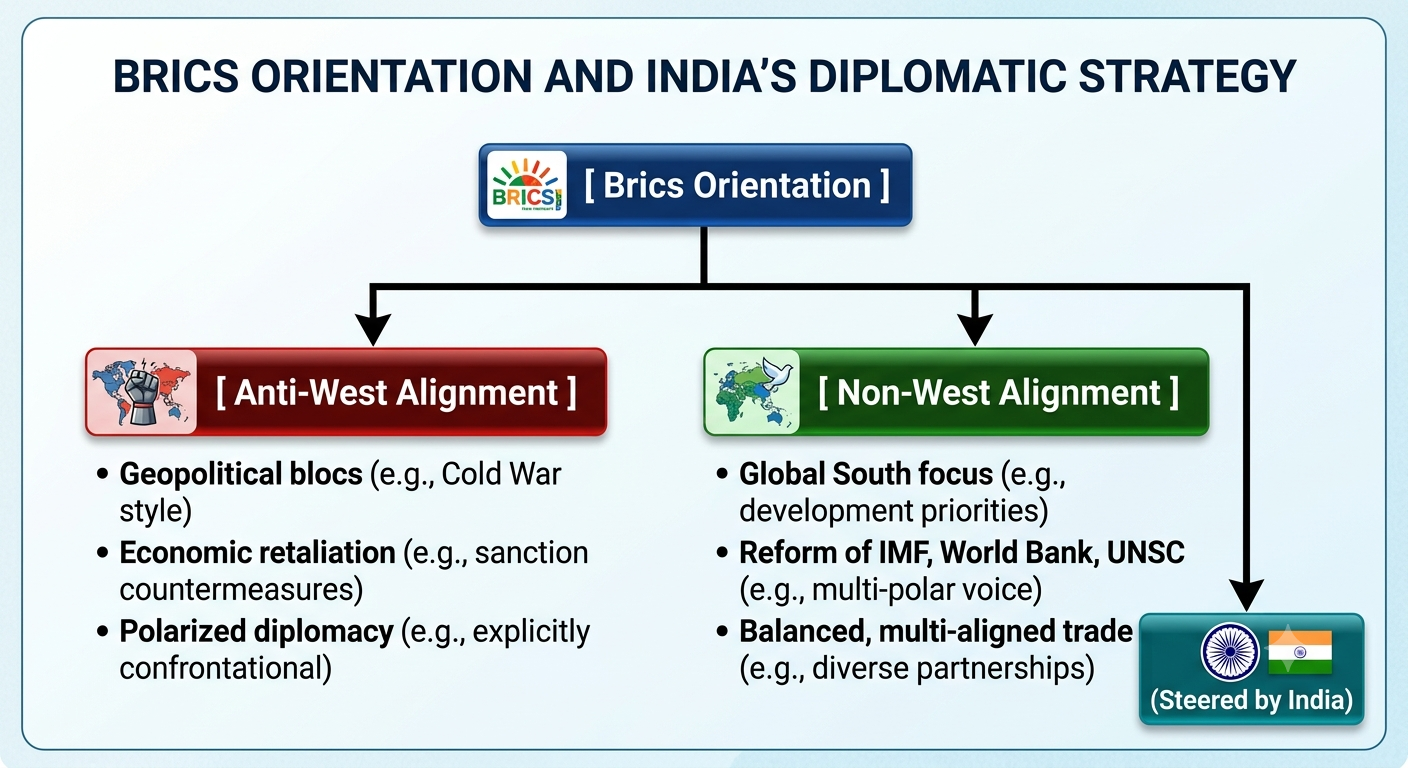
Former Indian diplomat Veena Sikri summed up this position very clearly: “We are not anti‑West; we want to live as one world.”
India balanced the criticism of trade tariffs and coercive economic measures with constructive appeals for open rules‑based multilateral trade. In addition India preserved its independence keeping strong ties with Western powers while leading discussions, among developing countries.
5. Successfully Navigating an Expanded Bloc Through Geopolitical Turmoil
Managing a 5‑member Brics required a lot of negotiation. Coordinating an 11‑member Brics while the world faces economic uncertainty needs a deal of balance. The larger Brics group brings together different political models, economic priorities and foreign policies.
During three days, in New Delhi Prime Minister Modi met with 15 visiting heads of state in formal bilateral meetings. This direct diplomatic work made sure that each country’s concerns were heard before any final papers were written.
       [ 11 Diverse Member Nations ]
                     │
     (15 Formal Bilateral Meetings)
                     │
                     ▼
  [ Focus on Global South Development ]
  • Digital Public Infrastructure (DPI)
  • Renewable Energy & Climate Finance
  • Startup & Innovation Networks
The success of this approach showed results that go beyond politics. India’s Brics Sherpa, Sudhakar Dalela said that all Brics member nations agreed to grow innovation networks, startup incubators and technology funds. Chinese President Xi Jinping and other leaders backed these shared innovation goals proving that the Brics bloc can bring economic value even though the countries differ politically.
What Lies Ahead for Brics?
The success of the Brics Delhi Summit sets an example for how different nations can come together in a meaningful way in a multipolar world. India showed that when member countries have very different opinions on major conflicts it is still possible to find practical agreement. This shows that dialogue and cooperation are not impossible in difficult situations.
As China gets ready to take over the Brics presidency in 2027 one key question remains: Can this spirit of unity and compromise continue? The summit in New Delhi proved that Brics is still an active platform for the Global South. It is not a talking shop—it helps build connections, between countries instead of pushing them further apart. The future of Brics depends on keeping that momentum alive.