
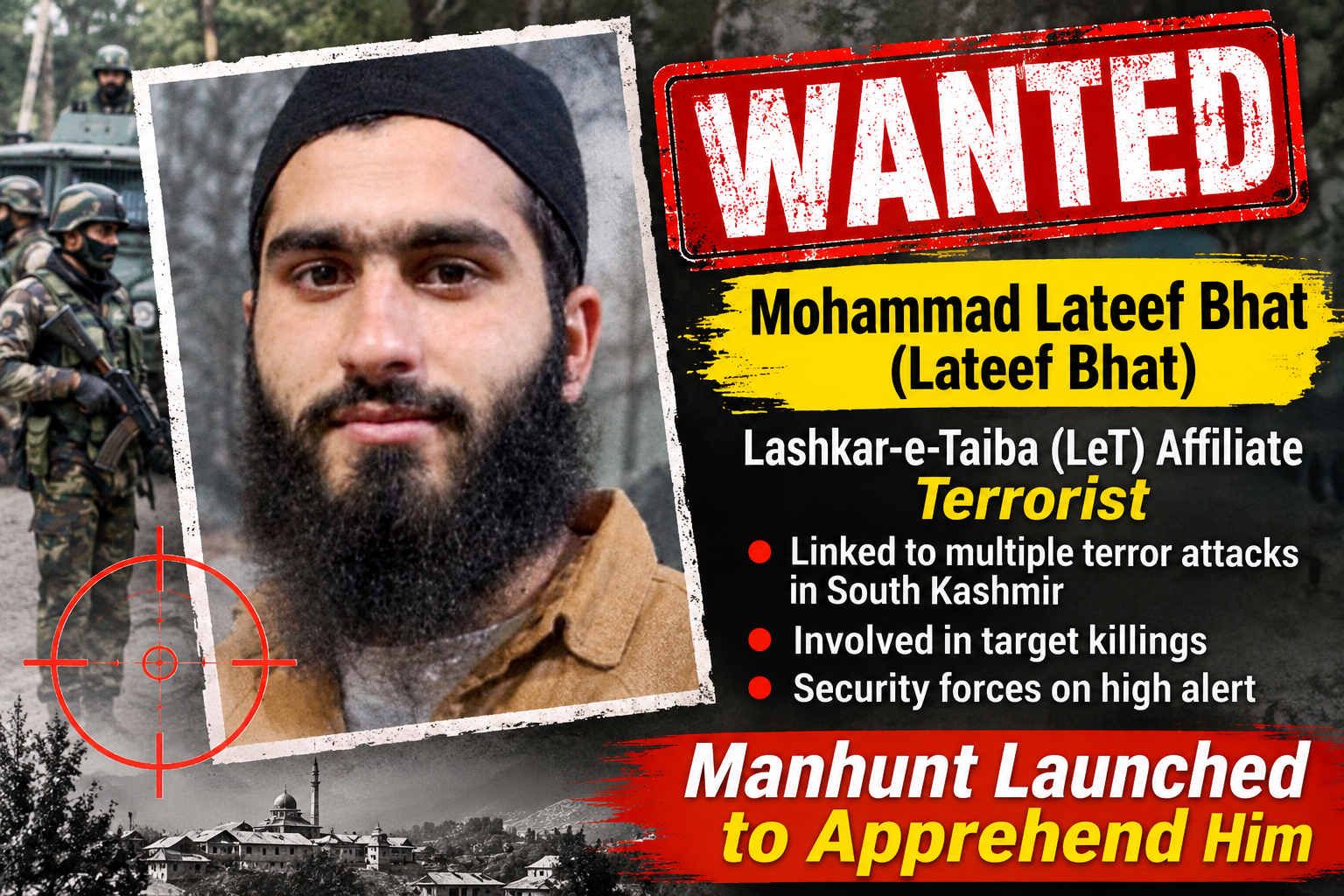
Lateef Bhat, a wanted terrorist suspected of having links with Lashkar-e-Taiba (LeT) and its proxy organisation, The Resistance Front (TRF), has come under fresh scrutiny following an attack on a Central Reserve Police Force (CRPF) checkpoint in Kulgam district of Jammu and Kashmir.
Security agencies suspect that Bhat may have been involved in the latest firing incident, in which three CRPF personnel were injured. Investigators are examining similarities between this attack and several earlier incidents in South Kashmir, including the method of firing, the escape route and ballistic evidence collected from different locations.
The latest incident has once again raised concerns about the security situation in South Kashmir, particularly the possibility of small terrorist groups carrying out targeted attacks before disappearing into nearby residential areas.
According to information shared by security sources, the attacker reportedly opened fire on the CRPF personnel and escaped after the security forces retaliated. Investigators believe the incident may be connected to a wider network operating in the region.
However, the involvement of Lateef Bhat has not been officially established, and the investigation remains focused on identifying those responsible for the attack.
Kulgam CRPF Attack: What Happened?
The latest attack took place at a CRPF naka, or security checkpoint, in Kulgam district on Wednesday. According to preliminary information, terrorists opened fire on the CRPF personnel deployed at the location.
Three personnel were injured in the incident.
The attack reportedly happened suddenly, giving the security personnel very little time to respond. CCTV footage accessed by the police allegedly shows CRPF personnel taking cover as bullets were fired towards their position.
Investigators have reportedly counted around 30 rounds fired within approximately 15 seconds.
The CRPF personnel responded to the attack, forcing the suspected attacker to leave the location. However, the individual managed to escape before security forces could establish control over the surrounding area.
Investigators believe the attacker may have taken advantage of nearby residential areas and local movement to avoid immediate detection.
This has become an important part of the investigation, as identifying the escape route and possible support network could help security agencies locate those involved.
The injured CRPF personnel were taken for medical treatment. Meanwhile, security forces increased their presence in the area and began efforts to identify the attacker.
Why Are Investigators Suspecting Lateef Bhat?
The name of Lateef Bhat has emerged during the investigation because of similarities between the Kulgam incident and previous attacks allegedly linked to his group.
According to intelligence inputs, the method used in the latest attack resembles a series of firing incidents reported in South Kashmir during July.
The suspected pattern involves approaching a security position, opening sudden fire and escaping before reinforcements can arrive.
Security agencies are examining whether the same group was responsible for these incidents.
One of the most important developments is the reported recovery of cartridge casings from the Kulgam attack site.
Investigators have reportedly found similarities between these casings and evidence collected from earlier attack locations. Such findings could help establish whether the same firearm was used in multiple incidents.
However, forensic similarities alone do not establish the identity of the person who fired the weapon. Investigators need to combine ballistic evidence with CCTV footage, intelligence inputs, witness statements and other material before reaching a conclusion.
This is why Lateef Bhat remains a suspect rather than a confirmed attacker.
Security agencies are also examining whether other individuals were involved in planning the attack or helping the suspected gunman escape.
What Is the Shoot-and-Scoot Method?
The term “shoot-and-scoot” is being used by investigators to describe the alleged pattern behind several recent attacks in Kashmir.
In simple terms, it refers to an attack in which an armed individual opens fire on a selected target and quickly leaves the location.
Unlike a prolonged gun battle, these incidents are generally brief. The attacker attempts to avoid remaining at the scene long enough for security forces to surround the area.
In the Kulgam incident, investigators believe the suspected attacker escaped after CRPF personnel responded to the firing.
The main security challenge is that the individual may disappear before a coordinated response can be established.
Investigators are therefore looking beyond the actual firing incident. They are examining possible links between the attacker, people who may have provided local assistance and individuals who could have helped with movement or shelter.
The important question is not only who fired the bullets, but also whether the attacker had support before or after the incident.
If multiple attacks are connected through the same network, identifying that network could be more important than investigating each incident separately.
Lateef Bhat’s Alleged Connection With Lashkar-e-Taiba and TRF
Lateef Bhat is suspected of having links with The Resistance Front (TRF), an organisation widely described by Indian authorities and security agencies as a proxy of Lashkar-e-Taiba.
TRF came into the spotlight after the reorganisation of militant activity in Kashmir and has been associated with several attacks and targeted killings in the region.
According to the information available to investigators, Bhat was previously involved in an encounter in Shopian district alongside Lashkar commander Zakir Ganai.
The encounter reportedly continued for five days.
During the operation, security forces killed Zakir Ganai, while Bhat managed to escape.
His escape made him an important figure in subsequent intelligence investigations. Agencies reportedly suspected that he later attempted to rebuild his connections and maintain links with individuals operating in South Kashmir.
Investigators have also been examining whether he was connected to sleeper networks allegedly involved in targeted attacks against security personnel and civilians.
Such networks are difficult to investigate because not every person providing assistance is necessarily involved in direct militant activity. Security agencies must establish individual roles through evidence.
The alleged connection between Bhat, TRF and Lashkar-e-Taiba remains an important part of the ongoing investigation.
Who Is Lateef Bhat? Background and Personal Details
Lateef Bhat, also identified as Mohammad Latief Bhat, is a resident of Kulgam district in South Kashmir.
According to details shared by investigators, he completed his schooling up to Class 12 at Government Higher Secondary School, Ashmuji.
He later enrolled at Government Degree College in Kulgam but reportedly discontinued his studies before completing his degree.
After leaving college, he worked as a carpenter at a beading-machine unit in Khrewan.
His early background was reportedly different from his later identity as a wanted militant.
One of the most important dates in his case is November 19, 2025.
According to the information provided in the investigation, Bhat went missing from his home on that date. His family subsequently filed a missing-person report at Kulgam police station.
Investigators believe that by this time he had gone underground and joined the TRF network.
He was allegedly influenced by terrorist Zakir Ahmad, although the full circumstances surrounding his recruitment have not been independently established in the information available.
His disappearance from home became an important starting point for investigators attempting to reconstruct his movements and alleged involvement in militant activities.
Earlier Terror Attacks Under Investigation
Lateef Bhat has reportedly been linked by investigators to several violent incidents in South Kashmir during the current year.
Two incidents mentioned in the investigation are particularly significant.
1. Killing of a police constable in Anantnag
On July 22, a police constable was reportedly killed in the Lal Chowk area of Anantnag.
Investigators suspect that Bhat was involved in this incident as part of a wider pattern of attacks targeting security personnel.
The case is significant because it involved an attack on a serving police officer in a populated area.
2. Killing of migrant workers in Kulgam
Another major incident took place on July 31, when migrant workers were reportedly killed in Kulgam district.
The attack raised serious concerns about the safety of people working away from their home states in Kashmir.
Investigators have alleged that Bhat was connected to this incident as well.
According to intelligence information, he was subsequently instructed by handlers operating across the border to remain inactive for some time.
Agencies believe he may have used this period to rebuild his network and re-establish connections.
These allegations are being examined as part of the wider investigation into the latest CRPF attack.
Lateef Bhat Was Reportedly Spotted in Srinagar
Another important development is the reported sighting of Lateef Bhat in Srinagar.
Fresh intelligence inputs reportedly suggested that the wanted terrorist had recently been seen in the city.
Following these inputs, police circulated posters carrying his photograph and requested residents to share information about his movements and whereabouts.
The posters reportedly included details of other wanted terrorists from Baramulla who are believed to be operating from Pakistan-Occupied Kashmir (PoK).
The police have announced a reward of Rs 15 lakh for information about Bhat’s movements and his alleged overground support network.
The appeal is aimed at encouraging people to share credible information that could assist security agencies in locating him.
The circulation of posters across Srinagar also indicates that investigators are not limiting their search to Kulgam and other parts of South Kashmir.
At the same time, authorities need to verify information carefully to prevent innocent individuals from being wrongly identified or targeted.
Security Forces Begin Action Against the Overground Network
Following the Kulgam attack, security agencies have reportedly increased questioning of overground workers (OGWs) across South Kashmir.
In the context of counterterrorism investigations, the term OGW generally refers to individuals suspected of providing support to militant groups without necessarily participating in armed attacks themselves.
The alleged support may involve shelter, communication, transportation, financial assistance or other forms of logistical help.
Investigators suspect that Bhat may have been moving between different hideouts with the assistance of a local support network.
If these intelligence inputs are accurate, identifying the individuals involved could help agencies understand how the suspected group maintained its presence despite ongoing security operations.
The questioning of suspected associates is also intended to establish whether the Kulgam attack was independently planned or part of a larger operation.
Security forces are expected to examine previous cases, local intelligence records and other available evidence to identify possible connections.
However, any individual questioned by the authorities should not automatically be considered guilty. Establishing involvement requires proper investigation and supporting evidence.
Why the Latest Attack Is a Serious Security Concern
The Kulgam incident is significant for several reasons.
First, the attack reportedly took place against personnel deployed at a security checkpoint. Such locations are important for maintaining security and monitoring movement in sensitive areas.
Second, the short duration of the firing highlights the challenges security forces face when responding to sudden attacks.
Third, the reported similarities between cartridge casings collected from different incidents raise the possibility of a common link between multiple attacks.
Finally, the suspected involvement of a wider support network creates additional concerns about how armed individuals may be receiving assistance.
For security agencies, the challenge is not simply to identify the person who carried out the attack. They must also determine whether the incident was part of a coordinated campaign and whether other individuals were involved.
The investigation could therefore have wider implications for security arrangements across South Kashmir.
What Happens Next in the Investigation?
The coming days will be important for investigators as they attempt to establish the identity of those responsible for the attack.
Several areas are likely to remain central to the investigation.
- Forensic examination: Investigators will examine the recovered cartridge casings and compare them with evidence from previous incidents.
- CCTV analysis: Available footage may help establish the sequence of events and identify possible movements before and after the firing.
- Intelligence assessment: Security agencies will examine whether the latest incident is connected to previously investigated attacks.
- Support network investigation: Authorities will attempt to identify individuals suspected of providing assistance to the attackers.
- Search operations: Security forces may continue operations in areas where the suspected attackers are believed to have moved.
The combination of forensic evidence, intelligence information and witness accounts will be important in determining whether Lateef Bhat was directly involved.
Until investigators establish the facts, his alleged role should be treated as a suspicion rather than a confirmed finding.
Find Takeaway
The attack on the CRPF naka in Kulgam has brought the name of wanted terrorist Lateef Bhat back into focus.
Security agencies suspect that he may be connected to the firing incident, particularly because of similarities with previous attacks and the reported forensic findings.
His alleged links with TRF and Lashkar-e-Taiba, his escape during the Shopian encounter and his suspected involvement in earlier attacks make him an important subject of the ongoing investigation.
However, the most significant question is whether the Kulgam attack was carried out by an individual acting alone or by a group supported by a wider network.
The investigation will need to establish the facts through reliable evidence.
For now, the priority remains identifying those responsible, protecting CRPF personnel and civilians, and preventing further attacks in Jammu and Kashmir.