

New Delhi,Union Budget 2026: No Relief for Taxpayers, STT Hike Triggers Market Crash, and the Dawn of New Income Tax Act 2025.Union Finance Minister Nirmala Sitharaman created history today, February 1, 2026, by presenting her 9th consecutive Union Budget under the leadership of Prime Minister Narendra Modi. Breaking tradition, this was the first time the Indian Budget was presented on a Sunday.
While the speech, lasting approximately 90 minutes, laid out a grand vision for a “Viksit Bharat 2047”, it left the common man and the stock market in a state of shock. With no changes in income tax slabs and a surprise hike in Securities Transaction Tax (STT), the Dalal Street witnessed a bloodbath, wiping out nearly ₹10 lakh crore of investor wealth in a single session.
1. The Common Man’s Verdict: No Tax Relief, Only Reforms
The middle class, particularly salaried professionals, were pinning their hopes on an increase in the Standard Deduction or a rejig of tax slabs. However, the Finance Minister chose to maintain the status quo on tax rates, focusing instead on structural legislative changes.
The New Income Tax Act, 2025
The biggest announcement for taxpayers was the implementation of the New Income Tax Act, 2025, effective from April 1, 2026. This replaces the decades-old Income Tax Act of 1961.
Simplified Language: The Act aims to remove redundant provisions and simplify the complex legal jargon.
The “Tax Year” Concept: The confusing “Assessment Year” and “Previous Year” terminology will be replaced by a single “Tax Year”.
Digital Assets: Clearer guidelines and stricter compliance for Virtual Digital Assets (Crypto/VDA).
Buyback Tax: Proceeds from share buybacks will now be taxed as capital gains rather than income, a move welcomed by IT sector investors.
2. Market Bloodbath: Why Sensex and Nifty Crashed
The stock market, which was open for a special Sunday session, reacted violently to the budget announcements. The primary culprit was the unexpected hike in Securities Transaction Tax (STT) on derivatives.
Market Closing (February 1, 2026):
BSE Sensex: Closed at 80,722.94, down 1,546.84 points (1.88%).
Nifty 50: Ended at 24,825.45, down 495.20 points (1.96%).
Bank Nifty: Witnessed a sharp sell-off, falling over 2.5% as banking heavyweights like SBI and ICICI Bank tumbled.
Why the Panic?
STT Hike on F&O: STT on futures rose from 0.02% to 0.05%, and on options from 0.1% to 0.15%. This significantly increases the cost of trading for retail and institutional players.
No LTCG Relief: Investors were hoping for a revision in Long-Term Capital Gains (LTCG) tax limits, which remained untouched.
Gold & Silver Correction: Precious metals hit the lower circuit as the government rationalized duties, leading to a 9-15% crash in prices.
3. What’s Cheaper and What’s Costlier?
The budget introduced significant changes in Customs Duties to boost domestic manufacturing (Make in India) and provide relief to critical sectors like health.
The Price List 2026-27
| Items That Got Cheaper | Items That Got Costlier |
| 17 Essential Cancer Drugs: Customs duty fully exempt. | Luxury Watches & Alcohol: Significant tax hike. |
| Rare Disease Medicines: Duty-free import for 7 diseases. | Cigarettes & Tobacco: “Sin tax” increased again. |
| Mobile & Tablet Parts: Local assembly to become cheaper. | Imported Coffee Machines: Exemptions removed. |
| EV Batteries & Solar Glass: Duties reduced for green energy. | Foreign TV & Cameras: Import duty hiked for electronics. |
| Foreign Education & Medical: TCS reduced from 5% to 2%. | Umbrella Parts: Duty correction makes them dearer. |
| Leather Goods: Inputs for exports made duty-free. | Some Fertilizers: Ammonium phosphate may see price rise. |
4. Sector-wise Fund Allocation: Where the Money Goes
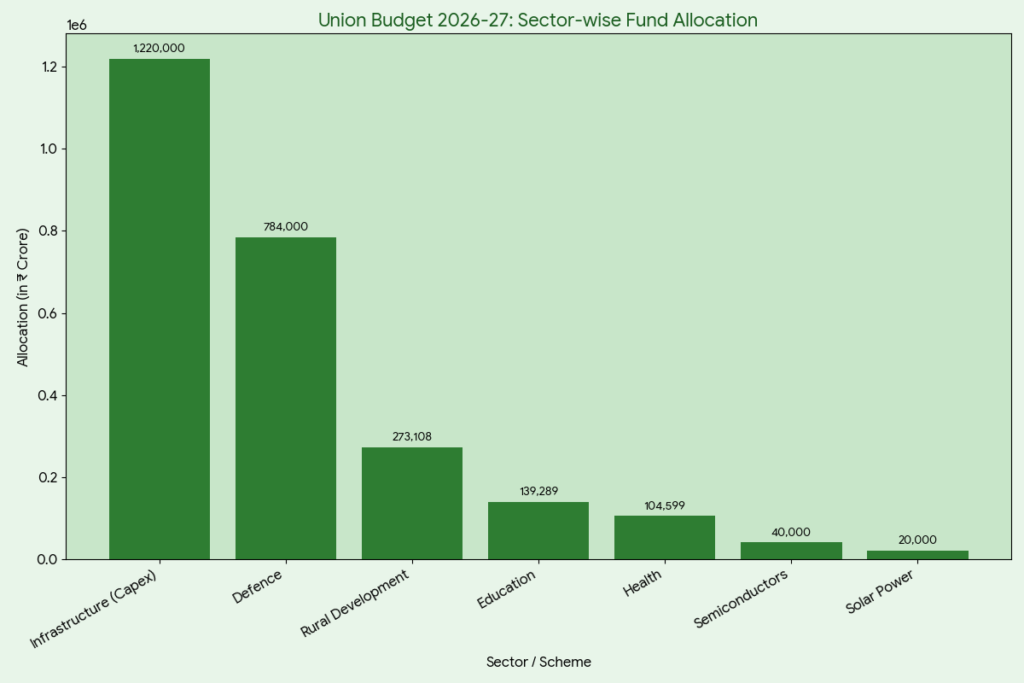
The total size of the Union Budget for 2026-27 is pegged at ₹53.5 lakh crore, with a record Capital Expenditure (Capex) target of ₹12.2 lakh crore.
| Sector / Scheme | Allocation (₹ Crore) | Strategic Focus |
| Infrastructure (Capex) | ₹12,20,000 | 7 new rail corridors and East-West freight corridor. |
| Defence | ₹7,84,000 | 75% of modernization budget for domestic industry. |
| Rural Development | ₹2,73,108 | Focus on VB-G RAM G and Jal Jeevan Mission. |
| Education | ₹1,39,289 | 15,000 schools to get AVGC/VFX labs. |
| Health | ₹1,04,599 | ₹10,000 crore for ‘Biopharma SHAKTI’ mission. |
| Semiconductors | ₹40,000 | Launch of ISM 2.0 for chip supply chains. |
| Solar Power | ₹20,000 | PM Surya Ghar: Free electricity for 1 cr homes. |
In the Union Budget 2026-27, Finance Minister Nirmala Sitharaman has prioritized infrastructure as the primary driver for India’s transition into a developed nation. The massive allocation of ₹12.2 lakh crore for Capital Expenditure (Capex) marks a nearly 9% increase from the previous year, aimed at modernizing transport and logistics.
Here are the full details of the infrastructure and railway announcements:
1. The ₹12.2 Lakh Crore Capex Push
The government has enhanced the public capital expenditure from ₹11.2 lakh crore to ₹12.2 lakh crore for FY27.
Multiplier Effect: Every rupee spent on infrastructure is estimated to generate a ₹3.5 multiplier effect on the GDP.
Focus Areas: Highways, Ports, Railways, and the “Future-Ready Bharat” initiative.
Infrastructure Risk Guarantee Fund: A new fund will be established to provide credit guarantees to lenders, reducing the risk for private developers during the construction phase of large projects.
2. Seven New High-Speed Rail Corridors
Dubbed as “Growth Connectors,” these corridors are designed to provide environmentally sustainable, high-speed passenger transport between major economic hubs.
| Sl. No. | Route | Key Regions Impacted |
| 1 | Mumbai – Pune | Drastic reduction in travel time for the financial-industrial belt. |
| 2 | Pune – Hyderabad | Connects the automobile/manufacturing hub with the IT hub. |
| 3 | Hyderabad – Bengaluru | Links the “Silicon Valley of India” with another major tech center. |
| 4 | Hyderabad – Chennai | Strengthens the southern industrial and pharmaceutical cluster. |
| 5 | Chennai – Bengaluru | Facilitates seamless movement in the manufacturing and port-access zone. |
| 6 | Delhi – Varanasi | Major boost for tourism, religious circuits, and connectivity to UP. |
| 7 | Varanasi – Siliguri | A vital link connecting North India to the Gateway of the Northeast. |
3. East-West Dedicated Freight Corridor (DFC)
To reduce logistics costs from the current 14-16% of GDP to single digits, the FM announced the Surat-Dankuni Freight Corridor.
Route: Connecting Surat (Gujarat) in the West to Dankuni (West Bengal) in the East.
Integration: This new corridor will bridge the existing Eastern and Western DFCs, creating a continuous “Freight Spine” across central India.
Purpose: Dedicated tracks for cargo will decongest passenger lines, speed up the movement of minerals/coal from the east, and manufactured goods from the west.
[Image showing the layout of the East-West Dedicated Freight Corridor across India]
4. Port and Waterway Expansion
The infrastructure push extends beyond tracks and roads to the water:
25 New National Waterways: Proposed to be operationalized over the next five years to facilitate cheaper inland cargo movement.
Coastal Cargo Promotion Scheme: Aimed at doubling the share of inland waterways and coastal shipping from 6% to 12% by 2047.
Seaplane VGF Scheme: A Viability Gap Funding (VGF) scheme to support seaplane operations for remote connectivity and tourism.
5. City Economic Regions (CER)
The budget allocates ₹5,000 crore per City Economic Region over five years. This is aimed at Tier-II and Tier-III cities with populations over 5 lakh, transforming them into independent growth hubs through “challenge-mode” funding.
Summary Impact: This budget signals a shift from purely “building roads” to “building integrated ecosystems.” By linking industrial corridors with high-speed rail and dedicated freight paths, the government aims to make Indian manufacturing globally competitive.
the Union Budget 2026-27 introduces several strategic missions to make India a global powerhouse in defense, healthcare, and high-tech manufacturing.
1. Defence: ₹7,84,000 Crore (The Modernization Push)
The Ministry of Defence (MoD) continues to receive the highest allocation among all ministries. The government has signaled a “Buy Indian” approach to strengthen national security and boost domestic industry.
75% Domestic Procurement: A record 75% of the modernization (capital acquisition) budget is now reserved for procurement from Indian vendors. This is up from 68% in previous years, aimed at ending reliance on foreign arms.
Focus on Private Industry: Within the domestic share, 25% is earmarked specifically for private industries, startups, and MSMEs to encourage innovation in aerospace and naval systems.
Modernization Goals: Funding is allocated for the production of the C-295 transport aircraft, next-generation submarines, and indigenous Long Endurance Remotely Piloted Aircraft (Drones).
Border Infrastructure: The Border Roads Organisation (BRO) has received an increased outlay to expedite strategic tunnels and bridges in high-altitude regions like Ladakh and Arunachal Pradesh.
2. Health: ₹1,04,599 Crore (Biopharma SHAKTI Mission)
Addressing the shifting disease burden towards non-communicable diseases (NCDs), the health budget focuses on advanced medicine and research.
‘Biopharma SHAKTI’ Mission: An outlay of ₹10,000 crore over the next 5 years to build an ecosystem for the domestic production of biologics and biosimilars.
NIPER Network: The mission will establish 3 new National Institutes of Pharmaceutical Education and Research (NIPERs) and upgrade 7 existing ones to global standards.
Clinical Trials: Creation of a nationwide network of 1,000 accredited clinical trial sites to speed up drug discovery and validate new therapies within India.
Cancer & Rare Diseases: Full exemption of customs duty on 17 essential cancer drugs and 7 rare disease medicines to ensure affordability.
In the Union Budget 2026-27, Finance Minister Nirmala Sitharaman announced a total exemption of basic customs duty on 17 critical cancer drugs. Previously, these imported life-saving medicines attracted duties ranging from 5% to 10%, which significantly added to the financial burden of patients.
Here is the complete list of the 17 cancer drugs that are now duty-free:
The Official List of 17 Exempted Cancer Drugs
| Drug Name | Primary Use / Cancer Type |
| 1. Ribociclib | Metastatic breast cancer (Targeted therapy). |
| 2. Abemaciclib | Advanced or metastatic breast cancer. |
| 3. Venetoclax | Chronic lymphocytic leukemia (CLL) & AML. |
| 4. Ibrutinib | Mantle cell lymphoma and leukemia. |
| 5. Dabrafenib | Melanoma and non-small cell lung cancer (NSCLC). |
| 6. Trametinib | Used in combination with Dabrafenib for Melanoma. |
| 7. Ipilimumab | Immunotherapy for Melanoma and Renal cancer. |
| 8. Tremelimumab | Immunotherapy for liver and lung cancer. |
| 9. Ceritinib | Advanced lung cancer (ALK-positive NSCLC). |
| 10. Brigatinib | Metastatic lung cancer. |
| 11. Darolutamide | Prostate cancer. |
| 12. Ponatinib | Chronic myeloid leukemia (CML). |
| 13. Inotuzumab Ozogamicin | Acute lymphoblastic leukemia (ALL). |
| 14. Talycabtagene Autoleucel | Advanced CAR-T cell therapy for blood cancers. |
| 15. Toripalimab | Advanced solid tumors and nasopharyngeal cancer. |
| 16. Serplulimab | Immunotherapy for various solid tumors. |
| 17. Tislelizumab | Esophageal and lung cancer immunotherapy. |
3. Semiconductors: ₹40,000 Crore (ISM 2.0)
Building on the success of the first phase, India Semiconductor Mission (ISM) 2.0 has been launched to move beyond assembly and into core manufacturing.
ECMS Outlay: The Electronics Components Manufacturing Scheme (ECMS) outlay has been nearly doubled to ₹40,000 crore to capitalize on high investment momentum.
Indigenous IP: Focus shifts towards developing Indian Intellectual Property (IP) and “full-stack” design capabilities for chips.
Supply Chain Resilience: Funding will support the production of semiconductor equipment and specialized materials within India, reducing dependence on global supply shocks.
Training Centers: Establishment of industry-led research and training centers to create a workforce of 85,000 semiconductor engineers.
4. Solar Power: ₹20,000 Crore (PM Surya Ghar: Muft Bijli Yojana)
To achieve energy independence for households, the government has ramped up the rooftop solar initiative.
Free Electricity: The scheme aims to provide up to 300 units of free electricity per month to 1 crore households.
Direct Subsidies: Households can receive up to ₹78,000 as a direct subsidy for installing rooftop panels.
Income Generation: Families can earn an estimated ₹15,000–₹18,000 annually by selling surplus power back to the grid (DISCOMs).
Model Solar Villages: The budget provides for creating one Model Solar Village in every district to promote renewable energy adoption at the grassroots level.
5. Rural Game Changer: From MGNREGA to VB-G RAM G
The government announced a major shift in rural employment policy by introducing the Viksit Bharat–Guarantee for Rozgar and Ajeevika Mission (Gramin) (VB-G RAM G).
Work Guarantee: Increased from 100 days to 125 days per year.
Funding: Centrally sponsored scheme with a 60:40 cost-sharing with states (90:10 for NE/Hilly states).
Budget Outlay: ₹95,692 crore allocated for the new mission, while MGNREGA receives a legacy fund of ₹30,000 crore.
Agri-Pause: A 60-day planned pause during peak harvest to ensure agricultural labor availability.
6. The Three ‘Kartavyas’ (Responsibilities)
FM Sitharaman anchored the 2026 budget on three pillars:
Accelerating Growth: By enhancing competitiveness in manufacturing and rare earth corridors.
Fulfilling Aspirations: Giving the youth tools like the “Mother of All Deals” trade benefits.
Inclusive Participation: Ensuring regional growth in states like Odisha, Andhra Pradesh, and Kerala.
The Road Ahead
The Union Budget 2026-27 is a “bitter pill” for the stock market and the middle class, but a “growth tonic” for infrastructure and manufacturing. With the Fiscal Deficit projected to drop to 4.3%, the government has signaled that it values long-term stability over short-term popularity.
As the New Income Tax Act takes shape in April, all eyes will be on the fine print to see if any hidden reliefs emerge in the rules and return forms.
Disclaimer: This information is based on various inputs from news agency.