
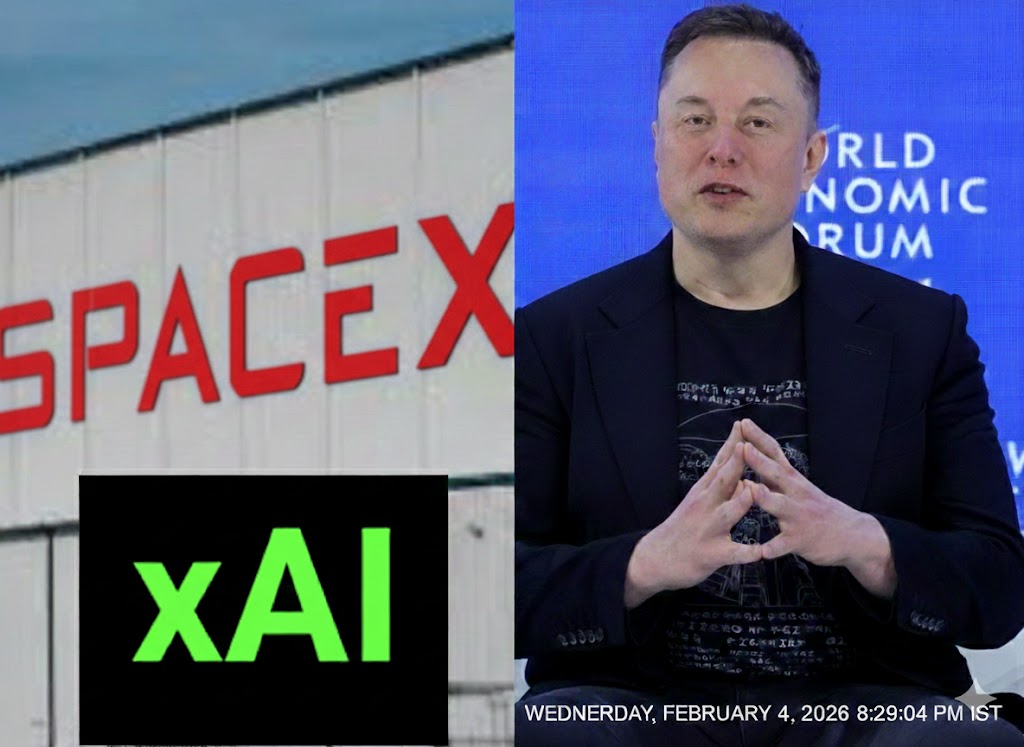
The $1.25 Trillion “Innovation Engine”: Inside Elon Musk’s Historic SpaceX and xAI Merger. In a move that has sent shockwaves through both the aerospace and silicon corridors of the world, Elon Musk has officially announced the merger of SpaceX and xAI. This consolidation creates the world’s most powerful private entity, a “super company” with a staggering total valuation of $1.25 trillion.
To put that number in perspective: this private firm is now worth more than the annual GDP of most nations, larger than the world’s biggest oil giants, and more valuable than entire national stock markets. Here is everything you need to know about why this merger happened, the vision behind it, and the storm of controversy following in its wake.
The Deal: A Trillion-Dollar Integration
The merger was confirmed through an internal memo posted on the SpaceX website on February 3, 2026. While full financial terms remain under wraps, the math behind the valuation is clear:
- SpaceX was recently valued at approximately $1 trillion following a secondary share sale in late 2025.
- xAI, Musk’s artificial intelligence startup and creator of the Grok chatbot, was valued between $125 billion and $230 billion following its Series E funding round in January 2026.
By absorbing xAI, SpaceX now controls a vertically integrated empire that spans satellite internet (Starlink), global launch capacity, and frontier artificial intelligence.
The Deal: A Trillion-Dollar Integration
The merger was confirmed through an internal memo posted on the SpaceX website on February 3, 2026. While full financial terms remain under wraps, the math behind the valuation is clear:
- SpaceX was recently valued at approximately $1 trillion following a secondary share sale in late 2025.
- xAI, Musk’s artificial intelligence startup and creator of the Grok chatbot, was valued between $125 billion and $230 billion following its Series E funding round in January 2026.
By absorbing xAI, SpaceX now controls a vertically integrated empire that spans satellite internet (Starlink), global launch capacity, and frontier artificial intelligence.
Why Now? The Three Pillars of Musk’s Strategy
Critics and fans alike are asking why Musk chose to pull these entities together now. There appear to be three primary drivers:
- The Energy Crisis: Taking AI Off-Planet
Training advanced AI like Grok requires massive computing power, which in turn demands enormous amounts of electricity and water for cooling. Musk has argued that Earth-based grids simply cannot sustain the long-term growth of AI. His solution? Orbital Data Centers. By housing AI supercomputers in space, the systems can harness near-constant solar energy without competing for terrestrial resources. This merger provides the “lift” (SpaceX) needed to launch the “brain” (xAI) into orbit.
- The Path to a 2026 IPO
Rumors of a SpaceX Initial Public Offering (IPO) have circulated for months. By merging assets now, Musk simplifies the corporate structure and presents a “growth story” that is far more attractive to Wall Street: a company that doesn’t just launch rockets, but owns the future of global data processing and intelligence.
- The “Orchestra Conductor” Vision
Musk views his companies as a single system. In his vision, xAI acts as the “orchestra conductor”—an AI that runs Tesla factories, manages Starlink’s data pipelines, and coordinates the infrastructure for future Mars missions.
Wealth Milestone: Musk Becomes the First $850 Billionaire
The financial fallout of this merger has had a historic impact on Musk’s personal fortune. Following the valuation spike, Elon Musk’s net worth has officially crossed the $850 billion mark.
Market Comparison: At $852 billion, Musk’s personal wealth now exceeds the combined GDP of Pakistan, Sri Lanka, and Nepal. He currently sits nearly $600 billion ahead of the world’s second-richest person, Google co-founder Larry Page ($281 billion).
Shadows Over the Merger: Raids and Regulators
While the valuation is record-breaking, the merger comes at a time of intense legal scrutiny.
On the same day the merger gained steam, French prosecutors raided X’s offices in Paris. The investigation, which began in early 2025, has expanded to include Grok and focuses on serious allegations:
- Unlawful data extraction and algorithm manipulation.
- The proliferation of AI-generated sexualized deepfakes.
- Potential distribution of child exploitation material.
The UK’s Information Commissioner’s Office (ICO) and the European Commission have launched similar probes. While Musk has dismissed these as “attacks on free speech,” the mounting pressure introduces significant regulatory hurdles for the new $1.25 trillion entity.
What Happens Next?
The creation of this “super company” raises critical questions about market concentration. Regulators are no longer just looking at a social media platform or a rocket company; they are dealing with a single man who controls the pipelines of global information, satellite internet, and artificial intelligence.
As SpaceX eyes a potential IPO in June 2026, the world will watch to see if governments draw “red lines” or if the “Spirit of the Slopes” truly moves to the stars.
Disclaimer: This information is based on various inputs from news agency.