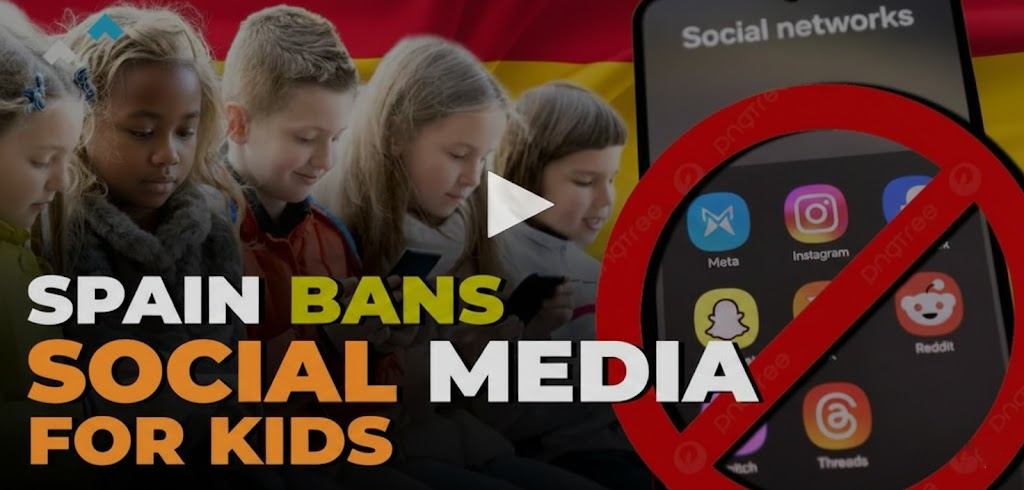
MADRID —The “Digital Iron Curtain”: Spain Becomes First European Nation to Ban Social Media for Kids, Igniting Global Ripple Effect. In a move that has sent shockwaves through the tech world and ignited a firestorm of political vitriol, Spanish Prime Minister Pedro Sánchez has officially announced a groundbreaking bill to ban social media access for children under the age of 16. Speaking at the World Governments Summit in Dubai on Tuesday, February 3, 2026, Sánchez characterized the current digital landscape as a “failed state” and a “digital Wild West” that requires urgent, iron-fisted intervention to protect the nation’s youth.
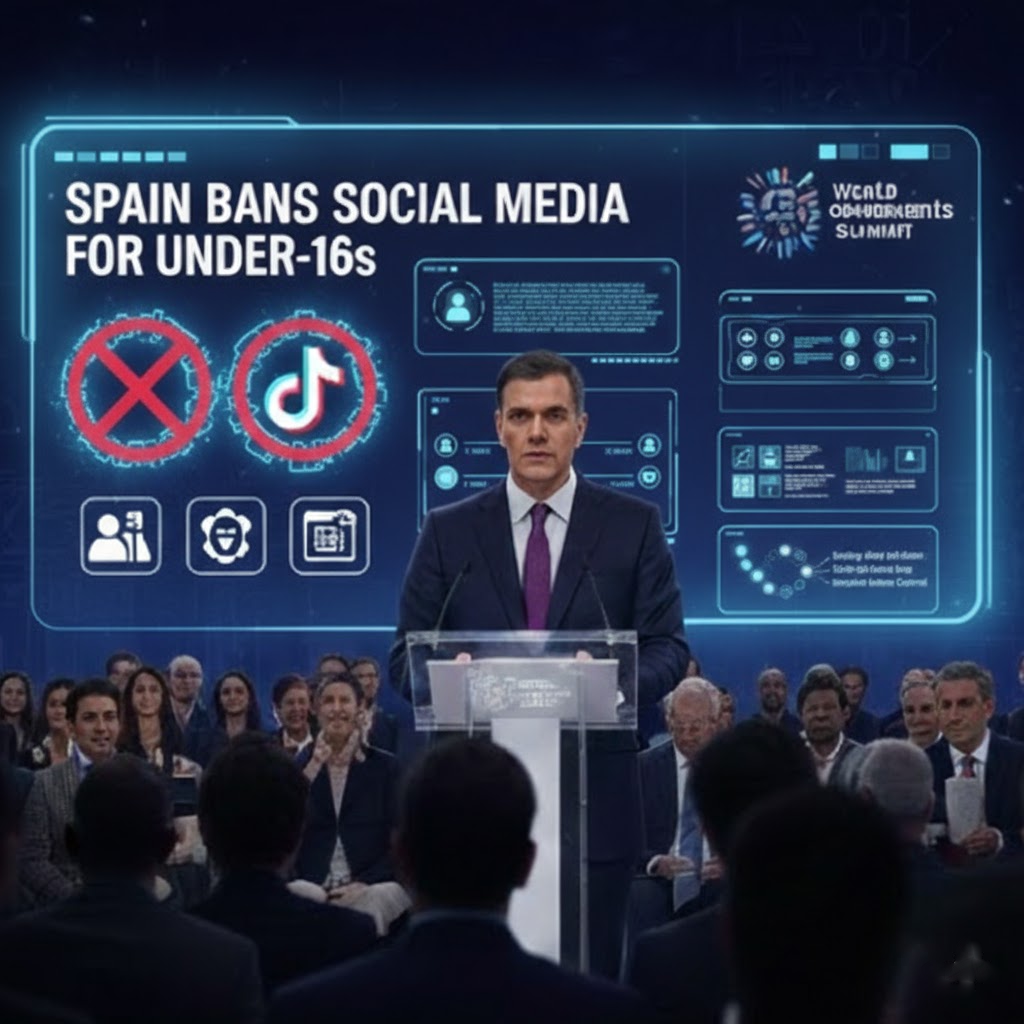
The proposal marks Spain as the first European nation to follow the trail blazed by Australia, which enacted a similar landmark ban in December 2025. However, Spain’s approach goes further, pairing the age restriction with aggressive new legal liabilities for tech giants and their executives.
“Not Just Checkboxes”: The Architecture of the Ban
For years, social media platforms have relied on self-declaration—a simple “I am over 13” checkbox—to satisfy regulatory requirements. Sánchez has declared an end to this era of “good faith.”
Under the new legislation, platforms like TikTok, Instagram, and X (formerly Twitter) will be mandated to implement:
- Hard Age Verification: Systems that require real identification, biometric scans, or third-party verification to create an account.
- Executive Criminal Liability: For the first time, tech executives could face criminal charges for failing to remove illegal content, such as child sexual abuse material (CSAM) or AI-generated non-consensual deepfakes.
- Algorithmic Criminalization: The bill seeks to criminalize the use of “addictive by design” algorithms that intentionally amplify hate speech or polarization for profit.
- The Polarization Footprint: A new tracking system designed to monitor and hold platforms accountable for their “hate and polarization footprint” across Spanish society.
“Our children are exposed to a space they were never meant to navigate alone,” Sánchez told the summit. “We will protect them from the digital Wild West. No more pretending that technology is neutral.”
Musk Explodes: “Dirty Sánchez” and “Fascist Totalitarian”
The announcement did not sit well with Elon Musk, the billionaire owner of X, who has long positioned himself as a “free speech absolutist.” Musk took to his platform to launch a series of blistering personal attacks against the Spanish leader.
In a flurry of posts that quickly went viral, Musk branded Sánchez a “tyrant,” a “traitor to the people of Spain,” and most explosively, a “true fascist totalitarian.” Musk also used the derogatory term “Dirty Sánchez” to describe the Prime Minister, further inflaming a diplomatic tension that has been brewing since Spain began investigating Musk’s AI chatbot, Grok, for generating sexually explicit fake images of minors earlier this year.
Musk’s reaction mirrors his previous clashes with the Australian government, whom he also labeled “fascists” over their misinformation laws and age-based bans.
A Continent Divided: The Global Ripple Effect
Spain is not acting in a vacuum. Sánchez revealed that Spain has joined a “Coalition of the Digitally Willing” alongside five other European nations to coordinate cross-border enforcement against Big Tech.
- Greece: Officials confirm they are “very close” to announcing a ban for children under 15.
- France & Denmark: Both nations are currently refining legislation to set the “digital age of majority” at 15.
- United Kingdom: Following pressure from nearly 70 Labour MPs, the UK government is reportedly weighing an “Australian-style” ban to combat a rising mental health crisis among teens.
The Indian Perspective: Will New Delhi Join the Club?
As the global momentum for age-based bans builds, the debate has reached Indian shores. While the Central Government has focused on the Digital Personal Data Protection (DPDP) Act, which requires parental consent for users under 18, individual states are now looking at more restrictive models.
- Andhra Pradesh: IT Minister Nara Lokesh has formed a Group of Ministers (GoM) to study the feasibility of an under-16 ban.
- Goa: IT Minister Rohan Khaunte confirmed the state is analyzing the Australian model to see if a localized ban could curb cyberbullying and screen addiction.
The Skeptics: Protection or Censorship?
While the bill enjoys support from conservative groups and child safety advocates like UNICEF Spain (who support the intent but warn of “backfiring”), it faces fierce opposition from the far-right Vox party. Vox spokespeople have dismissed the move as a smokescreen for state censorship, claiming Sánchez is merely trying to silence his critics.
Digital rights experts also warn that mandatory age verification effectively kills online anonymity. “Once you require a government ID to use the internet, it’s no longer an open space,” says MediaNama founder Nikhil Pahwa. “The cost of protection is the total loss of privacy for everyone, not just children.”
Spain’s Council of Ministers is expected to approve the bill as early as next week. If passed, it could result in the immediate deactivation of hundreds of thousands of teenage accounts across the country.
Disclaimer: This information is based on various inputs from news agency.