
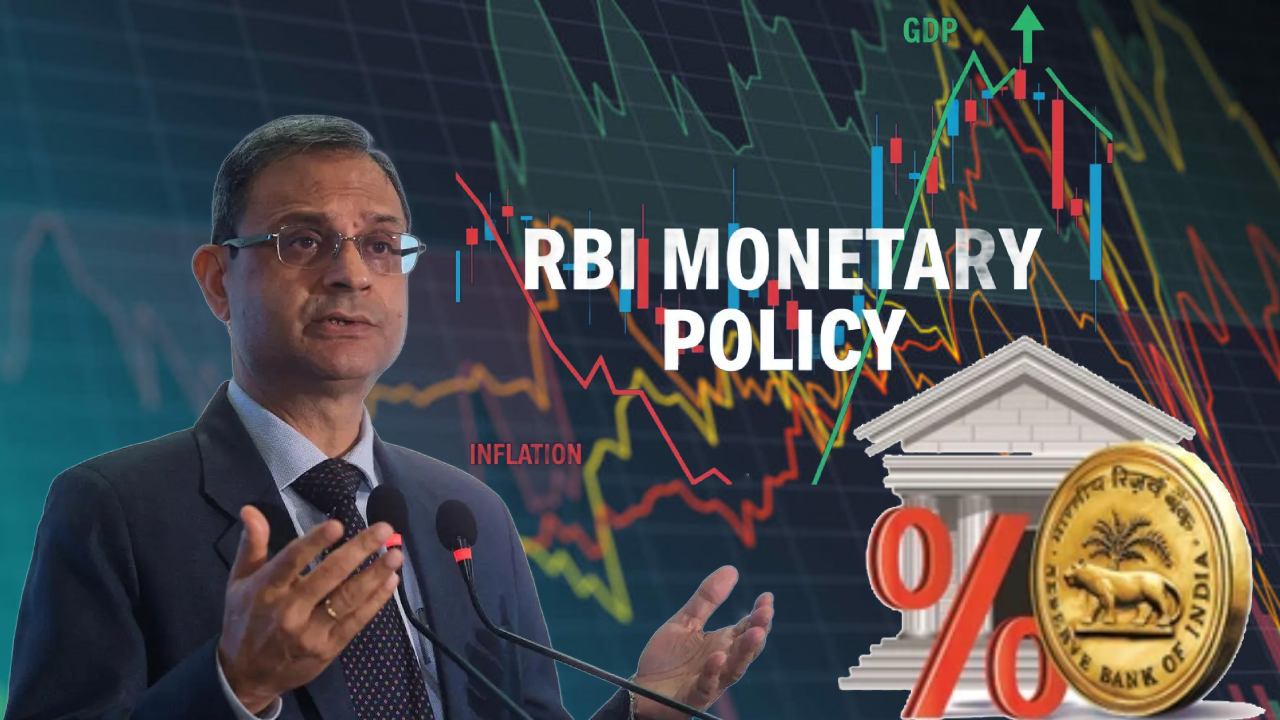
RBI Monetary Policy Feb 2026: Repo Rate Held Steady at 5.25% Amid Optimistic Growth Outlook. The Reserve Bank of India (RBI) has signaled a period of calibrated stability for the Indian economy. In the first Monetary Policy Committee (MPC) meeting following the Union Budget 2026-27, RBI Governor Sanjay Malhotra announced the decision to keep the policy repo rate unchanged at 5.25%.
This decision, which was arrived at unanimously by the six-member committee, reflects the central bank’s confidence in India’s domestic resilience despite a complex and often turbulent global economic landscape.
1. The Headline Decision: Holding the Line
The decision to maintain the status quo comes after a 25-basis-point cut in December 2025. By keeping the rate at 5.25%, the RBI is balancing the need to support a burgeoning growth narrative while remaining vigilant about inflationary pressures that could arise from intensified “external headwinds.”
Key Policy Rates at a Glance:
Policy Repo Rate: 5.25%
Stance: Neutral
Decision: Unanimous (6-0)
Governor Malhotra emphasized that the “neutral” stance provides the MPC with the flexibility to address evolving macroeconomic conditions without being tethered to a pre-determined path of tightening or easing.
2. Economic Growth: The Resilience Story
One of the most striking takeaways from the February announcement was the upward revision of India’s growth prospects. While the global economy grapples with uncertainty, the Indian engine appears to be gaining steam.
GDP Projections:
FY 2025-26 (Current): Pegged at a robust 7.4%.
FY 2026-27 Q1: Projected at 6.9%.
FY 2026-27 Q2: Projected at 7.0%.
The Governor noted that the domestic growth outlook remains “positive,” bolstered by strong underlying data and a sustained momentum in industrial and service sectors. A significant catalyst for this optimism is the recent trade agreement with the United States, which has effectively reduced tariff pressures and opened new corridors for Indian exports.
3. The Inflation Dynamics
Inflation management remains the cornerstone of the RBI’s mandate. The Governor provided a detailed roadmap for the Consumer Price Index (CPI) inflation, suggesting that while the immediate term looks comfortable, the central bank is keeping a close watch on the horizon.
FY 2025-26 Overall: Projected at a low 2.1%.
Current Quarter (Ending March 2026): Estimated at 3.2%.
FY 2026-27 Q1 (March-May): Revised slightly upward to 4.0% (from 3.9%).
FY 2026-27 Q2: Projected at 4.2%.
The slight uptick in projected inflation for the next fiscal year suggests that the RBI is accounting for potential supply-side shocks and the impact of intensifying external headwinds.
4. Liquidity and Forex: A Strong Foundation
Governor Malhotra reassured the markets regarding the “plumbing” of the financial system. System liquidity has remained stable, with a daily average of ₹75,000 crore.
Furthermore, India’s “war chest” of foreign exchange reserves remains incredibly healthy. As of late January 2026, reserves stood at $723.8 billion, providing a significant cushion against global currency volatility.
5. Major Structural Reforms and Proposals
Beyond interest rates, the February policy introduced several “pro-business” and “pro-consumer” initiatives designed to modernize India’s financial infrastructure.
A. Digital Safety Net for Consumers
In a major move to boost confidence in digital payments, the RBI proposed a framework to compensate customers up to ₹25,000 for losses incurred due to small-value digital transaction frauds. This is a landmark step in protecting the common man in an increasingly cashless economy.
B. Strengthening the Credit Ecosystem
Unified Portal for Lead Bank Data: A new portal will be established to streamline and manage data, ensuring better credit flow to priority sectors.
REITs Lending: In a move that will cheer the real estate sector, the RBI will now allow banks to lend to Real Estate Investment Trusts (REITs), albeit with specific safeguards.
NBFC Ease of Business: Norms for opening branches for Non-Banking Financial Companies (NBFCs) are being eased to improve financial inclusion in rural and semi-urban areas.
C. Fair Lending Practices
The Governor announced that draft guidelines would be issued regarding the misselling of loans and the conduct of recovery agents. This highlights the RBI’s commitment to “fair play” and preventing the harassment of borrowers.
6. The “Washington Factor”: Trade and Headwinds
The Governor’s speech repeatedly touched upon the external sector. The successful trade deal with the US is seen as a “structural tailwind” that offsets some of the “intensified external headwinds” mentioned in the report. By reducing the pressure of tariffs, India has secured a more predictable path for its manufacturing and IT export sectors.
7. Analysis: What This Means for You
For Homebuyers and Borrowers
With the repo rate held at 5.25%, EMIs (Equated Monthly Installments) on home, car, and personal loans are expected to remain stable. Since the stance is “neutral,” there is no immediate threat of a rate hike, which is good news for middle-class budgets.
For Investors
The RBI’s optimistic GDP forecast of 7.4% suggests that the corporate earnings cycle is likely to remain strong. The inclusion of REITs in bank lending portfolios could provide a significant boost to the real estate investment market.
For the Banking Sector
The focus on liquidity management and the proactive stance of the RBI ensures that banks have enough capital to meet the “productive requirements” of the economy without facing a credit crunch.
Conclusion: A Balanced Act
The February 2026 Monetary Policy is a testament to the RBI’s “Steady as she goes” approach. By keeping rates unchanged, Governor Sanjay Malhotra has prioritized stability and growth. The Indian economy, described as a “bright spot” amidst global uncertainty, seems well-positioned to navigate the challenges of the 2026-27 fiscal year.
With inflation largely under control and growth targets being revised upward, the message from Mint Street is clear: The Indian resilience is not just a catchphrase; it is backed by hard data.
Disclaimer: This information is based on various inputs from news agency.