

WASHINGTON D.C. —Unchained Arsenals: World Enters Uncharted Territory as New START Nuclear Treaty Officially Expires. Yesterday, February 5, 2026, the world crossed a silent but terrifying threshold. For the first time in over half a century, there are no legally binding limits on the strategic nuclear arsenals of the world’s two largest atomic powers. The New Strategic Arms Reduction Treaty (New START)—the final pillar of the Cold War-era arms control architecture—officially expired at midnight, leaving the United States and Russia to navigate a global security landscape without the guardrails of transparency or restraint.
The imagery of the treaty’s birth feels like a relic from a different world. On a Tuesday in April 2010, U.S. President Barack Obama and Russian President Dmitry Medvedev sat side-by-side in Prague, beaming as they signed six landmark documents. At the time, New START was a “victory for arms control,” designed to pull the world back from the brink of a nuclear abyss. Today, that optimism has been replaced by the “if it expires, it expires” pragmatism of U.S. President Donald Trump and a Moscow that now considers itself “free from the limits” set 15 years ago.
The Math of Mutual Destruction: The 2026 Stockpile
To understand why the lapse of this treaty is so significant, one must look at the sheer scale of the weapons at play. Despite decades of reductions, the world remains sitting on a powder keg of approximately 12,500 nuclear warheads.
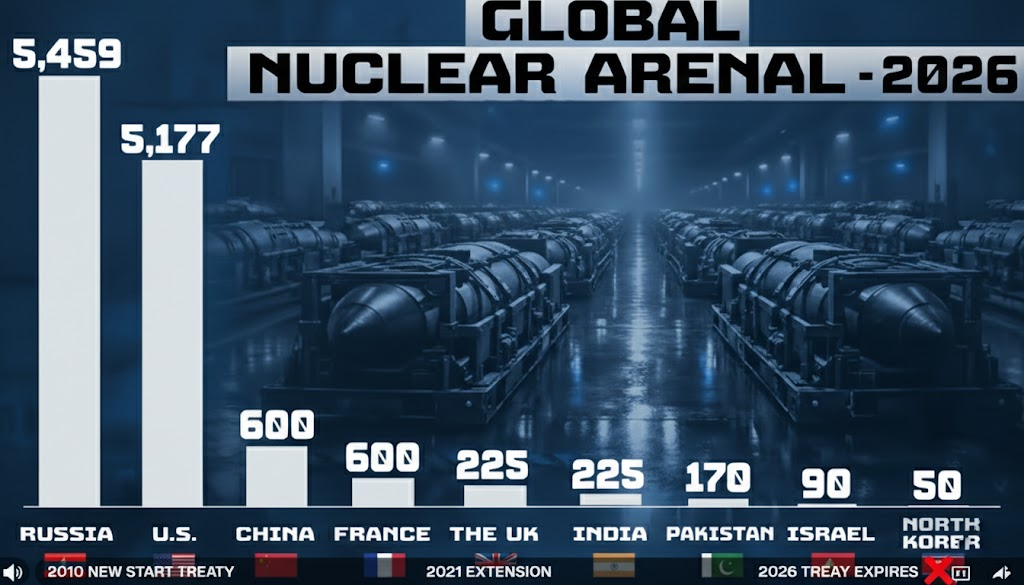
As of early 2026, the global distribution of these “war-enders” is as follows:
| Country | Total Warheads | Status |
| Russia | 5,459 | World’s largest nuclear power; increasing modernization. |
| United States | 5,177 | Second largest; currently resuming testing preparations. |
| China | 600 | Growing faster than any other; projected 1,000+ by 2030. |
| France | 290 | Stable inventory; sea and air-based. |
| United Kingdom | 225 | Increased ceiling from 180 to 260 recently. |
| India | 180 | Maintaining credible minimum deterrence. |
| Pakistan | 170 | Continued expansion of delivery systems. |
| Israel | 90 | Policy of nuclear ambiguity maintained. |
| North Korea | 50 | The only nation to conduct explosive tests in the last 20 years. |
Together, the U.S. and Russia hold nearly 90% of the world’s nuclear stockpile. New START focused specifically on “deployed strategic” warheads—those on high alert, ready to be fired across continents. While thousands of warheads remain in storage or are awaiting dismantlement, it is the deployed arsenal that keeps the world in a state of perpetual “high alert.”
Strategic vs. Tactical: The “War-Enders”
The New START treaty was surgical in its focus, curbing strategic nukes while leaving tactical nukes largely unaddressed. Tactical nuclear weapons have a lower yield and are designed for localized use on a battlefield. Strategic nukes, however, are designed to destroy entire civilizations. They target cities, command centers, and population hubs across thousands of miles.
Under New START, the limits were strict:
- Deployed Missiles: Only 800 actively deployed ICBMs (Intercontinental Ballistic Missiles), SLBMs (Submarine-Launched Ballistic Missiles), and heavy bombers.
- Deployed Warheads: A cap of 1,550 warheads.
- Launchers: A limit of 800 total (deployed and undeployed).
Beyond the numbers, the treaty’s soul was its verification regime. It allowed for 18 on-site inspections per year, where rivals could literally walk into each other’s nuclear sites to count warheads. This built a fragile but essential layer of trust. With the treaty’s expiration, that window into each other’s arsenals has been slammed shut.
The Trump Doctrine: Why Let it Expire?
President Donald Trump’s refusal to extend the treaty—which Joe Biden had previously salvaged in 2021—stems from a fundamental shift in American foreign policy. Washington’s opposition rests on two pillars.
- The China Factor The U.S. believes that any arms control treaty is a relic of the past if it doesn’t include Beijing. China’s nuclear arsenal is currently undergoing a “breathless” expansion. From 240 warheads when Xi Jinping took office to 600 today, Beijing is projected to hit the 1,000-mark by 2030. Trump argues that a bilateral deal with Russia effectively “handcuffs” the U.S. while China is free to build at will.
- Resuming Nuclear Testing Perhaps more shocking is Trump’s announcement that the U.S. would resume nuclear testing at its Nevada facility—the first such tests since 1992. The U.S. Navy and Department of Energy are reportedly preparing for underground detonations within 36 months. “If other countries do it, we’re going to do it,” Trump remarked in January. This ends a 60-year era where strategic nuclear capabilities were always constrained by some form of international law.
The Return of the “Golden Fleet”: USS Defiant
In a throwback to an older maritime warfare lexicon, the Trump administration has unveiled the Trump-class battleship. The centerpiece of this “Golden Fleet” is the USS Defiant, a 40,000-ton behemoth—roughly three times the size of an Arleigh Burke-class destroyer.
These are not the battleships of World War II. They are high-tech “arsenal ships” designed to carry:
- Hypersonic Missiles: Capable of outrunning any current interceptor.
- Laser Weapons: For high-speed defensive capabilities.
- SLCM-N: A new nuclear-armed sea-launched cruise missile.
While experts are skeptical of the $22 billion-per-hull cost, the administration believes these ships change the nature of American force projection. “When a conflict arises,” the Navy recently stated, “you’re going to ask two questions: where is the carrier, and where is the battleship?”
Russia’s Exotic Arsenals: Burevestnik and Poseidon
While the U.S. builds ships, Moscow has focused on “invulnerable” delivery mechanisms. Russia has recently prioritized weapons that fall outside traditional treaty definitions:
- Burevestnik (Skyfall): A nuclear-powered cruise missile with “unlimited range.” It can loiter in the air for days and follow an unpredictable trajectory to evade air defenses.
- Poseidon Torpedo: An underwater intercontinental drone. It is 20 meters long and designed to detonate off a coastline, triggering a massive radioactive tsunami to destroy naval bases and coastal cities.
These weapons operate in the “vulnerable areas”—underwater and at extremely low altitudes—where traditional air defenses struggle to detect them.
Modernization: The New Arms Race
The arms race of 2026 isn’t just about building more warheads, as it was in the 1960s; it’s about modernization. The U.S. is currently spending an estimated $1 trillion (2025–2034) to overhaul its triad.
- Land: The Sentinel ICBM will replace the aging Minuteman III missiles. The Air Force plans to procure 634 of these advanced missiles.
- Air: The B-21 Raider, a sixth-generation stealth bomber developed by Northrop Grumman, is currently undergoing flight tests and is expected to enter service later this decade.
- Sea: The aforementioned battleships and the development of new SLCMs.
Russia, however, faces a dilemma. Modernizing an arsenal while expanding it may be too expensive for Moscow’s sanctioned economy. China, meanwhile, continues its “No-First-Use” policy for now, but experts worry that as tensions rise over the Pacific, such policies may be discarded.
Conclusion: A Symptom of Tensions
The expiry of New START is not the trigger for a new nuclear clash; it is a symptom of existing, deep-rooted global tensions. The era of US hegemony that followed the Cold War has faded, replaced by a multi-polar world where Russia, China, and the U.S. are all vying for strategic dominance.
Unless world leaders find a way to return to the negotiating table, we are no longer just witnessing a shift in policy—we are witnessing the birth of a second nuclear age, one where the only limit is the size of a nation’s treasury and the extent of its ambition.
Disclaimer: This information is based on various inputs from news agency.