
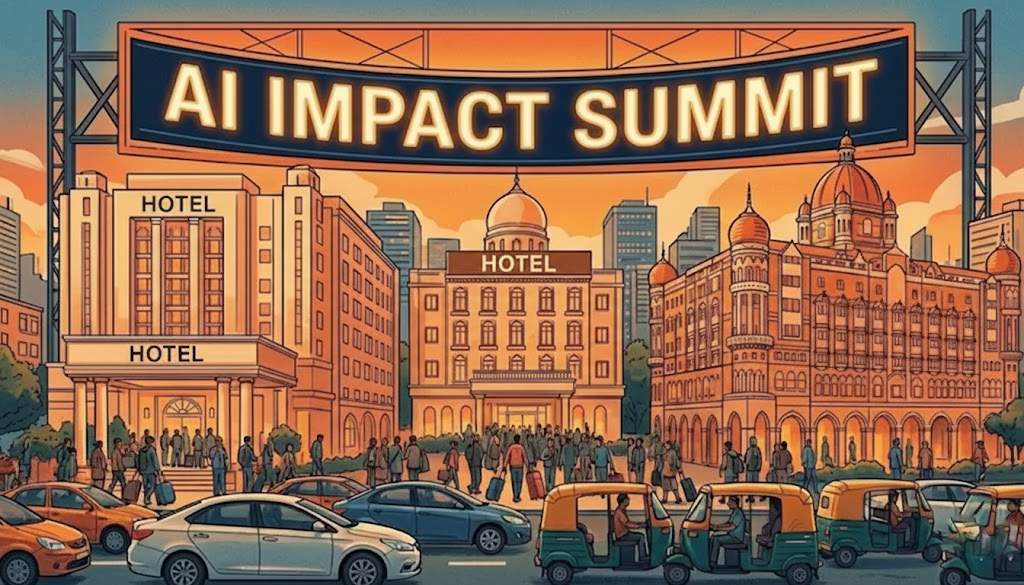
NEW DELHI, February 9, 2026 —AI Summit Gold Rush the national capital is witnessing a hospitality price surge of historic proportions. As New Delhi prepares to host the AI Impact Summit 2026 at Bharat Mandapam, room tariffs at the city’s premier luxury hotels have catapulted into the “shock category,” with some suites commanding an eye-watering ₹30 lakh to ₹32 lakh per night.
The summit, headlined by global tech luminaries like Sundar Pichai and Sam Altman, has triggered a 1,500% spike in tariffs compared to standard peak periods like Valentine’s Day. What was once the domain of high-end business travel has now entered eight-figure territory for multi-day stays, raising fundamental questions about the city’s accessibility during marquee global events.
AI Summit Gold Rush the ₹30-Lakh Room: A Breakdown of the Surge.
At the Taj Palace, New Delhi, a “Garden Luxury Suite” with a pool view is currently listed at ₹27.55 lakh per night for the summit window (February 16–20). Once taxes of approximately ₹5 lakh are factored in, the total bill for a single night reaches nearly ₹32 lakh. To put this in perspective, the same room is available just days earlier (February 13–14) for roughly ₹2 lakh.
This pattern is consistent across the city’s luxury “Lutyens” circuit:
- The Leela Palace: The Maharaja Suite is priced at ₹14–15 lakh per night, a staggering jump from its standard ₹1.15 lakh rate.
- The Oberoi: Luxury suites are quoting ₹25 lakh per night, with mandatory minimum stay requirements that force bookings through the duration of the summit.
- The Imperial: A Luxury Suite is currently listed at ₹10 lakh per night.
A “Sold-Out” Capital
Despite these astronomical prices, the city is effectively running on zero inventory. Major properties like ITC Maurya and Le Méridien are completely sold out for the summit dates. Even at Jaypee Vasant Continental, occupancy levels are hovering around 95%, with only a tiny fraction of premium inventory remaining for last-minute corporate bookings.
“The AI Summit has created a very strong spike in demand for the February 17–21 window,” noted Rajiv Mehra, General Secretary of FAITH. “A large portion of inventory was blocked well in advance by tech delegations and government agencies.”
According to ixigo, hotel searches for New Delhi have seen a 6x month-on-month jump, with even standard five-star rooms—those that usually cost ₹20,000—now retailing for upwards of ₹1 lakh.
Top 10 Luxury Hotel Tariff Comparisons: Summit vs. March Standard
| Hotel | Summit Rate (Feb 18-20) | Standard Rate (March) |
| Taj Palace (Presidential) | ₹30,00,000 | ₹2,37,500 |
| The Oberoi (Luxury Suite) | ₹25,00,000 | ₹3,25,000 |
| The Leela Palace (Suite) | ₹14,40,000 | ₹1,15,000 |
| The Imperial (Luxury Suite) | ₹10,00,000 | ₹1,50,000 |
| The Oberoi (Deluxe Suite) | ₹11,25,000 | ₹2,75,000 |
| Andaz Delhi (Signature) | ₹3,29,200 | Unavailable |
| Taj Mahal (Club Balcony) | ₹3,65,800 | ₹54,000 |
| The Lodhi (Standard Room) | ₹1,30,000 | ₹36,000 |
| JW Marriott (Exec. Room) | ₹1,12,100 | ₹27,000 |
| Andaz Delhi (Large View) | ₹79,200 | ₹34,000 |
AI Summit Gold Rush:Beyond the Bedroom: The MICE Hub Momentum
Hoteliers argue that these rates reflect a unique moment in Delhi’s evolution as a global MICE (Meetings, Incentives, Conferences, and Exhibitions) hub. The scale of the AI Impact Summit—hosting 35,000 delegates from over 100 countries—requires a level of service and security that justifies “event-era” pricing.
“Events of this scale reinforce Delhi’s positioning as a global policy hub,” said Animesh Kumar, Commercial Head at ibis & ibis Styles India. For many, the high prices are a signal of “high-quality demand” that brings global visibility to the Indian hospitality sector.
The Optics of Exclusion
However, the contrast remains stark. While luxury hotels can justify these rates as “demand-led pricing during exceptional periods,” the optics of a ₹32-lakh hotel bill raise questions about whether the capital is quietly becoming one of the world’s most expensive cities. As India positions itself as the voice of the Global South, the extreme cost of participation in its premier forums may inadvertently create barriers for the very delegates it seeks to include.
For now, as the private jets of Sam Altman and Sundar Pichai prepare to land at IGI Airport, the message from Delhi’s hotels is clear: the city is open for business, but only if you have the budget of a tech titan.
The Logistics of a Global Stage: Airfares and Ironclad Security
As the world’s tech elite prepares to touch down in New Delhi for the AI Impact Summit 2026 (February 16–20), the city is not just experiencing a hotel room shortage—it is seeing a total logistical recalibration. From skyrocketing airfares to a security blanket that rivals a G20 summit, here is how the capital is preparing for the arrival of the “Sultans of Silicon Valley.”
Airfare Surge: The “Pichai-Altman” Effect
The 1,500% spike in hotel rates has been mirrored in the aviation sector. Data from major travel portals like ixigo and Yatra indicates a massive month-on-month jump in flight searches for New Delhi.
While economy tickets from major Indian metros like Kolkata and Mumbai usually hover around ₹5,000, last-minute bookings for the summit window are now frequently exceeding ₹15,000–₹25,000. Business class seats—the preferred choice for the 500+ global AI researchers and CTOs attending—have seen an even steeper incline, with round-trips from domestic hubs hitting the ₹60,000 to ₹1 Lakh range.
- International Influx: With over 35,000 registrations from 100+ countries, international flight capacity into IGI Airport is at its highest utilization since the 2023 G20 Summit.
- The “Extended Stay” Trend: Hoteliers and travel agents are observing that delegates aren’t just flying in for the two-day leaders’ plenary; many are arriving as early as February 12th to combine the summit with business engagements in Noida and Gurugram.
Security at Bharat Mandapam: An Ironclad Protocol
The Bharat Mandapam, the summit’s primary venue, has been turned into a high-security fortress. Given that the event features 15 to 20 heads of government and top-tier CEOs like Sam Altman and Sundar Pichai, the Ministry of Electronics and Information Technology (MeitY) has coordinated with Delhi Police to implement a multi-layered security grid.
- The “Safe & Trusted AI” Perimeter: Exclusive “Green Corridors” have been established from Aerocity and the Diplomatic Enclave to the Pragati Maidan complex. Delhi Police are utilizing AI-based facial recognition and crowd-monitoring systems to manage the 1.5 lakh expected visitors at the AI Impact Expo.
- The “Three Sutras” of Operations: The summit is anchored on the principles of People, Planet, and Progress. This translates to specialized “Personalized Check-in Services” for dignitaries, a fleet of high-end electric vehicles (EVs) for intra-city transit, and dedicated high-speed business centers at the venue.
Summary of Summit Logistics
| Category | Impact / Detail |
| Total Attendees | 35,000+ International Delegates |
| Key Venues | Bharat Mandapam, Sushma Swaraj Bhawan, Ambedkar Bhawan |
| Airfare Surge | 6x increase in Delhi-bound searches; 3-4x price hike |
| Tech Presence | 40+ prominent global companies (Google, OpenAI, Microsoft, etc.) |
| Unique Factor | First global AI summit hosted in the Global South |
As New Delhi transforms into the “AI Capital of the World” for five days, the immense cost of entry—both in flights and five-star suites—underscores the high stakes of this technological revolution.
Disclaimer: This information is based on various inputs from news agency.