
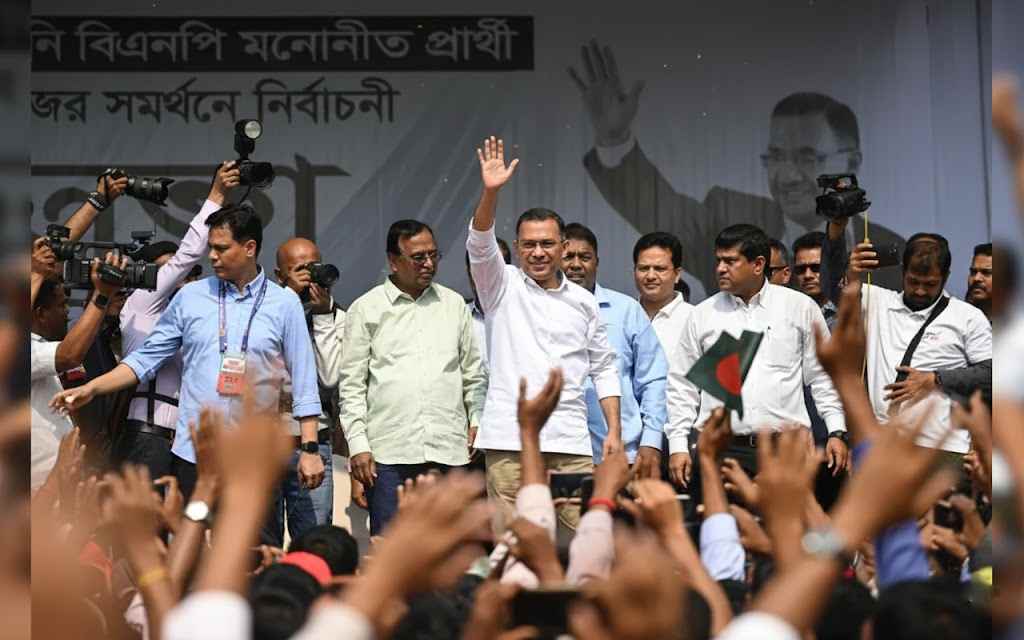
DHAKA / NEW DELHI —Bangladesh Election Result: In a historic political earthquake that has redrawn the landscape of South Asia, the Bangladesh Nationalist Party (BNP) is cruising toward a massive landslide victory in the nation’s first general election since the 2024 student-led uprising. With unofficial results pouring in, party chairman Tarique Rahman is poised to become the next Prime Minister of Bangladesh, marking a triumphant return from 17 years of exile.
While the Election Commission of Bangladesh continues to finalize the official tally for the 299 contested seats, global powers and regional neighbors have wasted no time in acknowledging the decisive mandate.
10 Points on the Historic Bangladesh Election Results
- The Majority Mark: As of Friday morning, media projections show the BNP has surged well past the 150-seat threshold. Major broadcasters like Jamuna Television report that the BNP has secured at least 212 seats, placing it on track for a two-thirds majority.
- Jamaat’s Concession: The 11-party alliance led by Jamaat-e-Islami, which mounted a disciplined grassroots campaign, has secured roughly 70 seats. Despite this leap in representation, Jamaat chief Shafiqur Rahman formally conceded defeat, pledging that his party would engage in “positive politics” rather than obstruction.
- Rahman’s Dual Victory: Leading from the front, Tarique Rahman won both constituencies he contested—Dhaka-17 and Bogura-6—according to unofficial results.
- US Endorsement: The United States Embassy in Dhaka was swift to congratulate the BNP on its “historic victory,” even before the final commission report, signaling strong Western support for the transition.
- Yunus to Step Down: Nobel laureate Muhammad Yunus, who has served as the interim leader since the ouster of Sheikh Hasina in August 2024, will step down once the new government is sworn in.
- End of the “Begum” Era: This was the first election in decades not dominated by the rivalry between Sheikh Hasina (now in India) and Khaleda Zia, who passed away in December 2025.
- The Referendum: Voters also participated in a referendum on the July National Charter, which proposes a two-term limit for Prime Ministers and the restoration of a neutral caretaker government system for future polls.
- Hasina’s Protest: From India, deposed leader Sheikh Hasina termed the election “deceptive” and “voterless,” calling for its cancellation and the resignation of the Yunus administration.
- India’s Diplomatic Pivot: Prime Minister Narendra Modi and EAM S. Jaishankar have extended a hand of friendship to the incoming administration, emphasizing a “democratic and inclusive” Bangladesh.
- A Return to Stability: Senior BNP leader Ruhul Kabir Rizvi has called for nationwide prayers rather than celebratory rallies to ensure peace and stability following a campaign period that saw sporadic violence.
The “India Factor”: Modi and Jaishankar Extend Support
In a significant diplomatic shift, New Delhi has moved quickly to establish rapport with the Tarique Rahman-led BNP. Historically, the relationship between India and the BNP had been “cool,” particularly during the party’s 2001-2006 tenure. However, the statements from the highest levels of the Indian government suggest a mutual desire for a “reset.”
What PM Narendra Modi Said
On Friday, Prime Minister Modi took to X (formerly Twitter) to offer his warm congratulations to the BNP leadership. His message was seen as an olive branch after months of strained ties following the fall of the pro-India Awami League government.
Modi’s emphasis on an “inclusive” Bangladesh is a subtle reference to India’s concerns regarding the safety of minorities, particularly Hindus, who have faced an uptick in attacks since the 2024 uprising.
External Affairs Minister S. Jaishankar reposted the Prime Minister’s statement, echoing the sentiment of cooperation. Jaishankar’s personal involvement in this transition began earlier in January 2026, when he traveled to Dhaka to attend the funeral of Khaleda Zia and hand-delivered a condolence letter from PM Modi to Tarique Rahman.
His current stance reflects a pragmatic “neighborhood first” policy. Addressing the elections earlier, MEA spokesperson Randhir Jaiswal noted that India was waiting for the mandate of the people to emerge before addressing the “issues that are there.” With the mandate now clear, Jaishankar is expected to lead the “thaw” in bilateral relations.
Who is Tarique Rahman? From Exile to the PMO
The 60-year-old Tarique Rahman is the eldest son of former President Ziaur Rahman and three-time PM Khaleda Zia. Often called the “dark prince” by his detractors, he served as the de facto boss of the BNP during the early 2000s.
His path back to power was anything but smooth. After being arrested by a military-backed caretaker government in 2007 and allegedly tortured, he lived in exile in London for 17 years. During Sheikh Hasina’s 15-year rule, he was convicted in absentia on various charges, including money laundering and a plot to assassinate Hasina—charges his supporters maintain were politically motivated.
His convictions were overturned by the courts following the August 2024 uprising. Rahman returned to Dhaka on Christmas Day, December 25, 2025, ending nearly two decades of political fugitive status. In his first speech, he struck a mature, inclusive tone, quoting Martin Luther King Jr. and stating, “I have a plan for Bangladesh.”
The Geopolitical Challenge: Balancing India, Pakistan, and China
A major test for the new BNP government will be its “Bangladesh First” doctrine. Under Sheikh Hasina, India was the closest ally. Now, New Delhi is watching closely to see if Dhaka pivots toward closer ties with Pakistan and China.
Tarique Rahman has acknowledged there are “issues” with India but insists he wants a relationship based on “mutual respect and mutual understanding.” When asked by The Guardian if friendship could be rebuilt while India hosts Sheikh Hasina, Rahman replied cautiously, “That depends. It has to be on them too.”
The Path Ahead
As the 85-year-old Muhammad Yunus prepares to hand over the reins, the BNP faces a daunting task. The country is grappling with high inflation, youth unemployment (currently at 13.5%), and a deeply polarized society.
The BNP has instructed its supporters to avoid celebratory processions, focusing instead on honoring the memory of Khaleda Zia. By emphasizing institutional reform through the “July National Charter,” Tarique Rahman is attempting to signal that this BNP administration will be different from the one that ruled 20 years ago—one that is ready for the “adult in the room” responsibilities of regional leadership.
Disclaimer: This information is based on various inputs from news agency.