

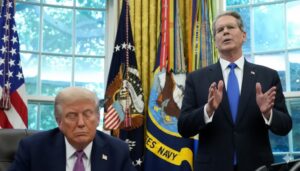
“Financing a War Against Themselves”: Team Trump Slams India-EU ‘Mother of All Deals’. As India and the European Union (EU) celebrate the conclusion of a historic free trade agreement (FTA) today, the Trump administration has launched a scathing critique of the pact. US Treasury Secretary Scott Bessent has warned that Europe is effectively “financing a war against itself,” arguing that the deal creates a lucrative loophole for Russian oil to flow into European markets via Indian refineries.
The friction highlights a widening rift between Washington’s “America First” tariff-driven strategy and the EU’s efforts to secure its economic future through a massive new partnership with New Delhi.
The ‘Ultimate Act of Irony’: Washington’s Warning
Speaking to ABC News on Sunday, Treasury Secretary Scott Bessent framed the India-EU trade deal as a betrayal of global efforts to isolate Moscow. While the US has made “significant sacrifices” by imposing steep 50% tariffs on Indian goods—specifically a 25% penal duty for India’s continued purchase of Russian crude—Europe has chosen a path of deeper integration.
“We have put 25 per cent tariffs on India for buying Russian oil. Guess what happened last week? The Europeans signed a trade deal with India,” Bessent remarked. He went on to describe a cycle where Russian crude is shipped to India, refined into products like diesel and jet fuel, and then sold back to European nations. “They are financing the war against themselves,” he added, referring to the ongoing Russia-Ukraine conflict now entering its fourth year.
An Imbalance in Sacrifice
The Trump administration argues that its aggressive tariff policy has been a “huge success” in forcing India to pivot. According to recent data, Indian refinery purchases of Russian oil have plummeted to their lowest levels since 2022, a shift Bessent attributes directly to US trade pressure.
However, Team Trump claims that Europe’s “virtue signalling” is masking a lack of real economic sacrifice. By finalizing the “Mother of All Deals” now, the EU is accused of providing New Delhi with an economic safety net that undermines the leverage Washington is trying to exert.
“Our virtue-signalling European allies refused to [impose tariffs] because they wanted to sign this big trade deal with India.”
The EU Response: ‘Making History’
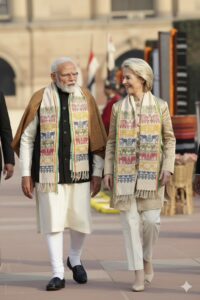
Despite the pressure from Washington, European Commission President Ursula von der Leyen and European Council President Antonio Costa have remained steadfast. Attending India’s 77th Republic Day celebrations as Chief Guests, they hailed the FTA as a move that makes the world “more stable, prosperous, and secure.”
The EU has its own set of rules, including the 18th sanctions package which prohibits the import of petroleum products refined from Russian crude. However, these rules are notoriously complex, allowing imports from refineries that can prove they have segregated Russian crude or have not processed it for 60 days.
The Strategic Importance of the FTA
For the 27-nation European bloc, the deal—which covers nearly 25% of global GDP—is a survival tactic in an era of “geopolitical shocks.”
- Supply Chain De-risking: The EU seeks to reduce its dependence on both the US and China.
- Economic Growth: The deal is expected to double EU exports to India by 2032, protecting over 800,000 European jobs.
- Green Energy: The pact includes a €500 million support package for India’s green transition, a key priority for Brussels that the Trump administration has largely ignored.
What’s at Stake for India?
For Prime Minister Narendra Modi, the deal is a crowning achievement of “India First” diplomacy. By securing zero-duty access to the EU for over 99% of its exports, India has effectively offset the damage caused by US tariffs.
Labour-intensive sectors—textiles, leather, gems, and jewellery—which were reeling under the Trump administration’s 50% duties, now have a wide-open door to one of the world’s wealthiest consumer markets.
| Issue | US Position (Team Trump) | EU/India Position |
| Russian Oil | Impose 25% penal tariffs to stop all flow. | Use complex “segregation” rules to manage energy needs. |
| Trade Strategy | Bilateral deals based on “reciprocity” and tariffs. | Multilateral FTA to build “trusted ecosystems.” |
| Climate Change | Policy deprioritized; focus on traditional energy. | Integrated into trade (e.g., €500m Green Transition fund). |
Conclusion: A Divided West
The conclusion of the India-EU FTA marks a definitive shift in the global order. While Washington remains focused on using economic penalties to dictate foreign policy, the EU and India have opted for a “comprehensive partnership” that prioritizes long-term growth and supply chain resilience.
As legal scrubbing begins on the deal, the world will be watching to see if the Trump administration escalates its trade war against the “Mother of All Deals” or if a “path to easing tariffs” can be found as India continues to diversify its energy sources.
Disclaimer: This information is based on various inputs from news agency.
‘Mother of All Deals’: India-EU FTA to Reshape Global Trade and Boost ‘Make in India’ in details