
India vs Pakistan Clash in Jeopardy: Pakistan Announces Boycott; ICC Warns of “Long-Term Sanctions“.In world cricket, few fixtures stop time like India vs Pakistan. It is a match that fills stadiums, freezes TV schedules, and fuels the global economy of the sport. But for the ICC Men’s T20 World Cup 2026, that marquee clash may not happen. While the Pakistan government has cleared its team to travel for the tournament, it has issued a stunning directive.
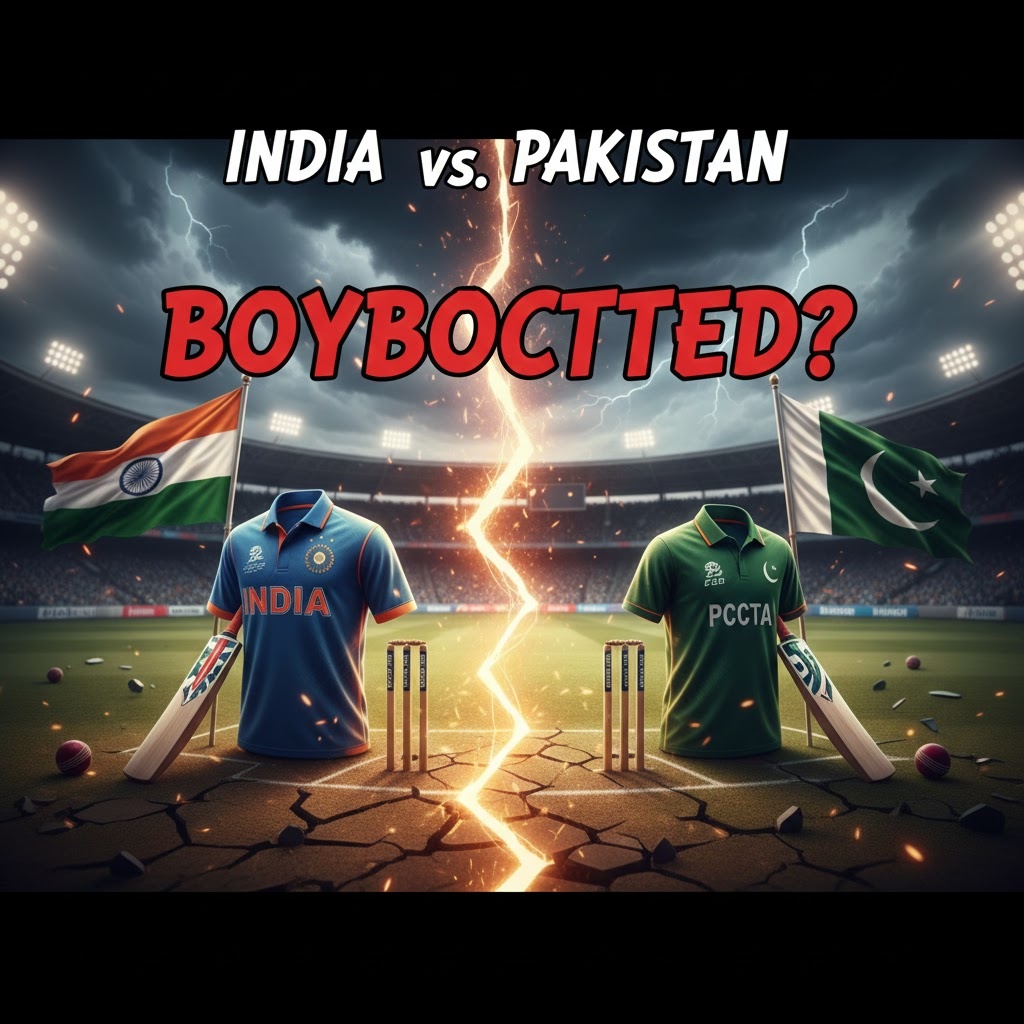
The team must not take the field against arch-rival India. This unprecedented decision has turned the most anticipated game of the event into its biggest uncertainty, sparking a firestorm of drama just days before the opening ceremony.
Why Pakistan is Boycotting the India Game
The 20-team tournament, co-hosted by India and Sri Lanka, is set to begin in Colombo this Saturday. Due to ongoing political tensions, a “hybrid model” was already in place, ensuring Pakistan would play all its matches—including any potential knockouts—in Sri Lanka. The high-profile Group A clash was scheduled for February 15, 2026, in Colombo.
On Sunday, February 1, the Pakistani government made its stance official via X (formerly Twitter):
“The Government of the Islamic Republic of Pakistan grants approval to the Pakistan Cricket Team to participate in the ICC World T20 2026. However, the Pakistan Cricket Team shall not take the field in the match scheduled on 15th February 2026 against India.”
While no formal reason was given, the move is widely seen as a protest against the ICC’s recent handling of the Bangladesh controversy. After the ICC refused to move Bangladesh’s matches out of India despite security concerns raised by the BCB, Bangladesh was replaced in the tournament by Scotland. Pakistan Cricket Board (PCB) Chairman Mohsin Naqvi slammed the ICC for “double standards,” ultimately leaving the final decision on participation to Prime Minister Shehbaz Sharif.
The ICC Breaks Its Silence
The International Cricket Council has not taken the boycott lightly. In a strongly worded statement released on February 2, the governing body warned that “selective participation” threatens the very integrity of global sport.
“This position of selective participation is difficult to reconcile with the fundamental premise of a global sporting event where all qualified teams are expected to compete on equal terms,” the ICC stated.
The ICC further warned of “significant and long-term implications” for Pakistan cricket. Sources suggest the global body is contemplating punitive sanctions, which could include:
- Financial Penalties: Withholding the PCB’s share of central revenue (roughly $35 million).
- Rankings & Points: Loss of World Test Championship (WTC) points and a freeze on rankings.
- The PSL Factor: Instructions to other member boards to deny No-Objection Certificates (NOCs) to foreign players for the Pakistan Super League (PSL).
What It Means for the Tournament
If the boycott stands, the match on February 15 will be declared a forfeit.
- Points: India will automatically receive two points.
- The Toss Protocol: According to ICC protocol, the Indian team, led by captain Suryakumar Yadav, will arrive at the stadium, conduct a press conference, and walk out for the toss. If Pakistan captain Salman Ali Agha does not appear, the match referee will officially award India the walkover.
- Net Run Rate (NRR): Pakistan’s NRR will take a massive hit. Under Clause 16.10.7, a defaulting team is treated as if they were dismissed for zero runs in 20 overs.
The Financial & Strategic Fallout
The commercial stakes are astronomical. An India-Pakistan match is the single biggest revenue driver for broadcasters like Disney Star. Reports suggest that both boards could lose roughly ₹200 crore ($24 million) in direct and indirect revenue if the game is cancelled.
Renowned commentator Harsha Bhogle noted that while such a loss is “painful but manageable” for a wealthy board like the BCCI, it is “existential math” for the PCB. If ICC revenue shares are slashed, the most affected will be the smaller nations and those—like the West Indies, Sri Lanka, and Pakistan—who rely heavily on the global body’s distributions.
Politics vs. Sport: A Fragile History
India and Pakistan have not played a bilateral series in 14 years. While they have continued to meet in ICC events, the relationship has grown increasingly frosty. Tensions spilled over during last year’s Asia Cup when Indian players reportedly refused to shake hands with their Pakistani counterparts in multiple matches.
As the Pakistan squad departs for Sri Lanka today, back-channel diplomacy is reportedly underway to find a “mutually acceptable resolution.” However, with the government’s directive being public and explicit, the “Mother of all Cricket Matches” currently hangs by a very thin thread.
Disclaimer: This information is based on various inputs from news agency.