
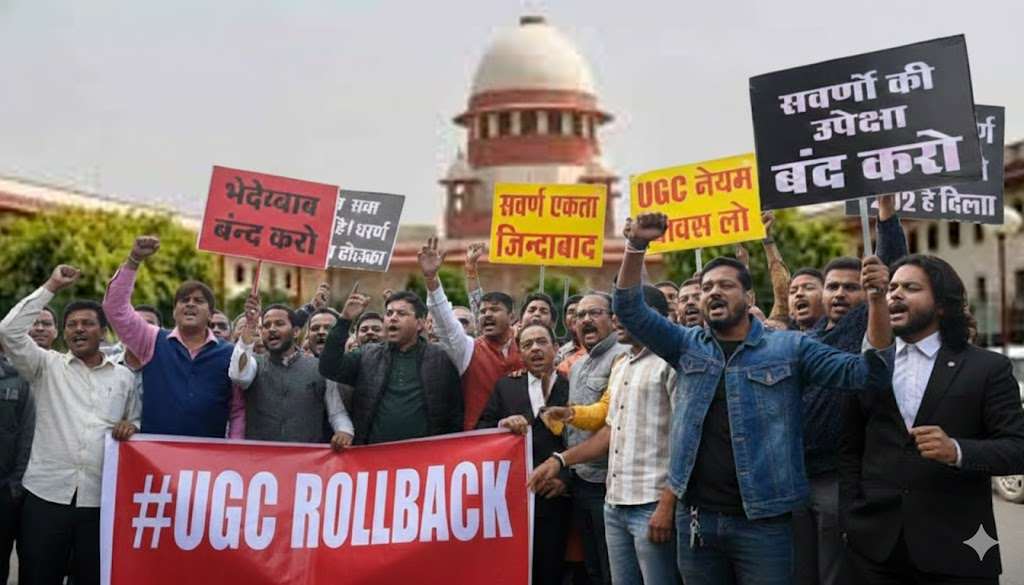
NEW DELHI —Major Setback for UGC: Supreme Court Stays 2026 Equity Rules Amid Protests In a move with far-reaching implications for India’s higher education landscape, the Supreme Court of India today halted the implementation of the UGC (Promotion of Equity in Higher Education Institutions) Regulations, 2026. Citing concerns that the rules were “vague” and “capable of misuse,” the apex court directed the Central Government to redraft the framework to ensure it does not become a tool for societal division.
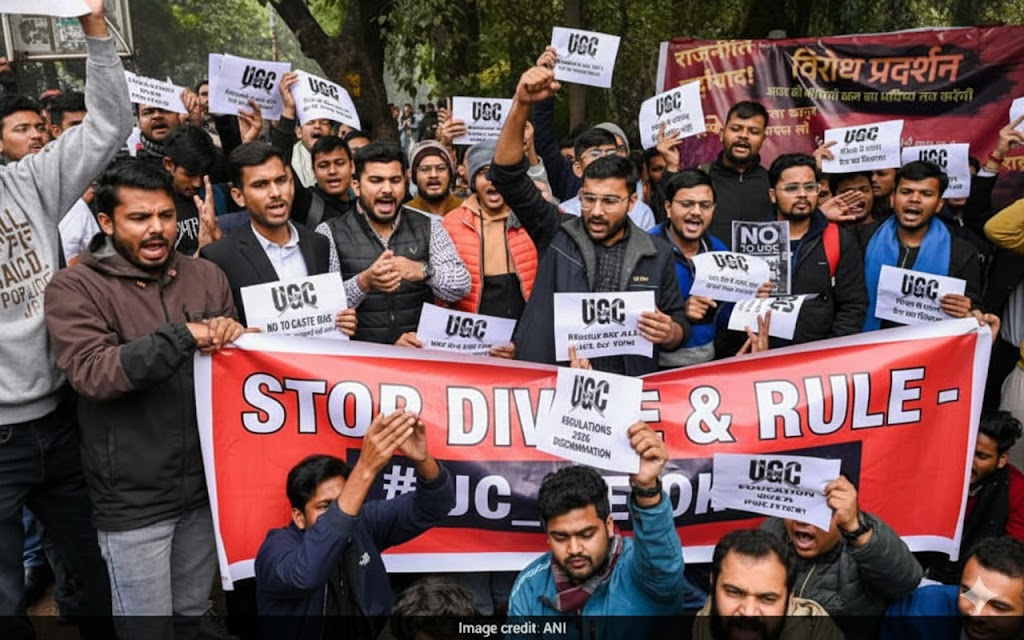
The decision comes after weeks of intense campus protests and political friction, marking a significant pause in the government’s attempt to overhaul anti-discrimination policies in universities.
The Apex Court’s Intervention
A bench comprising Chief Justice Surya Kant and Justice Joymalya Bagchi issued the stay while hearing a cluster of writ petitions challenging the constitutionality of the new rules. The Court invoked Article 142—which empowers the Supreme Court to pass any decree necessary for doing “complete justice”—to ensure that while the new rules are paused, students are not left without protection.
“Vague and Capable of Misuse”
The Court’s observations were pointed. Chief Justice Surya Kant remarked that the language of the 2026 regulations appeared prima facie “vague” and suggested they could be exploited by “mischievous elements.”
Justice Bagchi echoed these concerns, questioning the necessity of creating new, rigid classifications when existing principles of equality are already enshrined in the Constitution. “When the three Es [Equity, Equality, and Empowerment] already exist, how does the concept of 2Cs [Caste-based Classifications] become relevant?” he asked during the proceedings.
Why the 2026 Regulations Sparked a Firestorm
Notified on January 13, 2026, the new regulations were intended to strengthen safeguards against discrimination. However, the fine print triggered “nationwide outrage” across colleges and universities.
1. The Exclusion of ‘General Category’ Students
The most contentious point is Regulation 3(1)(c), which defines “caste-based discrimination” strictly as discrimination against members of SC, ST, and OBC communities. Petitioners argued that this narrow definition effectively denies institutional protection to students from the general or non-reserved categories who may also face harassment or bias based on their caste identity.
2. Mandatory vs. Advisory
The 2026 rules sought to replace the 2012 UGC Regulations, which were largely advisory. The new framework made it mandatory for every institution to:
- Form “Equity Committees” with specific representation from SC, ST, OBC, women, and PwD groups.
- Establish 24/7 Equity Helplines.
- Face severe penalties, including funding cuts and derecognition, for non-compliance.
Critics argued that while the 2012 rules were broad and inclusive, the 2026 rules are “regressive” and risk institutionalizing caste-based divisions.
The Road to Redrafting: What Changes?
The Supreme Court has suggested that the regulations be revisited by a committee of eminent jurists who understand the delicate social fabric of Indian campuses. The goal is to modulate the language to prevent exploitation while maintaining robust protections for marginalized groups.
Comparative Overview of the Regulatory Shift
| Feature | 2012 Regulations (Interim Force) | 2026 Regulations (Stayed) |
| Legal Nature | Advisory/Guideline-based | Legally Mandatory |
| Definition of Caste Bias | Broad & Inclusive | Restricted to SC/ST/OBC |
| Grievance Body | Anti-Discrimination Officer | Multi-member Equity Committee |
| Punitive Actions | Limited / Moral Suasion | Financial Penalties & Derecognition |
| Scope of Victims | All Students | Categorical Protection |
What Happens Now?
For students and faculty, the immediate impact is a return to the status quo.
1. Status of the 2026 Rules: They are currently in abeyance (suspended).
2. Revival of 2012 Rules: The Supreme Court explicitly ordered that the 2012 UGC Regulations will continue to operate until further notice. This ensures that the existing redressal mechanisms for marginalized groups are not dismantled during the redrafting phase.
3. Next Hearing: The matter is listed for further hearing on March 19, 2026.
The Court’s closing sentiment was a reminder of the foundational goal of education: “The unity of India must reflect across educational institutions… we should not go to a stage of segregated schools.”
Disclaimer: This information is based on various inputs from news agency.