

North Korean Successor Designation: For decades, the inner workings of the North Korean leadership were a black box, shrouded in secrecy and state-mandated silence. The world once believed that the current leader, Kim Jong-un, might not have children at all—or if he did, they were destined to remain in the shadows until a moment of sudden crisis.
The first crack in this wall of secrecy appeared in 2013 from an unlikely source: former NBA star Dennis Rodman. After a controversial “basketball diplomacy” visit to Pyongyang, Rodman casually mentioned to the press that he had “held baby Ju-ae” and spent time with Kim’s family. For nearly ten years, that name—Ju-ae—was the only breadcrumb the world had. There were no photographs, no official mentions, and no confirmation that the “beloved daughter” even existed.
Everything changed in November 2022. State television broadcast footage of a young girl, estimated to be about nine or ten, walking hand-in-hand with Kim Jong-un as they inspected a massive Hwasong-17 intercontinental ballistic missile (ICBM). Since that day, she has been inescapable. As we move into February 2026, Kim Ju-ae is no longer just a daughter; she is the face of North Korea’s future.
North Korean Successor Designation: From “Successor Training” to “Successor-Designate”
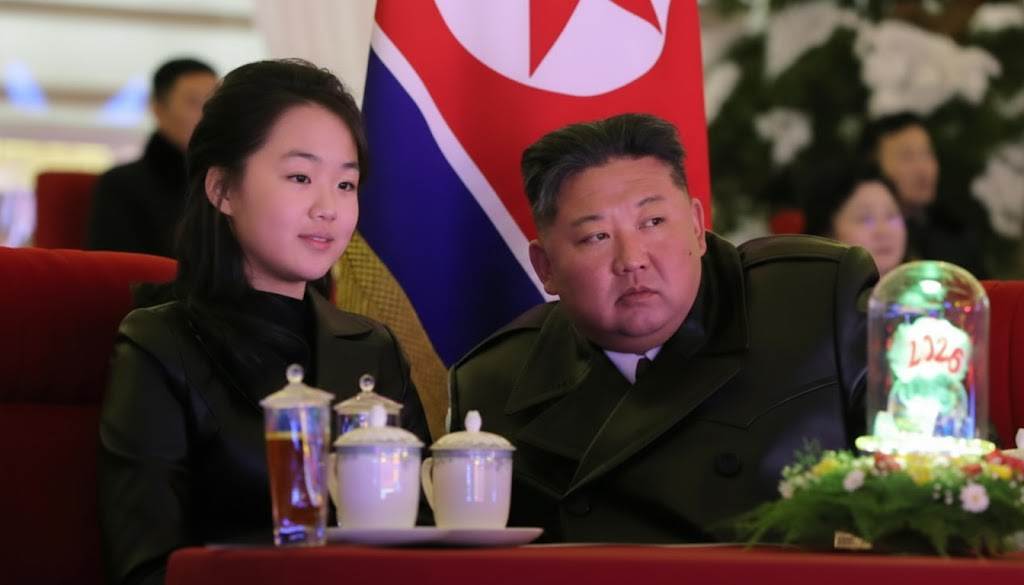
In North Korea, images are the primary currency of propaganda. Every frame released by the Korean Central News Agency (KCNA) is meticulously choreographed to send a message to both the domestic elite and the international community. Analysts have tracked a distinct evolution in how Ju-ae is presented. Initially shown as a curious child following her father, she is now frequently positioned at the center of the frame.
On February 12, 2026, South Korea’s National Intelligence Service (NIS) delivered a landmark briefing to lawmakers. The agency officially upgraded its assessment of the teenager, stating that she has moved beyond “successor training” and has entered the “successor-designate stage.” This shift in terminology is significant. Lawmaker Lee Seong-kwen reported that the NIS cited her “increasingly prominent public presence” and, more importantly, detected “signs of her voicing her opinion on certain state policies.” Despite being approximately 13 years old, she is reportedly providing policy input during field inspections—a level of authority unprecedented for someone her age in the regime’s history.
The 9th Party Congress: A Formal Coronation?
The world’s attention is now fixed on the 9th Congress of the Workers’ Party of Korea, set to take place in late February 2026. This rare political gathering, held only once every five years, is where North Korea outlines its military, economic, and foreign policy goals.
The NIS is closely monitoring whether Ju-ae will receive an official title during this event. While she has already achieved a high level of protocol—often standing in the center of veteran generals and even sharing the spotlight with global leaders during a high-profile visit to Beijing in September 2025—a formal title would cement her path to power.
Why the Hurry? Understanding the “Sacred Bloodline”
Kim Jong-un is still in his early 40s and appears to be in relatively stable health, having recently presided over major factory openings and military drills. So why designate a teenage heir now? The answer lies in the regime’s reliance on the Paektu Bloodline—the belief that only the direct descendants of the nation’s founder, Kim Il-sung, possess the “sacred” right to rule.
By introducing Ju-ae early, Kim Jong-un is achieving three critical strategic goals:
- Normalizing Her Presence: Transitioning the public from seeing her as a child to seeing her as a leader.
- Psychological Preparation: Forcing the deeply patriarchal military and political elite to accept a female heir.
- Preventing a Power Vacuum: Eliminating any ambiguity about succession should Kim Jong-un face a sudden health crisis.
While the NIS believes Kim may have an older son, he has never been acknowledged. In the brutal world of North Korean politics, Ju-ae has emerged as the “chosen one,” likely because she is the child Kim trusts most to carry the mantle into the fourth generation.
The Four Pillars of the Kim Dynasty
The elevation of Ju-ae highlights the brutal machinery that allows the Kim family to maintain absolute control over 26 million people. Their grip on power is sustained by four distinct pillars:
- Brutal Repression: Dissent is not tolerated. Kim Jong-un proved his ruthlessness early by executing his own uncle, Jang Song-thaek, in 2013. Reactionary speech or even a minor complaint about the state can result in life imprisonment or execution.
- Military Dominance: North Korea maintains one of the world’s largest standing armies. With 1.3 million active-duty soldiers—about 5% of the population—the military serves as both a shield against internal revolt and a machine for ideological indoctrination.
- Nuclear Deterrence: The regime views its nuclear arsenal as the ultimate insurance policy. By developing weapons capable of reaching the United States, they ensure that no foreign power will attempt a forced “regime change.”
- Total Isolation: From birth, North Koreans are taught that the Kim family is divine and the outside world is a hostile wasteland. With no open internet and state-run media as the only source of information, independent thought is effectively stifled before it can begin.
A New Chapter or More of the Same?
When Kim Jong-un took power in 2011, there was a fleeting hope that his Western education would lead to reform. Instead, he proved to be a master of the existing system, further isolating the country while perfecting its nuclear capabilities.
As Kim Ju-ae is groomed for leadership, the world asks the same question: Will she be different? Her constant presence at missile launches, military parades, and visits to the Kumsusan Palace of the Sun (the mausoleum of her grandfather and great-grandfather) suggests the answer is no. She is being raised in the shadow of the missile, trained not to dismantle the system, but to be its next caretaker.
As the 9th Party Congress approaches, the images of the “Respected Daughter” sitting beside her father will likely become even more frequent. In the secretive halls of Pyongyang, the transition to the fourth generation of the Paektu Bloodline is no longer a possibility—it is a carefully choreographed reality.
Disclaimer: This information is based on various inputs from news agency.